Why Cats Follow You Into the Bathroom
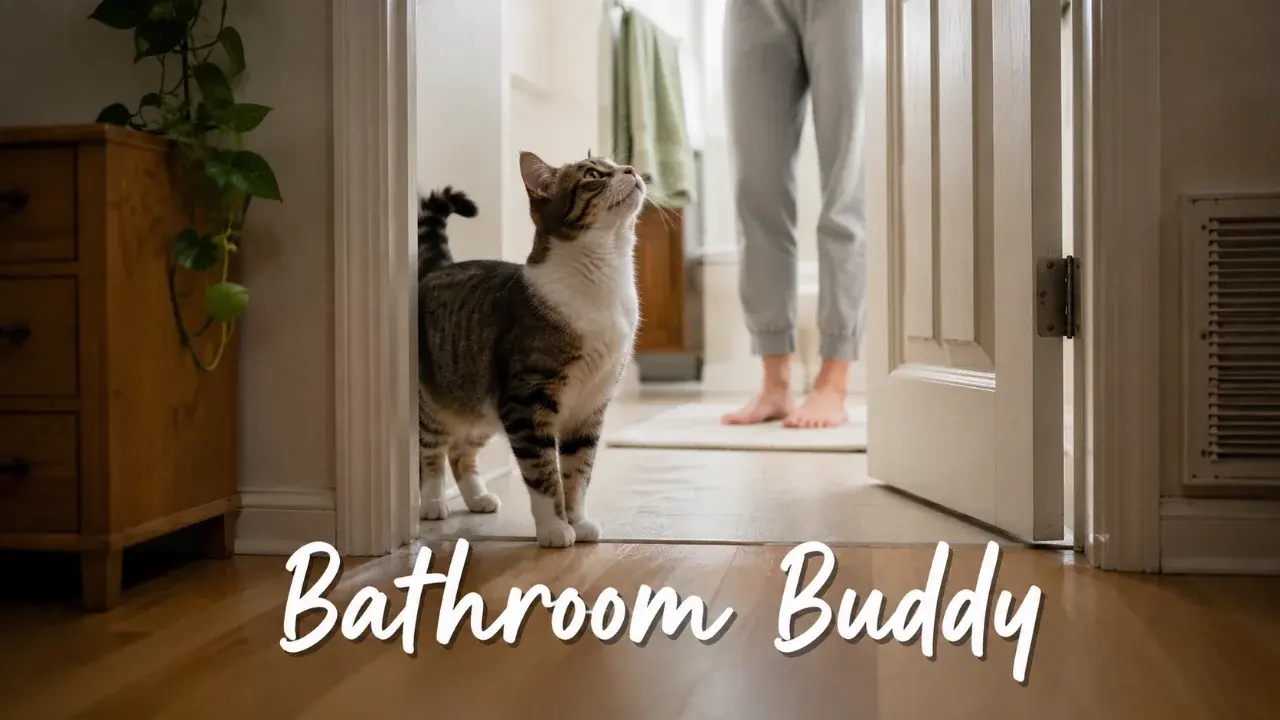
That awkward little bathroom habit is usually not random. It can be a mix of trust, curiosity, routine, attention-seeking, and the way cats understand their territory.
Your cat does not care that the bathroom is supposed to be private. To a cat, a closed door, running water, warm tiles, towels, familiar smells, and a human who has suddenly stopped moving can make the room oddly fascinating.
That is why so many cat owners know the routine. You walk toward the bathroom, and your cat appears behind you like a small, silent supervisor. It may sit outside the door, push a paw underneath, meow dramatically, jump into the sink, or stare at you as if you are the one behaving strangely.
The habit can feel funny, clingy, or slightly rude. But in most cases, it is normal cat behavior. The bathroom is part of your cat’s world, and you are one of the most interesting things in it.
Why your cat follows you in the first place
The simplest answer is that your cat follows you because you matter to them.
Cats have a reputation for being independent, but that does not mean they are emotionally distant. Many domestic cats form strong bonds with their caregivers and use familiar people as a source of comfort, routine, and security.
So when your cat follows you into the bathroom, it may be doing something very ordinary for a bonded animal: staying close to a trusted person.
That does not mean every cat is the same. Some cats are naturally more social, while others prefer distance. Some follow only at feeding time. Some trail their owners from room to room all day. The key is to look at your cat’s usual pattern, not compare it with every other cat online.
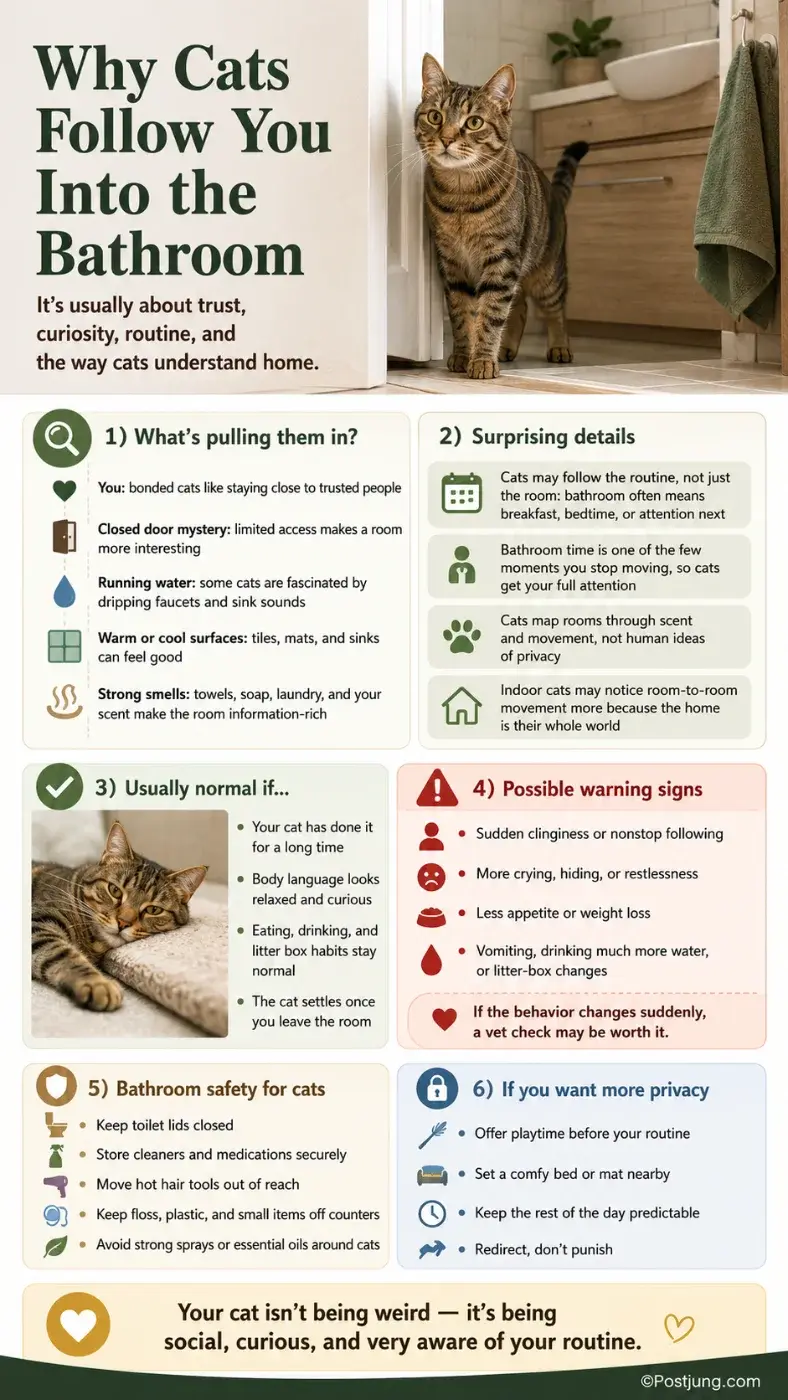
The bathroom is a curiosity trap
Cats are excellent observers. They notice doors opening, routines repeating, water running, and rooms that are not always available.
That makes the bathroom unusually tempting. It is often closed off, which can make it more interesting. When the door opens, your cat may see a brief chance to inspect a space it cannot always access.
Inside, there are plenty of small sensory rewards. The sink may be cool. The bath mat may be soft. The tiles may hold warmth. The faucet may drip. The cabinet may smell strange. The toilet paper may look like a toy, even though owners would strongly disagree.
To humans, it is just a bathroom. To a cat, it is a small room full of textures, sounds, smells, and objects worth investigating.
Your cat may want your full attention
The bathroom is also one of the few places where people stop multitasking.
You are not walking around, cooking, scrolling, cleaning, or leaving the room. You are briefly still. For a cat, that can look like a perfect social opportunity.
If following you into the bathroom leads to petting, talking, eye contact, laughter, or a few quiet minutes together, your cat may learn that the bathroom is a reliable place to get attention.
That is why some cats become extra affectionate there. They rub against your legs, jump onto the counter, sit on your lap, or roll around on the bath mat. The timing feels awkward to humans, but the logic is simple: you are available.
Scent matters more than people realize
Cats understand their homes through scent in ways humans often miss.
They rub their faces and bodies on furniture, corners, door frames, and people to leave familiar scent markers. These scent cues help them feel secure in their territory.
The bathroom can hold strong scent information: soap, towels, laundry, water, cleaning products, and the smell of the people who live there. Your cat may want to inspect those smells or add its own scent to the space by rubbing against objects.
This is also why strong cleaners, heavy fragrances, and some scented products can bother cats. A smell that seems mild to a person may be intense or confusing to a cat.
Routine makes the habit stronger
Cats may not understand a human schedule the way people do, but they are very good at learning patterns.
Alarm. Bathroom door. Running water. Toothbrush. Breakfast.
If the bathroom is part of the routine before feeding, playtime, work, or bedtime, your cat may start treating the bathroom trip as a signal that something else is about to happen.
This is especially common with cats that eat at predictable times. Your cat may not care deeply about your sink. It may simply know that breakfast often comes after the bathroom.
In that case, the behavior is not just affection or curiosity. It is pattern recognition.
The “protecting you” idea is partly possible, but often overstated
One popular explanation says cats follow people into the bathroom because they are protecting them during a vulnerable moment.
There may be a small piece of truth in the broader idea. Cats can notice stillness, routine, closed spaces, and vulnerability. A bonded cat may stay nearby because it feels safer when the group is together.
But it is easy to make this too dramatic.
Your cat is probably not imagining itself as a heroic bodyguard. More likely, several reasons are happening at once: attachment, curiosity, routine, attention, scent, and access to an interesting room.
Cat behavior is usually layered, not explained by one neat answer.
Why indoor cats may do this more
For indoor cats, the home is the whole world.
That is true in a U.S. apartment, a Bangkok condo, a townhouse, or any small living space where a cat’s daily environment is limited. Every door, window, mat, cabinet, balcony, and hallway becomes part of the cat’s mental map.
When a trusted person moves from one room to another, the cat may follow because movement itself matters. The bathroom is simply one stop on the daily route.
This does not always mean the cat is needy. It may mean the cat is socially engaged, curious, and paying close attention to the household.
When bathroom-following may be a warning sign
Most bathroom-following is harmless. But a sudden change is worth watching.
If a normally independent cat suddenly becomes very clingy, cries more than usual, hides, eats less, drinks much more water, loses weight, vomits, changes litter-box habits, or seems restless, it may be time to contact a veterinarian.
Behavior changes can be linked to stress, pain, illness, aging, environmental changes, or unmet needs. Cats often hide discomfort, so a shift in routine may be one of the first signs something is wrong.
The important point is not to panic. Compare the behavior with what is normal for your cat.
How to handle it kindly
If you enjoy the company, there is usually no problem. Let your cat sit nearby, offer a safe mat or perch, and make sure bathroom hazards are out of reach.
Keep toilet lids closed. Secure medications and cleaning products. Be careful with hot hair tools. Do not let cats chew plastic packaging, toilet paper, dental floss, or small bathroom items that could cause harm.
If you want privacy, avoid punishing your cat. Instead, redirect the habit. Offer playtime before your usual bathroom routine, set up a cozy spot outside the door, or give your cat a predictable alternative.
A closed door is easier for a cat to accept when the rest of its day includes attention, play, resting places, and a sense of security.
Your cat is not being weird. It is being a cat.
The bathroom-following habit is funny because it clashes with a very human idea of privacy. But from your cat’s point of view, the behavior makes sense.
You are part of its social world. The bathroom is part of its territory. The door is suspicious. The sink is interesting. The routine is familiar. The attention is rewarding.
So the next time your cat follows you in like a tiny roommate with no boundaries, try reading the moment differently. It may be less about weirdness and more about trust, curiosity, and the quiet way your cat keeps track of the home you share.
KEY TAKEAWAYS:
- Cats often follow owners into the bathroom because of bonding, curiosity, routine, and attention.
- A closed bathroom door can make the room more interesting, not less.
- Scent, warm surfaces, running water, and predictable routines can all attract cats.
- The behavior is usually normal, especially if your cat has always done it.
- Sudden clinginess or major behavior changes should be discussed with a veterinarian.
PetMD, Oregon State University, Current Biology, Feline Veterinary Medical Association, International Cat Care
References:
https://www.petmd.com/cat/behavior/why-does-my-cat-follow-me
https://news.oregonstate.edu/news/cats-children-and-dogs-develop-attachments-their-caregivers-study-shows
https://catfriendly.com/wp-content/uploads/2025/05/FelineVMA-Environmental-Needs_Web.pdf

เขียนโดย Postjung Insights
 รู้หรือไม่? เปิดรายได้พนักงานส่งพัสดุของแต่ละแอป วันหนึ่งได้เท่าไร
 5 คณะที่เรียนจบมาแล้ว มีอาชีพรองรับมากกว่าที่คิด
 Google ยอมรับแล้ว! Gemini AI เข้าถึงระบบบริษัทจริง 3 แห่ง ระหว่างการทดสอบความปลอดภัย
 อำเภอที่มีชื่ออำเภอสั้นที่สุด 3 อำเภอเท่านั้นในประเทศไทย
 เปิดรายชื่อโรงเรียนในไทยที่ “ว่ายน้ำ” อยู่ในหลักสูตร เรียนจริงตั้งแต่อนุบาลถึงมัธยม
 เลขเด็ดปฏิทิน "หลวงปู่โต๊ะ" งวดวันที่ 1 ตุลาคม 69..ส่องเลย เลขไหนให้โชค!
 ทำไมของพลาสติกเก่าบางชิ้นถึง “เหนียว” ขึ้นมาเอง ทั้งที่ไม่ได้เปื้อนอะไร?
 โรงเรียนที่มีนักเรียนมากที่สุดในไทย
 เปิด 5 โรงเรียนหญิงล้วนเก่าแก่ของไทย ที่มีประวัติยาวนานกว่าศตวรรษ
 แปลปกสลาก งวด 1 ต.ค. 69 ส่องตัวเลขจากภาพปกสลากกินแบ่งรัฐบาล
 ตาราง “เด่นเหนือเด่นใต้” งวด 1 ต.ค. 69 เปิดข้อมูลตามโพย เลขไหนอยู่ตรงไหน
 โรงเรียนเพียงแห่งเดียวของประเทศไทย ที่อยู่มาตั้งแต่ยุครัชกาลที่ 45 คณะที่เรียนจบมาแล้ว มีอาชีพรองรับมากกว่าที่คิดเปิดรายชื่อโรงเรียนในไทยที่ “ว่ายน้ำ” อยู่ในหลักสูตร เรียนจริงตั้งแต่อนุบาลถึงมัธยมGoogle ยอมรับแล้ว! Gemini AI เข้าถึงระบบบริษัทจริง 3 แห่ง ระหว่างการทดสอบความปลอดภัยเลขเด็ดปฏิทิน "หลวงปู่โต๊ะ" งวดวันที่ 1 ตุลาคม 69..ส่องเลย เลขไหนให้โชค!ทำไมของพลาสติกเก่าบางชิ้นถึง “เหนียว” ขึ้นมาเอง ทั้งที่ไม่ได้เปื้อนอะไร?
 อุทยานเขาใหญ่เรียกตัว “ตีนผี” หลังขับจี้ช้างป่าพ่อลูก ลั่นระยะ 50 เมตรต้องจำให้ขึ้นใจ
 English Edition