Why Cats Quiver Their Tails When They Greet You
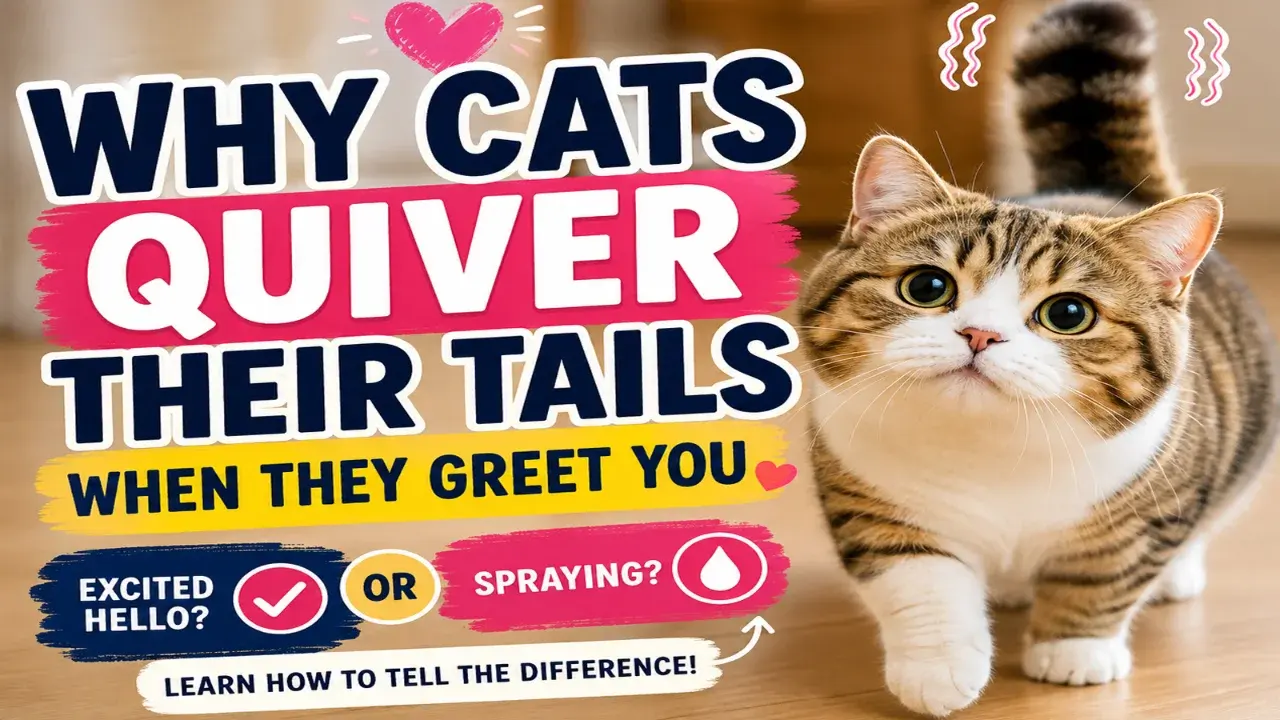
An upright tail that trembles when your cat approaches can be a sign of excitement and friendly social behavior. But because cats also quiver their tails while urine marking, the rest of the body—and the setting—matters.
If your cat walks toward you with their tail standing almost straight up and suddenly makes it tremble like a tiny antenna, there is a good chance you are seeing an especially enthusiastic greeting.
Cat behavior guidance from Cats Protection describes tail quivering without urine release as a behavior that can occur during greetings, particularly when a cat is excited to see someone. Veterinary guidance from VCA Animal Hospitals similarly notes that a cat whose tail shakes or quivers upon seeing a person is generally excited.
The important word, however, is context. A vibrating tail does not have one universal meaning.
The upright tail already carries a social message
Before focusing on the vibration, look at the position of the whole tail.
A relaxed cat approaching with the tail held vertically is displaying one of the best-known friendly signals in domestic cat body language. Cats Protection describes an upright, relaxed tail during an approach as greeting behavior, while research on domestic cats has linked the “tail-up” posture with amicable social interactions.
A 2009 study published in Behavioural Processes examined cats living socially in a colony in Rome. Researchers found that adult cats used the tail-up display when approaching one another and that it was associated with affiliative behavior—the kinds of interactions that help maintain peaceful social relationships.
Research published in 2021 also found a particularly strong association between tail-up postures and cats approaching humans. In the observed cat-human interactions, cats approaching with their tails raised frequently went on to rub against the person’s legs.
So when the upright tail begins to quiver as a cat reaches you, the movement may amplify an already friendly, highly aroused greeting.
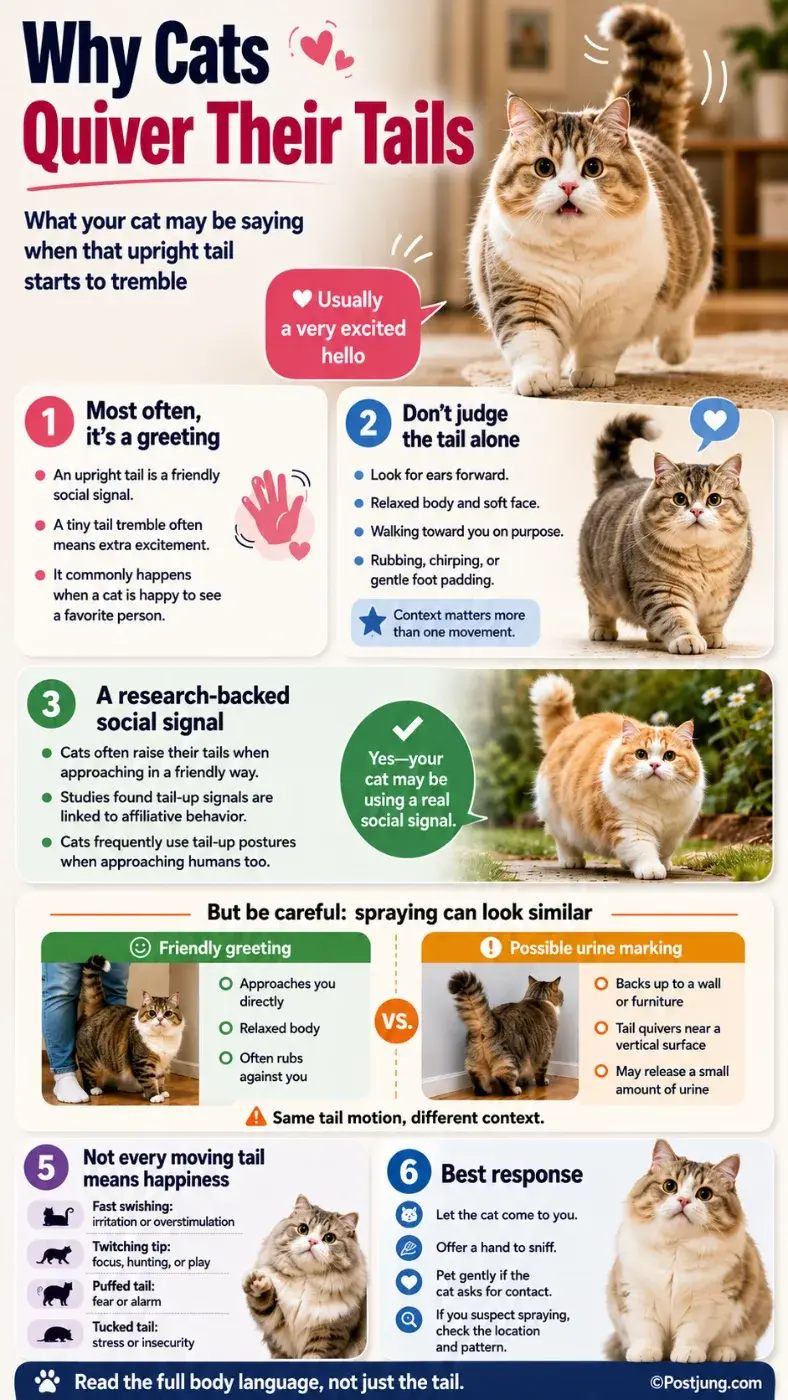
Think of it as excitement, not a literal translation
It is tempting to translate every cat gesture into a human sentence—“I love you,” for example—but feline body language is not quite that precise.
A greeting quiver is better understood as a sign of heightened excitement within a friendly interaction. A cat might approach with their tail up, quiver it, step rhythmically with their back feet, chirp, rub against your legs, or push their head toward your hand.
Those behaviors together make the interpretation much stronger than the tail movement alone.
Cats Protection specifically notes that cats displaying a tail quiver may also pad their feet and that the behavior can occur when they are excited to see someone.
Other details can reinforce the friendly reading: ears facing forward, a relaxed body, voluntary approach, cheek rubbing, or a tail whose tip curves gently as the cat comes toward you.
The confusing part: spraying can look almost identical
There is one major reason not to interpret every trembling upright tail as affection.
Cats also quiver their tails when urine spraying.
Cornell University’s Feline Health Center describes a typical spraying posture as a cat standing near a vertical surface, lifting the tail, quivering it, and depositing a small amount of urine. Unlike ordinary urination, spraying generally occurs while the cat remains standing rather than squatting.
VCA offers a useful distinction: a cat that quivers the tail when seeing you is generally excited, while a cat that backs toward a vertical surface and quivers the tail may be urine marking.
Some cats also perform what is sometimes called “pseudo-spraying” or “fake spraying.” They take up a spraying-like posture and quiver their tail but release no urine. Cats Protection notes that this behavior can be associated with marking and, depending on the circumstances, stress.
That is why the setting matters so much.
A cat running toward you at the door, tail vertical and trembling before rubbing against your legs, presents a very different behavioral picture from a cat backing toward a wall or piece of furniture with a rigid quivering tail.
Not every moving tail means happiness
Cats use many different tail movements, and they should not be interpreted the way people often interpret a wagging dog tail.
Rapid side-to-side movement can indicate irritation or heightened arousal. A twitching tip may appear during hunting or focused play. A puffed tail can accompany fear or a perceived threat. A tucked tail can be associated with fear or stress.
The safest way to read a cat is therefore to look at the whole animal: ears, eyes, whiskers, body tension, direction of movement, vocalizations, surrounding environment, and whether the cat is choosing to approach or trying to create distance.
How to respond to the quivering-tail hello
If the cat looks relaxed and is approaching voluntarily, you do not need to do anything elaborate.
Allow the cat to control the interaction. Offering a hand at a comfortable distance can give them the option to sniff or rub against it. If they continue soliciting contact, gentle petting around the head, cheeks, or along the back may be welcome.
The larger lesson is that a quivering tail is not an isolated code to memorize. It is one piece of a broader social display.
When an upright tail starts trembling as your cat happily approaches you, it often reflects a burst of excitement attached to a friendly greeting. But the nearly identical motion can occur during spraying, which makes context—not the quiver alone—the key to understanding what your cat is communicating.
SOURCES USED:
- Cats Protection — Cat tail meanings Source page
- Cats Protection — Feline Behaviour Visual Guides: body language Behavior guide
- VCA Animal Hospitals — How Does a Kitten Communicate With Their Tail? VCA guide
- Cornell University College of Veterinary Medicine — Feline Behavior Problems: House Soiling Cornell Feline Health Center
- Cafazzo & Natoli — The social function of tail up in the domestic cat PubMed record
- Animals — Heads and Tails: An Analysis of Visual Signals in Cats, Felis catus Full research article

เขียนโดย Postjung Insights
 รู้หรือไม่? เปิดรายได้พนักงานส่งพัสดุของแต่ละแอป วันหนึ่งได้เท่าไร
 เจาะลึกรายได้พนักงานส่งอาหารแต่ละวันได้เท่าไร/หักค่าใช้จ่ายอะไรบ้าง
 สุดระทึก! ไฟไหม้รางรถไฟฟ้า MRT สถานีเตาปูน-บางโพ..หยุดให้บริการชั่วคราวทุกสถานี
 โรงเรียนที่มีนักเรียนมากที่สุดในไทย
 ตาราง “เด่นเหนือเด่นใต้” งวด 1 ต.ค. 69 เปิดข้อมูลตามโพย เลขไหนอยู่ตรงไหน
 เกษียณแล้วทำอะไรดี เปิด 4 กลุ่มอาชีพที่ผู้สูงวัยไทยทำกันน้อย จากข้อมูล 5.26 ล้านคน
 โรงเรียนเพียงแห่งเดียวของประเทศไทย ที่อยู่มาตั้งแต่ยุครัชกาลที่ 4
 อำเภอที่มีชื่ออำเภอสั้นที่สุด 3 อำเภอเท่านั้นในประเทศไทย
 ส่องเลข 3 สำนักพิมพ์ งวด 1 ต.ค. 69 ตัวไหนมีข้อมูลตรงกัน
 เปิดศึกเลขเด็ดงวดนี้! เจ้าพ่อปากแดง ปะทะ เจ้าแม่ตะเคียนทอง งวด 1 ต.ค. 59 คัดมาให้เน้นๆ พร้อมลุ้นรวย
 เลขเด็ดไพ่ยิปซี งวด 1 ตุลาคม 2569 รวมเลขเด่นและเลขท้าย 2 ตัว
 แปลปกสลาก งวด 1 ต.ค. 69 ส่องตัวเลขจากภาพปกสลากกินแบ่งรัฐบาลสุดระทึก! ไฟไหม้รางรถไฟฟ้า MRT สถานีเตาปูน-บางโพ..หยุดให้บริการชั่วคราวทุกสถานีเจาะลึกรายได้พนักงานส่งอาหารแต่ละวันได้เท่าไร/หักค่าใช้จ่ายอะไรบ้าง
 เปิด 5 โรงเรียนหญิงล้วนเก่าแก่ของไทย ที่มีประวัติยาวนานกว่าศตวรรษ
 เปิด 5 สินค้าส่งออกของลาวที่คนไทยอาจคาดไม่ถึง หนึ่งในนั้นทำเงินเกือบ 1 พันล้านดอลลาร์เกษียณแล้วทำอะไรดี เปิด 4 กลุ่มอาชีพที่ผู้สูงวัยไทยทำกันน้อย จากข้อมูล 5.26 ล้านคนโรงเรียนเพียงแห่งเดียวของประเทศไทย ที่อยู่มาตั้งแต่ยุครัชกาลที่ 4
 English Edition