Is It Jealousy or Resource Competition Between Pets?

Dogs can show behaviors that resemble jealousy, but competition over food, toys, resting places, territory, and access to people can look remarkably similar. Watching what triggers the behavior is often more useful than trying to name the emotion.
A dog wedges itself between you and another pet. A cat suddenly occupies your lap whenever its housemate approaches. One animal stares, vocalizes, blocks a doorway, steals a toy, or pushes into an interaction.
It is easy to call these behaviors jealousy. Sometimes that interpretation may be reasonable, especially in dogs. But in a multi-pet household, the same behavior can also reflect competition over something the animal values: food, a resting place, a toy, personal space, or access to you.
The distinction matters because the best response depends less on the human label and more on what is triggering the behavior.
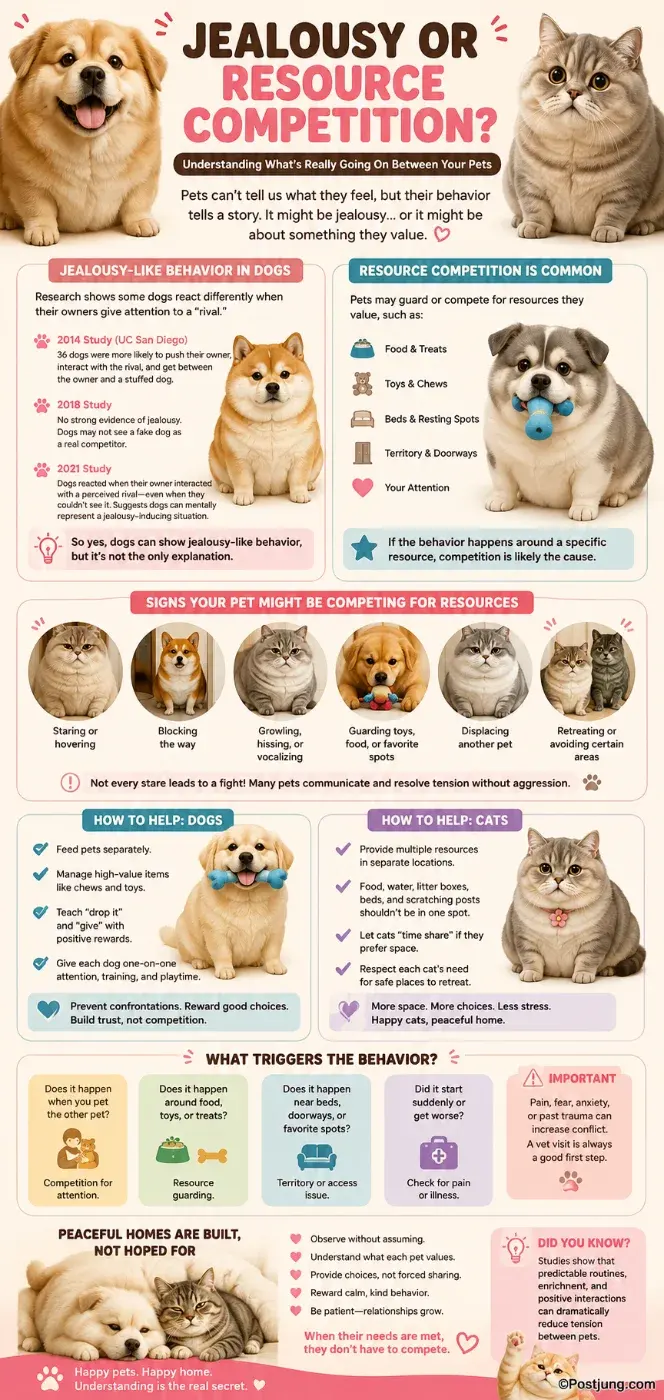
Dogs can show jealousy-like behavior — but the evidence is nuanced
Scientists have experimentally tested whether dogs behave differently when their owners direct affection toward a potential social rival.
In a 2014 study involving 36 dogs, researchers at the University of California, San Diego found that dogs were more likely to push or touch their owner, interact with the apparent rival, and try to get between the owner and a realistic stuffed dog when the owner showed it affection. The researchers described the pattern as evidence consistent with a rudimentary or “primordial” form of jealousy.
Later work complicated that picture.
A 2018 study using fake dogs, puppets, and books found no convincing evidence that the tested dogs' responses were specifically caused by jealousy. One important limitation was that the dogs may not have regarded the artificial dogs as genuine social competitors.
Then, in a 2021 experiment, researchers reported three patterns consistent with jealousy-like behavior: dogs reacted when their owner interacted with a perceived social rival rather than merely because another dog was present, and the reaction persisted even when the interaction was hidden from view. The researchers concluded that dogs appeared capable of mentally representing a jealousy-inducing social interaction.
Taken together, the studies make “dogs can display jealousy-like behavior” a defensible statement. They do not justify assuming that every bark, shove, stare, or interruption is caused by the same emotional experience humans call jealousy.
Resource competition can look almost identical
Veterinary behavior specialists use the term resource guarding for behavior intended to maintain access to something an animal values.
In dogs, those resources can include food, treats, chews, toys, stolen objects, resting places, and even preferred people. Dogs living together may also come into conflict because of fear, anxiety, high arousal, frustration, or communication problems rather than a single simple cause.
That means a dog squeezing between you and another dog might be responding to a perceived threat to a social relationship. But if the behavior predictably occurs around your lap, a particular bed, treats, or one favored location, competition for access to that resource may be the more useful explanation.
Look for the trigger.
If trouble begins when another pet approaches a food bowl, chew, toy, doorway, sofa, bed, or favorite person, resource competition should be high on the list of possibilities.
Signs can include freezing, staring, hovering over an item, blocking another animal's path, rushing toward a resource, growling, snapping, chasing, or repeatedly displacing the other pet.
Not every competition escalates into a fight. Dogs often resolve conflicts through social signals without aggression.
Cats may compete without obvious fighting
With cats, interpreting a tense relationship becomes even trickier because conflict can be quiet.
Feline environmental guidelines note that cats in multi-cat households may appear to share eating or resting areas simply because those resources are concentrated in one location. Some cats instead “time share,” approaching the same resource at different times to avoid one another. Providing multiple, physically separated resources can reduce competition and stress.
Watch for one cat repeatedly controlling access while another waits, retreats, takes a longer route through the house, stops using a favorite location, or eats only when the other cat has left.
Veterinary guidance recognizes that aggression between cats can involve resource guarding as well as fear, play, arousal, and redirected aggression. Cats may attempt to control access to sleeping areas, shared spaces, or possessions.
So a cat that appears “jealous” when another cat receives attention may indeed value access to the person. But the broader social environment — including escape routes, resting areas and other resources — deserves attention too.
A simple way to investigate what is happening
Instead of beginning with “Which pet is jealous?”, keep track of what happens immediately before each episode.
Does the behavior appear only when you pet the other animal? That pattern makes competition for social attention particularly relevant.
Does it happen around food, chews or toys regardless of whether you are involved? Resource guarding becomes more likely.
Does one pet block access to hallways, litter boxes, sleeping places or elevated areas? The household may have a resource-distribution problem.
Does aggression suddenly appear in an animal that previously tolerated the same situations? A veterinary examination deserves priority. Pain and other medical problems can increase irritability and aggression in both dogs and cats.
Video can also be useful when it is safe to record normal interactions. Details that seem insignificant in the moment — staring, freezing, retreating, blocking or avoiding eye contact — may help a veterinarian or qualified behavior professional understand the sequence.
Give pets alternatives instead of making them compete
For dogs that guard resources, management starts by preventing confrontations. Feeding animals separately, managing highly valued chews or toys, and teaching voluntary exchanges can be safer than repeatedly taking prized items away. Veterinary guidance recommends reward-based approaches such as exchanging an item for something valuable and teaching cues such as “give” or “drop.”
For cats, separation of resources is particularly important. Feline environmental guidelines recommend multiple locations for food, water, toileting, resting, scratching, play and hiding, rather than forcing cats to access everything in one shared area. Individual feeding locations can reduce feeding competition.
Physical separation matters as much as quantity. Two food bowls placed side by side may function socially like one feeding station if one cat can control both.
Positive individual attention can also help. Predictable play, training, grooming when enjoyed, and quiet one-on-one interaction give each animal opportunities to obtain valued social contact without having to interrupt another pet.
When it stops being a harmless rivalry
Growling, hissing or posturing should not be punished simply because it is inconvenient. Those signals provide information that an animal is uncomfortable and can precede more serious aggression.
If pets are biting, injuring one another, repeatedly trapping or pursuing each other, or making another animal afraid to eat, rest or use the litter box, physically manage them to prevent further confrontations and seek professional help.
Veterinary behavior guidance advises separating cats involved in serious aggression and gradually reintroducing them as part of a structured behavior program. Aggression in dogs can also be complex, and punishment-based techniques may make an existing aggression problem worse.
The most useful question, then, is often not whether your pet is “really jealous.”
Ask instead: What does this animal believe it might lose?
Attention may be the resource. So may dinner, a favorite bed, a sunny windowsill or simply enough personal space. Identifying that pattern gives you something concrete to change — and can make life considerably easier for every animal sharing the home.
SOURCES USED:
- PLOS ONE — “Jealousy in Dogs” PLOS ONE study
- PLOS ONE — “Pet dogs’ behavior when the owner and an unfamiliar person attend to a faux rival” PLOS ONE follow-up study
- Psychological Science — “Dogs Mentally Represent Jealousy-Inducing Social Interactions” Psychological Science study
- Merck Veterinary Manual — “Behavior Problems of Dogs” Merck Veterinary Manual: dogs
- AAFP and ISFM — “Feline Environmental Needs Guidelines” Feline environmental guidelines
- Merck Veterinary Manual — “Behavior Problems of Cats” Merck Veterinary Manual: cats

เขียนโดย Postjung Insights
 รู้หรือไม่? เปิดรายได้พนักงานส่งพัสดุของแต่ละแอป วันหนึ่งได้เท่าไร
 เจาะลึกรายได้พนักงานส่งอาหารแต่ละวันได้เท่าไร/หักค่าใช้จ่ายอะไรบ้าง
 เกษียณแล้วทำอะไรดี เปิด 4 กลุ่มอาชีพที่ผู้สูงวัยไทยทำกันน้อย จากข้อมูล 5.26 ล้านคน
 สุดระทึก! ไฟไหม้รางรถไฟฟ้า MRT สถานีเตาปูน-บางโพ..หยุดให้บริการชั่วคราวทุกสถานี
 โรงเรียนที่มีนักเรียนมากที่สุดในไทย
 โรงเรียนเพียงแห่งเดียวของประเทศไทย ที่อยู่มาตั้งแต่ยุครัชกาลที่ 4
 อำเภอที่มีชื่ออำเภอสั้นที่สุด 3 อำเภอเท่านั้นในประเทศไทย
 ความลับ 30 ล้านปีของ “แม่น้ำไนล์”: ทำไมสายน้ำสายนี้ถึงไม่เคยเหือดแห้งกลางทะเลทรายซาฮารา
 ตาราง “เด่นเหนือเด่นใต้” งวด 1 ต.ค. 69 เปิดข้อมูลตามโพย เลขไหนอยู่ตรงไหน
 แปลปกสลาก งวด 1 ต.ค. 69 ส่องตัวเลขจากภาพปกสลากกินแบ่งรัฐบาล
 เปิดศึกเลขเด็ดงวดนี้! เจ้าพ่อปากแดง ปะทะ เจ้าแม่ตะเคียนทอง งวด 1 ต.ค. 59 คัดมาให้เน้นๆ พร้อมลุ้นรวย
 ส่องเลข 3 สำนักพิมพ์ งวด 1 ต.ค. 69 ตัวไหนมีข้อมูลตรงกันสุดระทึก! ไฟไหม้รางรถไฟฟ้า MRT สถานีเตาปูน-บางโพ..หยุดให้บริการชั่วคราวทุกสถานีเจาะลึกรายได้พนักงานส่งอาหารแต่ละวันได้เท่าไร/หักค่าใช้จ่ายอะไรบ้าง
 เปิด 5 โรงเรียนหญิงล้วนเก่าแก่ของไทย ที่มีประวัติยาวนานกว่าศตวรรษ
 เปิด 5 สินค้าส่งออกของลาวที่คนไทยอาจคาดไม่ถึง หนึ่งในนั้นทำเงินเกือบ 1 พันล้านดอลลาร์เกษียณแล้วทำอะไรดี เปิด 4 กลุ่มอาชีพที่ผู้สูงวัยไทยทำกันน้อย จากข้อมูล 5.26 ล้านคนโรงเรียนเพียงแห่งเดียวของประเทศไทย ที่อยู่มาตั้งแต่ยุครัชกาลที่ 4
 English Edition