What Visitors Should Know Before Entering a Thai Temple
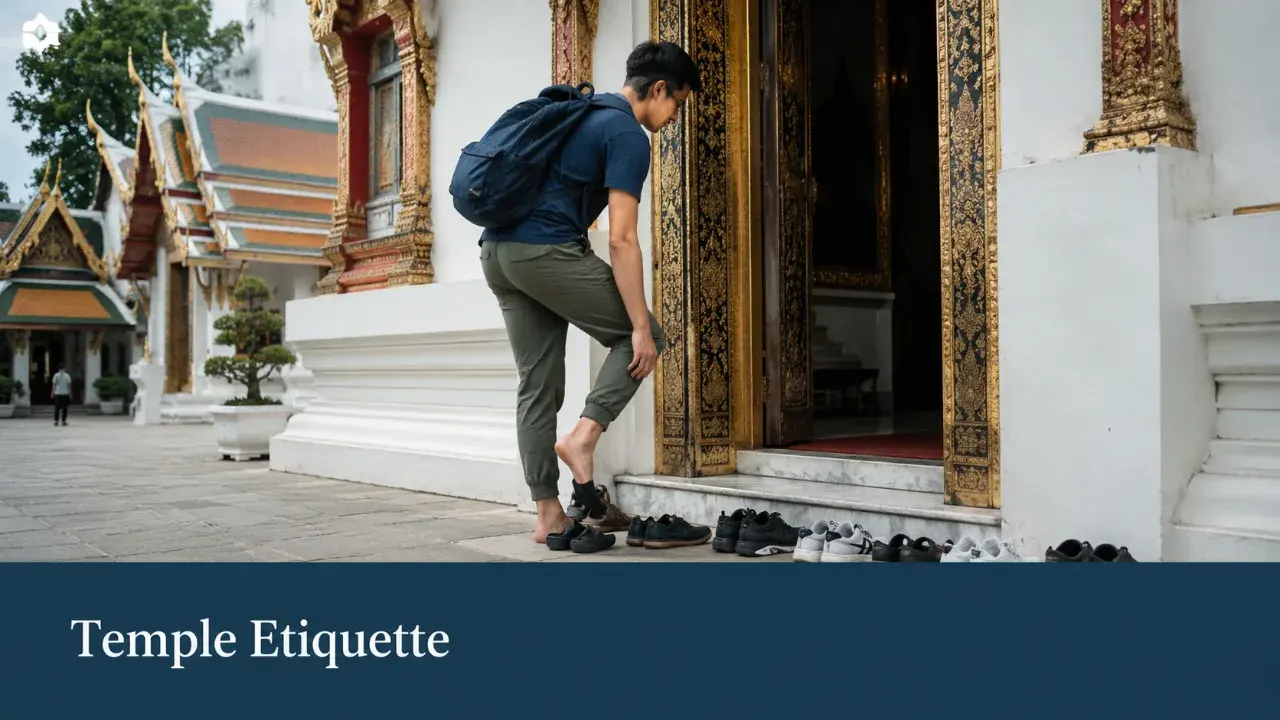
Thai temples are welcoming places, but they are also active sacred spaces. A few small habits — from shoes to photos to where you point your feet — can help visitors move through them with respect.
A Thai temple may look peaceful, open, and easy to enter. That can make it easy for visitors to miss the small customs that matter most.
In Thailand, temples are not just beautiful places for photos. They are living religious spaces where people pray, make offerings, listen to monks, mark family moments, and find quiet in the middle of daily life.
That is why temple etiquette matters. It is not about memorizing a long rulebook. It is about noticing where you are and adjusting your behavior with care.
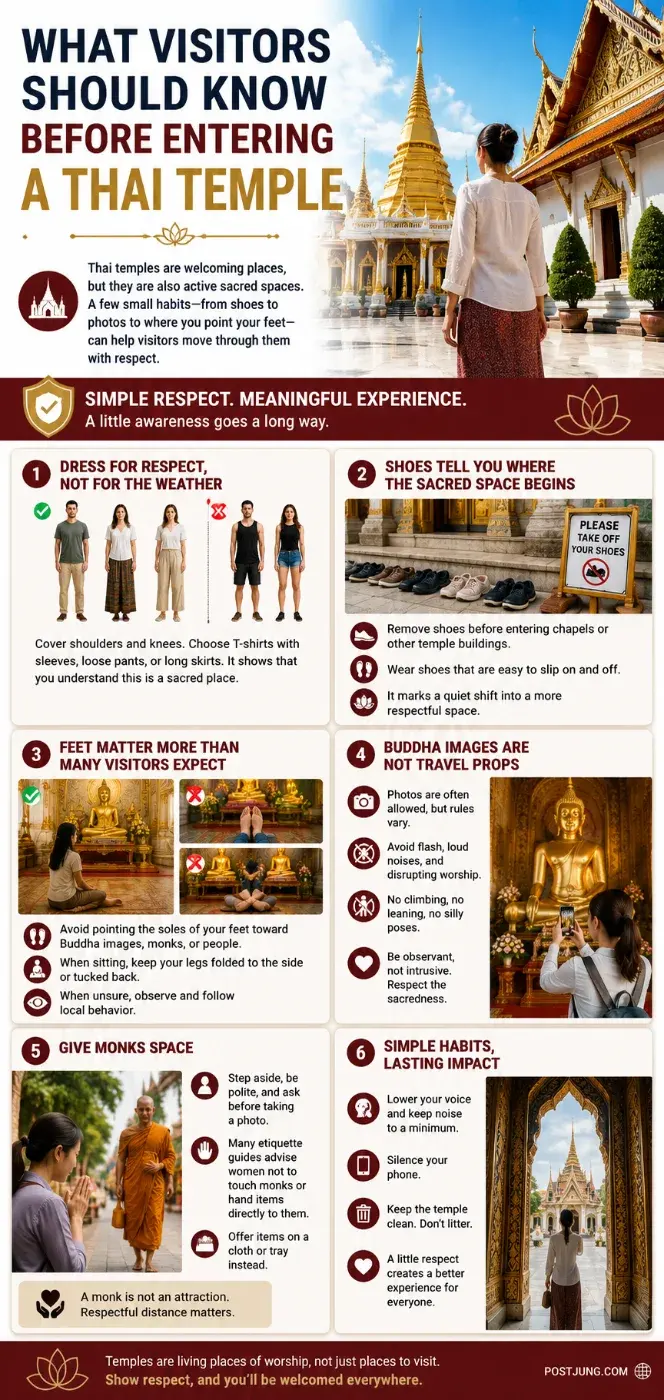
For first-time visitors, the basics are simple: dress modestly, remove shoes before entering sacred buildings, lower your voice, keep your feet pointed away from Buddha images, and think before taking photos.
Thailand’s official government portal advises visitors to dress politely when entering temples, including long sleeves, trousers or knee-length skirts, and avoiding sleeveless, tight, or revealing clothing. It also notes that shoes should be removed before entering chapels or other temple buildings.
Dress for respect, not for the weather
Thailand is hot, and many travelers dress for comfort. That makes sense on beaches, walking streets, or island trips.
A temple is different.
For visitors, the easiest rule is to cover shoulders and knees. A T-shirt with sleeves, loose pants, a long skirt, or a light shirt is usually a safe choice. Breathable fabric helps in the heat, especially if you plan to visit several temples in one day.
The mistake is assuming that because Thailand is a warm-weather destination, very casual clothing is accepted everywhere.
Inside a temple, clothing sends a message. It tells people whether you understand that the space has religious meaning, even if it is also popular with tourists.
You do not need to look formal. You do need to look respectful.
Shoes tell you where the sacred space begins
One of the clearest signs at a Thai temple is a row of shoes outside a building.
That usually means shoes come off before entering. This is common before stepping into a prayer hall or other sacred interior space. Temple grounds, outdoor courtyards, and walkways may allow shoes, but interiors often do not.
Travelers who plan to visit temples should wear shoes that are easy to slip on and off. It sounds small, but it makes the day much easier.
Removing shoes is not just about cleanliness. It marks a quiet shift from the outside world into a more respectful place.
If you are not sure what to do, look down. The shoes at the doorway are often the best instruction.
Feet matter more than many visitors expect
For many American and global visitors, feet may not carry much symbolic meaning.
In Thailand, they do.
Feet are generally seen as the lowest and least respectful part of the body. Inside temples, that becomes especially important. Visitors should avoid pointing the soles of their feet toward Buddha images, monks, or people who are praying.
If you sit on the floor, avoid stretching your legs straight out toward the altar. Sitting with your legs folded to the side or tucked back is usually more respectful.
No one expects a visitor to know every detail perfectly. But visible effort matters.
When unsure, quietly observe how Thai visitors sit and move. Following local behavior is often the safest guide.
Buddha images are not travel props
Buddha images can be visually striking, especially for visitors seeing Thai temple art for the first time. But they should not be treated like decorations, backdrops, or props.
Avoid climbing onto platforms, leaning against sacred objects, posing in a silly way, or taking photos that make the image look like part of a joke.
Photos are often allowed in temple grounds, but rules vary. Some halls prohibit photography. Others allow it but expect visitors to avoid flash, stay quiet, and not interrupt worshippers.
A respectful temple photo should feel observant, not intrusive.
Capture the architecture, murals, flowers, rooflines, or atmosphere. Do not block people who are praying. Do not turn a sacred moment into a performance.
The best photo is never worth disturbing someone’s worship.
Give monks space
Monks are a familiar sight in Thai temples, but visitors should treat them with calm respect.
It is fine to step aside, greet politely, or ask before taking a photo. It is also fine to say nothing and simply give space.
One point often surprises visitors: in Thai Buddhist practice, monks follow strict rules around physical contact with women. Many etiquette guides advise women not to touch monks or hand items directly to them. If something needs to be offered, it can often be placed on a cloth, tray, or nearby surface instead.
Respectful distance matters for everyone, not only women. A monk is not a costume, attraction, or photo accessory. If a monk is praying, teaching, eating, walking with purpose, or speaking with local worshippers, it is best not to interrupt.
Keep the mood calm
Thai temples are not always silent. Some are lively community spaces. You may hear chanting, bells, schoolchildren, sweeping, birds, tour groups, or vendors near the entrance.
Still, the expected mood is calm.
Keep your voice low inside sacred areas. Avoid loud jokes, dramatic posing, public displays of affection, or blocking doorways for photos.
This does not mean acting stiff or nervous. It simply means not making yourself the center of attention.
A good visitor moves lightly through the space.
What travelers often misunderstand
The biggest misunderstanding is thinking temple etiquette is only about rules.
It is really about reading the room.
A Thai temple can be many things at once: a neighborhood landmark, a place of worship, a cultural site, a tourist stop, and a community gathering space. One area may feel relaxed and social. A few steps away, people may be kneeling in prayer.
Both can be true.
That mix can confuse visitors from countries where religious spaces are more clearly separated from everyday life. In Thailand, daily life and spiritual life often sit close together.
This is part of what makes temple visits meaningful. The goal is not to act like an expert. The goal is to move with humility.
A simple checklist before entering
Before walking into a Thai temple building, check five things.
Are your shoulders and knees covered?
Have others removed their shoes?
Are you keeping your voice low?
Are your feet pointed away from Buddha images and worshippers?
Is photography allowed in this part of the temple?
These small checks will help most visitors avoid awkward moments.
A light scarf, sarong, or loose overshirt can also be useful if a dress code is stricter than expected. Small cash for donations may be helpful, but donations should be quiet and voluntary, not treated like a photo opportunity.
The real point of temple etiquette
Thai temple etiquette is not meant to make visitors anxious.
Most local people understand that travelers come from different cultures. A small mistake is usually not a disaster if the visitor notices, adjusts, and shows care.
What matters is the attitude behind the action.
Taking off your shoes, lowering your voice, dressing with care, and pointing your feet away may seem like small gestures. Inside a Thai temple, they carry a bigger meaning.
They show that you came not only to look, but to understand.
KEY TAKEAWAYS:
- Thai temples are active sacred spaces, not just tourist attractions.
- Visitors should dress modestly, usually covering shoulders and knees.
- Shoes are commonly removed before entering prayer halls or sacred buildings.
- Feet should not be pointed toward Buddha images, monks, or worshippers.
- Photos may be allowed in some areas, but visitors should avoid interrupting prayer or treating sacred objects as props.
Thailand.go.th, Centara Hotels & Resorts, General cultural knowledge, User-provided source material
References:
https://thailand.go.th/issue-focus-detail/009_138
https://www.centarahotelsresorts.com/journal/sacred-spaces-how-to-behave-and-dress-in-a-buddhist-temple

เขียนโดย Postjung Insights
 รู้หรือไม่? เปิดรายได้พนักงานส่งพัสดุของแต่ละแอป วันหนึ่งได้เท่าไร
 เปิดรายชื่อ 5 โรงเรียนเอกชนขนาดใหญ่ นักเรียนกว่า 5,000 คนทุกแห่ง
 เปิดรายชื่อ 5 โรงเรียนเป้าหมาย เด็กสอบเข้าต้องเตรียมตัวให้พร้อม
 อำเภอที่มีชื่ออำเภอสั้นที่สุด 3 อำเภอเท่านั้นในประเทศไทย
 ราคาทองวันนี้ 21 ก.ย. 69 อัปเดตตลาดทองคำ ทองรูปพรรณแตะ 69,750 บาท
 ซาบีดา” เรียกถกด่วน ปมภาพ “ชุดไทย” ถูกนำไปอ้างเป็นชุดกัมพูชา
 หนุ่มขับ Porsche ใจหล่อสุดๆ ติดประกาศเด็กหายไว้รอบคัน..หวังช่วยเผยแพร่ข้อมูลให้ตามหาได้เร็วขึ้น
 แปลปกสลาก งวด 1 ต.ค. 69 ส่องตัวเลขจากภาพปกสลากกินแบ่งรัฐบาล
 โรงเรียนที่มีนักเรียนมากที่สุดในไทย
 เปิด 5 โรงเรียนหญิงล้วนเก่าแก่ของไทย ที่มีประวัติยาวนานกว่าศตวรรษ
 ตาราง “เด่นเหนือเด่นใต้” งวด 1 ต.ค. 69 เปิดข้อมูลตามโพย เลขไหนอยู่ตรงไหน
 'สควีชชี่'ของเล่นที่กำลังเป็นไวรัลอาจถูกเจ้าหน้าที่ของสนามบินยึดได้ ตรวจสอบให้ดีก่อนนำขึ้นเครื่อง
 เปิด 5 สินค้าส่งออกของลาวที่คนไทยอาจคาดไม่ถึง หนึ่งในนั้นทำเงินเกือบ 1 พันล้านดอลลาร์ราคาทองวันนี้ 21 ก.ย. 69 อัปเดตตลาดทองคำ ทองรูปพรรณแตะ 69,750 บาทเปิดรายชื่อ 5 โรงเรียนเอกชนขนาดใหญ่ นักเรียนกว่า 5,000 คนทุกแห่งซาบีดา” เรียกถกด่วน ปมภาพ “ชุดไทย” ถูกนำไปอ้างเป็นชุดกัมพูชาเปิดรายชื่อ 5 โรงเรียนเป้าหมาย เด็กสอบเข้าต้องเตรียมตัวให้พร้อมหนุ่มขับ Porsche ใจหล่อสุดๆ ติดประกาศเด็กหายไว้รอบคัน..หวังช่วยเผยแพร่ข้อมูลให้ตามหาได้เร็วขึ้น
 English Edition