What Travelers Often Misunderstand About Thai Street Food
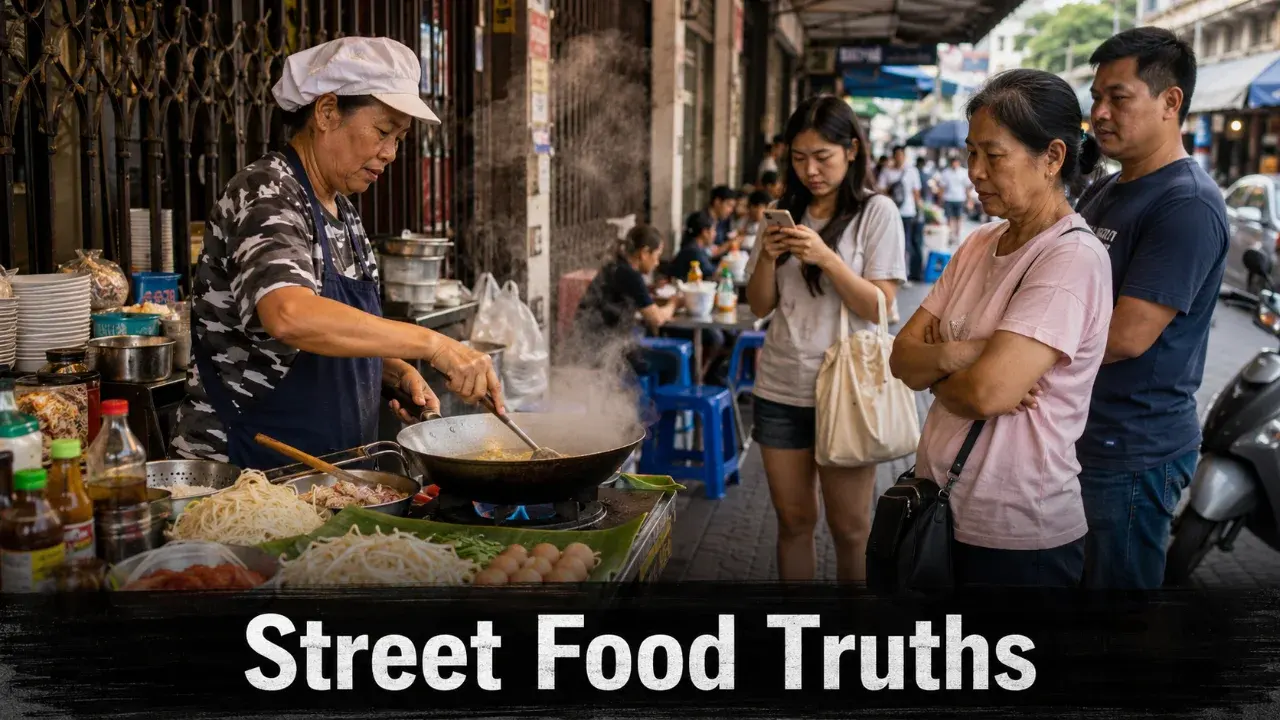
Thai street food is often judged by price, spice, and sidewalk settings. But for locals, it is a daily system built on speed, trust, habit, and sharp food instincts.
A Thai street food stall can look casual from the outside: a wok, a plastic stool, a small table of condiments, and a line of people waiting before lunch.
But that simple scene is easy to misread.
For many travelers, Thai street food is one of the most memorable parts of visiting Thailand. It is fast, colorful, affordable, and deeply tied to the country’s global image. Yet the most common misunderstandings are not only about flavor. They are about how street food works in daily Thai life.
Street food in Thailand is not just a tourist experience. For many people, it is breakfast before work, lunch near an office, dinner after a long commute, or a late-night meal after study or shift work. It is practical, social, and woven into the rhythm of neighborhoods.
That is why judging it only as “cheap food on a sidewalk” misses the bigger picture.
Outside does not automatically mean unsafe
One of the first assumptions some visitors make is that food cooked outdoors must be dirty or risky.
Food safety does matter. Outdoor food can carry risks anywhere, especially when ingredients are left uncovered, food sits too long, or cold items are not handled properly. Travelers should be cautious, particularly with raw seafood, lukewarm dishes, questionable ice, or stalls that look poorly maintained.
But in Thailand, many street stalls cook quickly, in small batches, right in front of customers. That visibility is part of the trust system. You can often see the ingredients, the wok, the grill, the soup pot, and the pace of service.
Thailand has also promoted food sanitation standards for food businesses and street vendors over many years. The “Clean Food Good Taste” project was described by Thailand’s Ministry of Public Health in a FAO-WHO food safety forum document, and Thailand’s Department of Health has more recently promoted SAN and SAN Plus standards as updated food sanitation marks.
That does not mean every stall is equally safe. It means the better question is not simply “Is Thai street food safe?” The better question is: how do locals decide where to eat?
A busy stall with high turnover, hot food, clean utensils, covered ingredients, and regular customers usually tells you more than a pretty sign. In Thai street food culture, the crowd is often a clue, not just background noise.
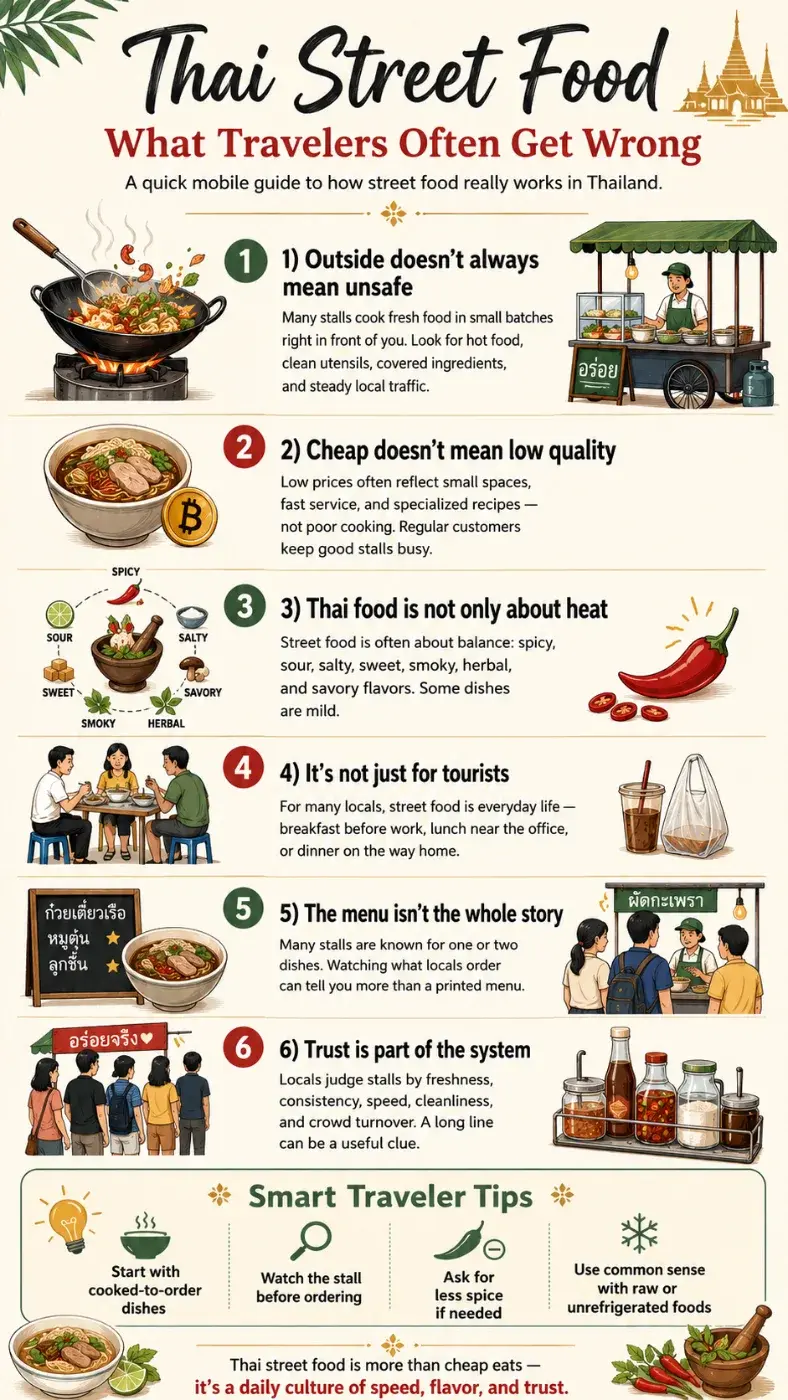
Cheap does not mean careless
Another misunderstanding is that low prices must mean low quality.
In Thailand, price often reflects format, speed, rent, and specialization. A vendor selling one dish from a small stall does not have the same costs as a full restaurant. That can make a meal affordable without making it careless.
A noodle vendor may spend years refining a broth. A grilled pork vendor may know exactly how long the skewers need over charcoal. A papaya salad vendor may adjust lime, fish sauce, chilies, and palm sugar by feel.
For American readers, this can be different from the way “street food” is often framed in the United States. Food trucks in some U.S. cities can be trendy, branded, and priced close to restaurant meals. In Thailand, street food is often closer to daily infrastructure: quick, local, and built around repeat customers.
The vendor survives because people come back. That regular-customer relationship matters.
A humble stall may not look polished, but it may be highly specialized. A famous stall may be worth visiting, but fame alone does not guarantee the best experience. Freshness and turnover matter more than a stall’s online reputation.
Thai food is not only about heat
Many visitors arrive expecting every Thai street dish to be extremely spicy.
Spice is important, but it is not the whole story. Thai cooking often balances sour, salty, sweet, spicy, herbal, smoky, bitter, fermented, and rich flavors. UNESCO’s description of Tomyum Kung, Thailand’s traditional prawn soup, notes its mix of tastes including sweet, sour, savory, spicy, creamy, and slightly bitter.
That balance is one reason Thai food can be so memorable.
Some street dishes are mild. Some are smoky from charcoal. Some are built around texture: crispy pork, springy noodles, soft rice, crunchy vegetables, chewy fish balls. Some are sweet, like mango sticky rice. Some are sharp and herbal. Some are salty and comforting.
Reducing Thai street food to “spicy food” misses how much control goes into a small cooking space. A mortar, a wok, a grill, a soup pot, and a condiment tray can produce a wide range of flavors.
Travelers can often ask for less spice. But “not spicy” does not always mean bland. Garlic, fish sauce, lime, herbs, chili paste, and fermented ingredients can still make a dish taste bold.
The best food is not always in the most famous place
Bangkok’s Chinatown, night markets, and tourist-friendly food streets are popular for good reason. They are lively, visual, and easy for visitors to understand.
But street food in Thailand is not only a tourist attraction.
Many of the most important stalls exist because nearby people need them. Office workers want a fast lunch. Students want snacks after school. Motorbike taxi drivers stop for noodles. Families buy dinner on the way home. Market vendors feed other market vendors.
That is why the most memorable meal may not come from a famous food street. It might come from a morning market, a small stall near an office building, or a neighborhood vendor who sells out before tourists arrive.
Bangkok’s street food has also been part of real urban debates. Thailand’s Ministry of Foreign Affairs has described efforts by Bangkok authorities to preserve street food while improving hygiene, waste management, and pedestrian access in well-known areas such as Yaowarat and Khao San Road.
That tension is important. Street food is beloved, but it also exists in a city that has to manage sidewalks, cleanliness, traffic, vendors, residents, and visitors.
The menu is not always the full experience
Many travelers look for a clear menu, English labels, photos, or a familiar ordering process.
Thai street stalls do not always work that way.
Some vendors are known for one dish. Some regular customers already know what to order. Some stalls change slightly by time of day. Some dishes are better eaten immediately, while others are commonly taken home.
This can feel confusing if you are new to Thailand. But it also gives travelers a useful strategy: watch before ordering.
If everyone is ordering the same thing, that is probably the stall’s strength. If a vendor is grilling chicken, do not expect the stall to operate like a restaurant with a full menu. If a noodle stall has a fast rhythm, look at how locals customize their bowls.
Thai street food rewards observation. The best guide is often local behavior.
That does not mean copying everything blindly. It means slowing down enough to notice what the stall actually does well.
The real ingredient is trust
The biggest misunderstanding may be thinking Thai street food is only about the dish.
It is also about trust.
Customers trust the vendor’s routine. Vendors trust regulars to return. People judge the smell, the line, the heat of the wok, the cleanliness of the setup, and whether food is moving quickly. That judgment happens fast.
This trust is not romantic or naive. Locals can be demanding. They care about taste, price, portion size, cleanliness, speed, and consistency. A stall that disappoints people does not stay busy for long.
For travelers, the practical lesson is simple: do not judge only by appearance. A basic stall can be excellent. A crowded stall can still require common sense. A beautiful stall can be average. A famous place can be good, but fame is not the same as freshness.
Approach Thai street food with curiosity, patience, and humility. Start with dishes cooked hot in front of you. Choose places with steady turnover. Learn a few simple food words. Point politely when needed. Watch how locals eat, season, wait, and order.
Thai street food is not a dare, a postcard, or a museum piece. It is a living part of everyday Thailand: fast, flavorful, imperfect, social, and constantly moving.
The real story is not only what ends up on the plate. It is the system of people, habits, trust, and judgment that gets it there.
KEY TAKEAWAYS:
- Thai street food is part of everyday life in Thailand, not just a tourist attraction.
- Outdoor cooking does not automatically mean unsafe, but travelers should still judge cleanliness, turnover, and food handling carefully.
- Low prices often reflect speed, specialization, and format — not necessarily poor quality.
- Thai food is not only about extreme spice; balance, texture, herbs, and freshness matter.
- Watching local customers is often one of the best ways to understand what a stall does well.
FAO-WHO Global Forum of Food Safety Regulators, Thailand Department of Health, UNESCO Intangible Cultural Heritage, Ministry of Foreign Affairs of Thailand
References:
https://www.fao.org/4/ab523e/ab523e.htm
https://multimedia.anamai.moph.go.th/news/130668/
https://ich.unesco.org/en/RL/tomyum-kung-01879

เขียนโดย Postjung Insights
 รู้หรือไม่? เปิดรายได้พนักงานส่งพัสดุของแต่ละแอป วันหนึ่งได้เท่าไร
 ดูหนัง–ซีรีส์ฟรีอาจไม่ฟรีอย่างที่คิด! เปิดโทษละเมิดลิขสิทธิ์ เตือนคนปล่อยคอนเทนต์เถื่อน เสี่ยงทั้งคุกทั้งปรับ
 5 คณะที่เรียนจบมาแล้ว มีอาชีพรองรับมากกว่าที่คิด
 แมคาเดเมีย (Macadamia): ราชินีแห่งถั่ว กับขุมทรัพย์โภชนาการจากออสเตรเลีย
 อำเภอที่มีชื่ออำเภอสั้นที่สุด 3 อำเภอเท่านั้นในประเทศไทย
 MRT เตาปูนกลับมาเปิดปกติแล้ว รมช.คมนาคมเผยปมไฟไหม้ พบประกายไฟจากชุดสายไฟ 750 โวลต์
 โรงเรียนที่มีนักเรียนมากที่สุดในไทย
 เปิด 5 โรงเรียนหญิงล้วนเก่าแก่ของไทย ที่มีประวัติยาวนานกว่าศตวรรษ
 ตาราง “เด่นเหนือเด่นใต้” งวด 1 ต.ค. 69 เปิดข้อมูลตามโพย เลขไหนอยู่ตรงไหน
 รมว.วัฒนธรรมเอาจริง! จ่อส่งหนังสือทักท้วง Miss Universe Cambodia ปมใช้ภาพหญิงกำแพงเพชร หากไม่แก้ เตรียมใช้กฎหมาย
 มัดรวมจับเลขชน สัตว์นำโชค 1 ตุลาคม 2569
 โรงเรียนเพียงแห่งเดียวของประเทศไทย ที่อยู่มาตั้งแต่ยุครัชกาลที่ 4
 English Edition