Why picking up a rabbit can be stressful—and what to do instead

Rabbits are ground-dwelling prey animals, so being lifted can feel very different from ordinary petting. Research and animal-welfare guidance suggest keeping interactions at ground level whenever possible and using secure, full-body support when lifting is necessary.
A rabbit may happily approach for food, accept a head rub, or relax beside a trusted person—and still strongly dislike being picked up.
That reaction makes sense from a rabbit’s point of view. Rabbits are ground-dwelling prey animals, and being lifted removes both their footing and their ability to move away. Animal-welfare organizations therefore recommend interacting with rabbits at ground level whenever possible and keeping necessary restraint to a minimum.
Being touched and being lifted are not the same experience
People often assume that a rabbit comfortable with petting will also enjoy being held. The two situations give the animal very different levels of control.
A rabbit resting on the floor can approach, move away, change position or retreat to a hiding place. Once lifted, those options disappear.
A 2018 survey involving 2,644 rabbit owners, caregivers, breeders and animal professionals noted that, as terrestrial prey animals, rabbits are likely to find being picked up inherently stressful. Among the handling methods examined, supporting a rabbit against the handler’s chest was viewed as the easiest and most welfare-friendly, while scruffing with rear support was considered the most distressing and painful.
More recent research adds physiological evidence to the discussion.
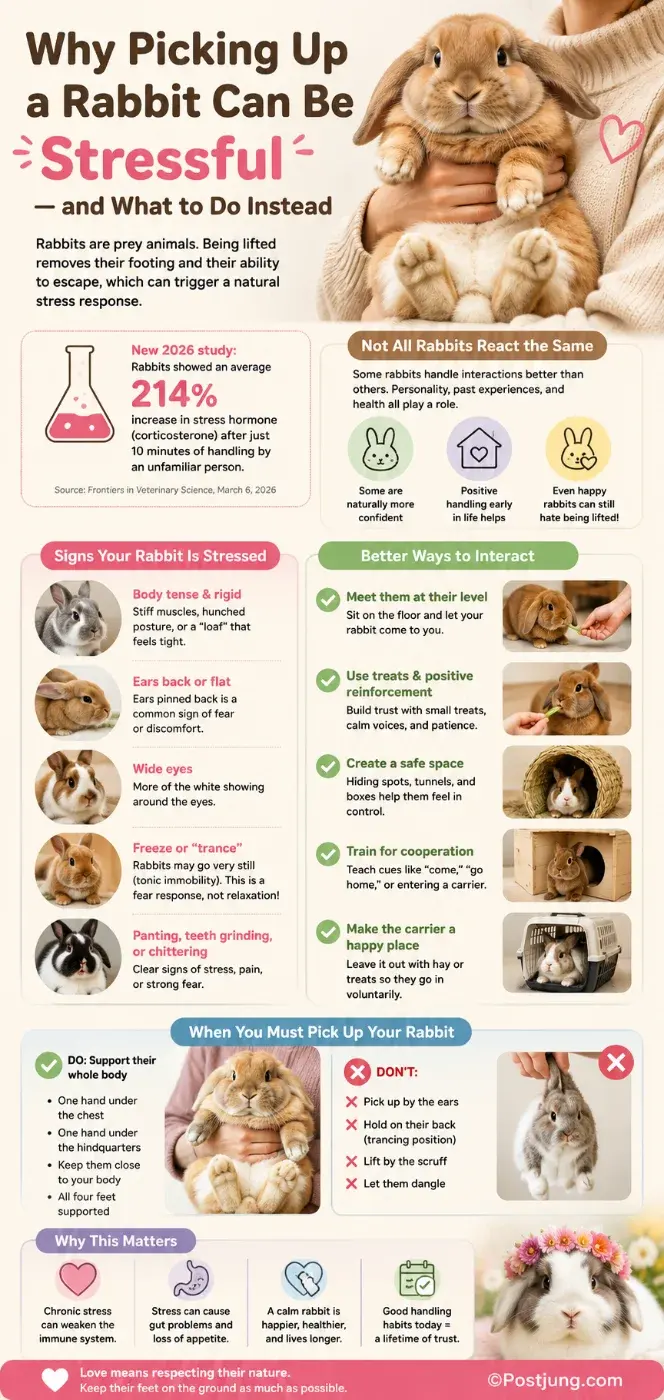
In a study published in Frontiers in Veterinary Science in March 2026, researchers studied seven adult female dwarf rabbits during repeated 10-minute sessions in which an unfamiliar person held and stroked each rabbit on their lap. Salivary corticosterone, a hormone used as a stress indicator in rabbits, increased by an average of about 214% after the interaction compared with control conditions. Rabbits also spent much of the session in tense postures, and greater body tension was associated with larger hormonal increases.
The experiment was small and involved a specific situation: unfamiliar people, seven female dwarf rabbits and lap handling rather than every possible form of lifting. It therefore should not be interpreted as proof that every rabbit experiences the same degree of stress whenever a familiar owner touches or briefly carries it. Individual responses in the study varied substantially.
What it does show is that apparently gentle human contact can still produce measurable stress in some rabbits.
A quiet rabbit is not automatically a relaxed rabbit
Rabbits do not always respond to fear by struggling.
One potentially misleading behavior is tonic immobility, sometimes called “trancing,” which can occur when a rabbit is placed on its back. The animal may become extremely still, creating the impression that it has relaxed.
Rabbit welfare guidance warns that this is a defensive fear response rather than a useful relaxation technique. The Rabbit Welfare Association & Fund says physiological and behavioral observations indicate that rabbits placed in this position remain aware of their surroundings and show signs of fear.
The RSPCA likewise advises against holding rabbits on their backs and recommends restraining them only as much as necessary.
Body tension and ears pressed back can also accompany acute stress, according to the 2026 study. Because rabbits differ in personality, history and socialization, no single posture should be interpreted in isolation.
Try meeting your rabbit at floor level
For ordinary social interaction, getting down to the rabbit’s level is usually a better starting point than repeatedly scooping it up.
Sit or kneel nearby and allow the rabbit to approach. Calm movement, quiet speech, food rewards and gentle stroking can help the animal learn that contact with people does not automatically lead to restraint.
The Rabbit Welfare Association & Fund recommends building confidence gradually with nervous rabbits, allowing them to become comfortable with touch before attempting to lift them.
Training can reduce lifting in other situations too. The RSPCA notes that rabbits can learn cues such as coming when called or returning to their enclosure, providing an alternative to chasing and grabbing them.
A carrier can also become something a rabbit enters voluntarily rather than an object that appears only before a stressful trip.
When you do need to pick a rabbit up
Avoiding unnecessary lifting does not mean a rabbit should never be handled. Owners may need to check the animal’s body, groom it, trim nails, administer treatment or move it safely.
When lifting is necessary, secure support matters.
The RSPCA advises supporting the rabbit’s back and bottom while keeping all four feet close to the handler’s body. Handling near ground level also reduces the consequences if the rabbit suddenly struggles or jumps.
The Rabbit Welfare Association & Fund similarly recommends supporting the chest and hindquarters, bringing the rabbit securely against the body without squeezing.
Never lift a rabbit by its ears. Welfare organizations also advise against suspending a rabbit by the scruff of its neck, and routine scruffing should be avoided when safer handling is possible.
A rabbit that repeatedly panics, suddenly becomes unusually defensive, or develops a new aversion to being touched should also be checked for possible pain or illness rather than assuming the problem is behavioral. The RSPCA recommends consulting a veterinarian when changes in handling tolerance raise concern.
The useful distinction is simple: affection does not have to mean being carried.
For many rabbits, the most comfortable relationship with a person may happen with all four feet firmly on the ground.
SOURCES USED:
- Frontiers in Veterinary Science — When touch is stressful: acute endocrine and behavioral responses of domestic rabbits to unfamiliar human handling Frontiers study
- PubMed — A Survey of Rabbit Handling Methods Within the United Kingdom and the Republic of Ireland PubMed study record
- RSPCA — Handling Rabbits: How to Pick Up a Rabbit RSPCA rabbit-handling guidance
- Rabbit Welfare Association & Fund — Handling Rabbits RWAF handling guidance
- Rabbit Welfare Association & Fund — Trancing RWAF tonic-immobility guidance

เขียนโดย Postjung Insights
 เจาะลึกรายได้พนักงานส่งอาหารแต่ละวันได้เท่าไร/หักค่าใช้จ่ายอะไรบ้าง
 รู้หรือไม่? เปิดรายได้พนักงานส่งพัสดุของแต่ละแอป วันหนึ่งได้เท่าไร
 อำเภอที่มีชื่ออำเภอสั้นที่สุด 3 อำเภอเท่านั้นในประเทศไทย
 สุดระทึก! ไฟไหม้รางรถไฟฟ้า MRT สถานีเตาปูน-บางโพ..หยุดให้บริการชั่วคราวทุกสถานี
 ตาราง “เด่นเหนือเด่นใต้” งวด 1 ต.ค. 69 เปิดข้อมูลตามโพย เลขไหนอยู่ตรงไหน
 เลขเด็ดไพ่ยิปซี งวด 1 ตุลาคม 2569 รวมเลขเด่นและเลขท้าย 2 ตัว
 เกษียณแล้วทำอะไรดี เปิด 4 กลุ่มอาชีพที่ผู้สูงวัยไทยทำกันน้อย จากข้อมูล 5.26 ล้านคน
 เปิด 5 โรงเรียนหญิงล้วนเก่าแก่ของไทย ที่มีประวัติยาวนานกว่าศตวรรษ
 โรงเรียนเพียงแห่งเดียวของประเทศไทย ที่อยู่มาตั้งแต่ยุครัชกาลที่ 4
 ความลับ 30 ล้านปีของ “แม่น้ำไนล์”: ทำไมสายน้ำสายนี้ถึงไม่เคยเหือดแห้งกลางทะเลทรายซาฮารา
 โรงเรียนที่มีนักเรียนมากที่สุดในไทย
 สถิติย้อนหลัง 10 ปี ออกเลขไหนบ้างมาดูกันสุดระทึก! ไฟไหม้รางรถไฟฟ้า MRT สถานีเตาปูน-บางโพ..หยุดให้บริการชั่วคราวทุกสถานีเจาะลึกรายได้พนักงานส่งอาหารแต่ละวันได้เท่าไร/หักค่าใช้จ่ายอะไรบ้างเปิด 5 โรงเรียนหญิงล้วนเก่าแก่ของไทย ที่มีประวัติยาวนานกว่าศตวรรษ
 เปิด 5 สินค้าส่งออกของลาวที่คนไทยอาจคาดไม่ถึง หนึ่งในนั้นทำเงินเกือบ 1 พันล้านดอลลาร์เกษียณแล้วทำอะไรดี เปิด 4 กลุ่มอาชีพที่ผู้สูงวัยไทยทำกันน้อย จากข้อมูล 5.26 ล้านคนโรงเรียนเพียงแห่งเดียวของประเทศไทย ที่อยู่มาตั้งแต่ยุครัชกาลที่ 4
 English Edition