How to Teach “Leave It” Without Turning It Into a Battle
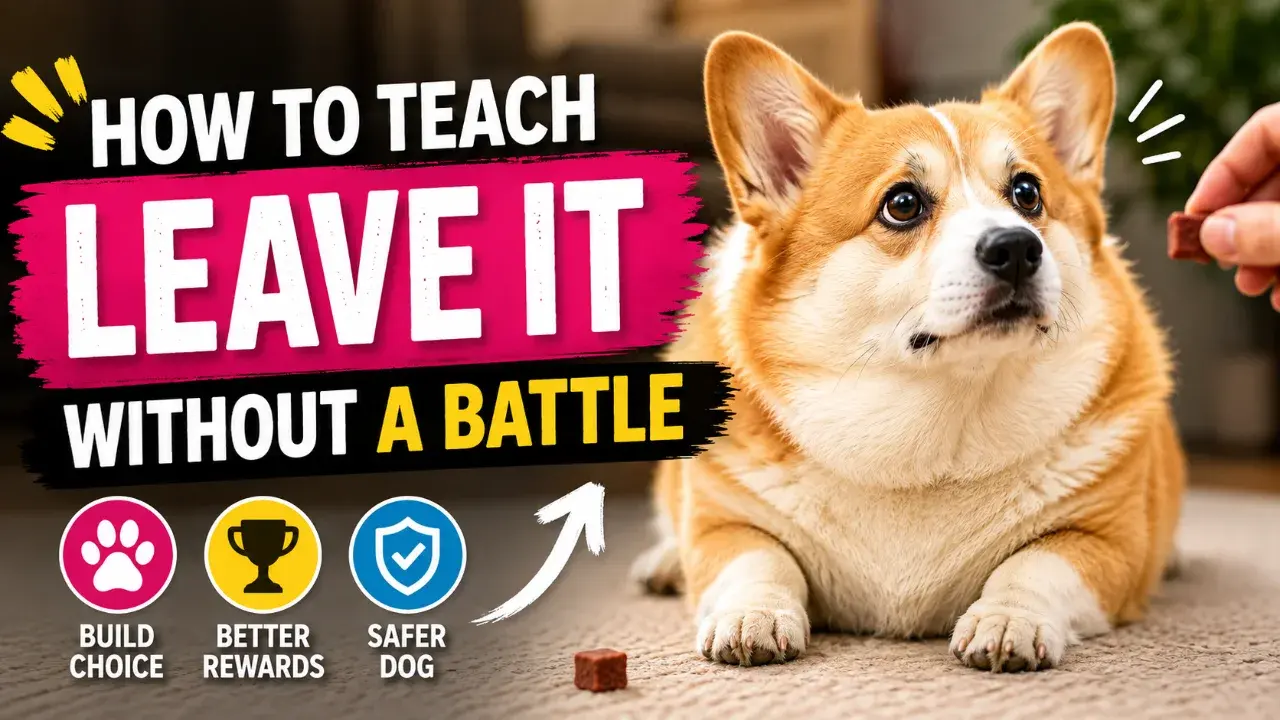
A reliable “leave it” is built by rewarding the moment your dog chooses to disengage, then gradually making the situation harder. The goal is not to overpower your dog, but to make moving away from temptation a behavior worth repeating.
A dog spots a piece of food on the sidewalk and moves toward it. The instinctive human response may be to tighten the leash, repeat “leave it” louder and louder, or rush in to grab the object first.
That can prevent an immediate mistake, but it is not the behavior you ultimately want to teach.
A strong “leave it” means the dog learns that backing away from something interesting is worthwhile. Reward-based training organizations recommend building that response gradually rather than relying on intimidation, physical correction, or a battle over the object. The American Veterinary Society of Animal Behavior says reward-based methods should be used for dog training and that aversive approaches are not necessary for teaching or behavior modification.
Start with a choice, not a confrontation
One of the simplest beginner exercises requires only two sets of treats.
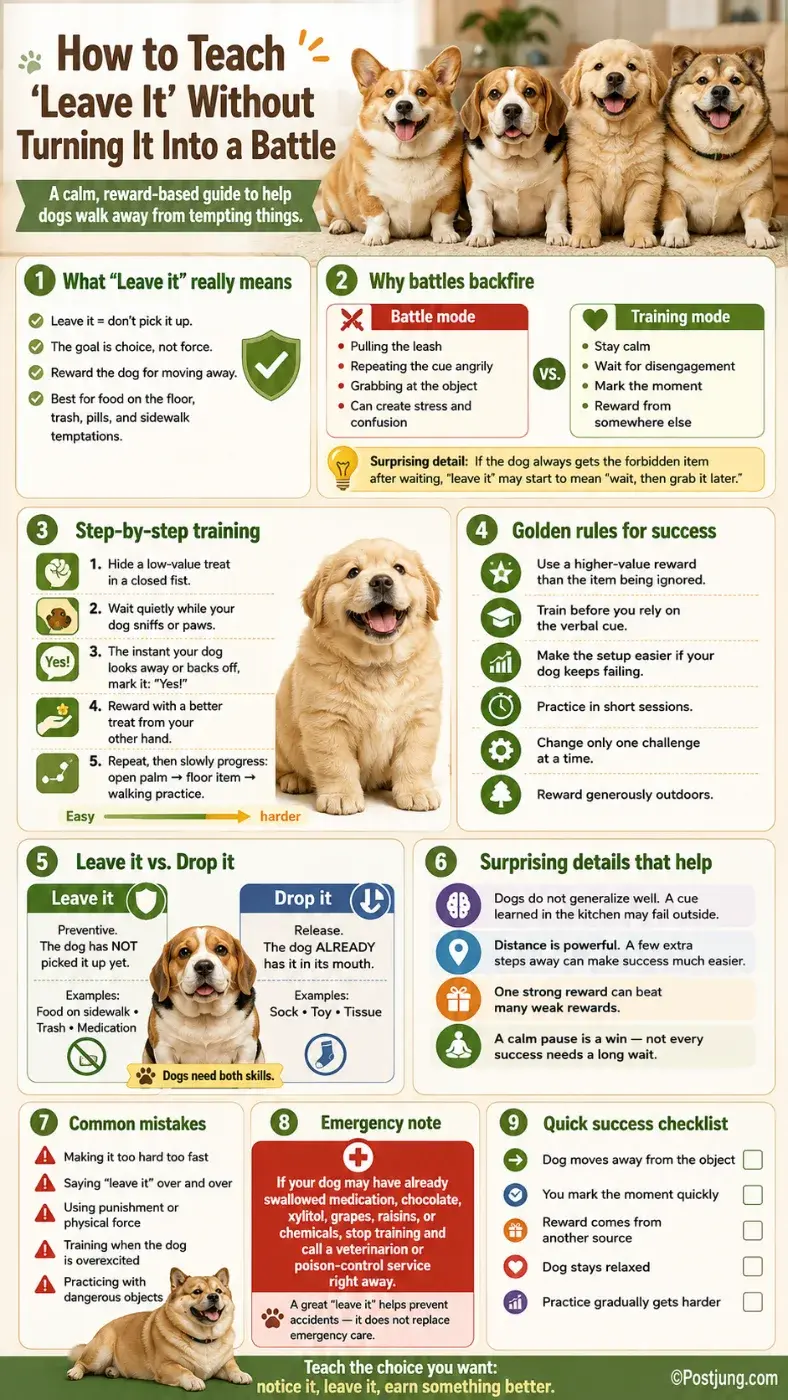
Put a relatively ordinary treat in a closed fist and present your hand to your dog. Your dog may sniff, lick, nudge, or paw at your hand. Keep the food safely enclosed and wait.
The important moment comes when the dog stops trying—even if the first attempt is only a tiny movement of the nose away from your hand.
Mark that choice immediately with a clicker, a consistent word such as “yes,” or calm praise, then reward the dog.
The RSPCA recommends a similar progression: wait quietly for the dog to move away from the closed hand, reinforce that choice, and practice in short, regular sessions before increasing the difficulty.
The lesson is subtle but important. The dog is not learning, “My person can overpower me.” The dog is learning, “Disengaging makes good things happen.”
Consider rewarding from the other hand
As training progresses, many trainers use one item as the thing the dog must leave and a different reward as payment for leaving it.
The American Kennel Club recommends rewarding successful disengagement with food from another hand or pocket, ideally something more valuable than the item being ignored once training moves to objects that are meant to remain off-limits.
There is a practical reason for the distinction.
In real life, “leave it” may refer to something the dog should never receive: a dropped pill, discarded food, trash, or another unsafe object. If every practice repetition ends with permission to eat the forbidden item, the dog may learn that waiting is simply the first step toward eventually getting it.
Using a separate reward can instead build the expectation that moving away leads to something better somewhere else.
Add the words after the behavior starts making sense
It is tempting to begin by repeatedly saying “leave it,” but a cue is most useful when the dog has a reasonable chance of understanding what behavior predicts a reward.
Once your dog is consistently backing away from the closed fist, begin pairing the verbal cue with the behavior.
Then increase difficulty gradually.
Open your hand so the treat is visible. If the dog dives toward it, simply close your hand again. When the dog backs away, mark and reward.
Next, place an item on the floor and cover it with your hand. When the dog disengages reliably, uncover it briefly. Later, practice standing up, using a leash for management and positioning yourself so the dog cannot accidentally grab the practice item.
The AKC recommends progressing from protected food to uncovered floor items and eventually to controlled walking exercises, while rewarding successful choices along the way.
If your dog keeps failing, make the exercise easier
A common training mistake is increasing the difficulty faster than the dog can handle.
A dog that ignores a cracker in your living room may completely forget the lesson when faced with half a sandwich on a sidewalk.
That does not necessarily mean the dog is stubborn. The distraction may simply be more valuable, the environment more stimulating, or the training history too limited.
Move farther away. Use a less tempting object. Practice somewhere quieter. Increase the value of the reward.
Most importantly, avoid repeatedly giving a cue when you already know your dog is unlikely to respond. The AKC cautions against allowing dogs to rehearse ignoring the cue and recommends returning to easier training when a distraction is beyond the dog's current ability.
Think of difficulty as a dial rather than a pass-or-fail test.
“Leave it” and “drop it” solve different problems
The two cues are easy to confuse.
“Leave it” is preventive: do not pick that thing up.
“Drop it” is corrective management after the dog already has something in its mouth: release what you are holding.
The AKC specifically distinguishes the two skills and recommends teaching both, because owners will not always notice an unwanted object before the dog reaches it.
That distinction also helps prevent another common battle: chasing a dog through the house or forcibly prying an object from its mouth.
A practiced “drop it,” typically taught through rewarding a voluntary release or trade, gives you a separate response for that situation.
Take the skill into the real world slowly
Once your dog succeeds indoors, change one variable at a time.
Practice in another room. Then the yard. Then a quiet outdoor location. Walk past deliberately placed low-value items while the dog is on leash. Eventually introduce toys, smells, food, and other distractions at manageable distances.
Reward generously when the dog notices something tempting and chooses to turn away.
Training in multiple environments matters because a dog that has learned a behavior in the kitchen has not automatically learned to perform it everywhere else. Real-world reliability comes from repeated successful practice under gradually changing conditions.
And rewards do not have to be limited to food. For some dogs, a toy, play, access to sniffing, or another activity can be highly motivating.
Calm training does not mean having no boundaries
Reward-based training is sometimes misunderstood as simply allowing a dog to do whatever it wants.
That is not what veterinary behavior guidance recommends.
AVSAB notes that dogs still need structure, routines, and clear guidelines; the difference is that those boundaries can be taught without fear, intimidation, or pain. Its current position also advises against aversive tools and physical or psychological punishment because of welfare risks and potential effects on the dog-human relationship.
Management is part of that structure. Use a leash when necessary. Keep medicines and dangerous foods out of reach. Prevent access to hazards while the dog is still learning.
Training works best when the environment gives the dog a realistic chance to succeed.
If the dangerous item has already been swallowed, training time is over
Even an excellent “leave it” cannot prevent every accident.
If a dog may have swallowed medication, a toxic food, a chemical, or another potentially poisonous substance, contact a veterinarian or an animal poison-control service promptly rather than relying on training cues or home remedies.
The ASPCA Animal Poison Control Center advises seeking expert guidance when poisoning is suspected. Poison-control guidance also cautions owners against inducing vomiting without veterinary direction because doing so can be dangerous in some exposures.
A reliable “leave it” is therefore best viewed as one layer of prevention—not a guarantee of safety.
The strongest version of the skill can look almost uneventful: your dog notices something interesting, pauses, and chooses to move away.
That quiet decision is exactly the point.
SOURCES USED:
- American Veterinary Society of Animal Behavior — Humane Dog Training Position Statement AVSAB Humane Dog Training Position Statement
- American Veterinary Society of Animal Behavior — Position Statements and Handouts AVSAB Position Statements
- American Kennel Club — “Leave It” Command: Training Your Dog to Ignore Food and Other Items AKC guide to teaching “leave it”
- RSPCA — How To Train Your Dog To Leave Something Alone RSPCA leave training guide
- American Kennel Club — How to Teach Your Dog to Drop It AKC guide to teaching “drop it”
- ASPCA — Animal Poison Control ASPCA Animal Poison Control

เขียนโดย Postjung Insights
 อำเภอที่มีชื่ออำเภอสั้นที่สุด 3 อำเภอเท่านั้นในประเทศไทย
 เจาะลึกรายได้พนักงานส่งอาหารแต่ละวันได้เท่าไร/หักค่าใช้จ่ายอะไรบ้าง
 สุดระทึก! ไฟไหม้รางรถไฟฟ้า MRT สถานีเตาปูน-บางโพ..หยุดให้บริการชั่วคราวทุกสถานี
 โรงเรียนที่มีนักเรียนมากที่สุดในไทย
 เกษียณแล้วทำอะไรดี เปิด 4 กลุ่มอาชีพที่ผู้สูงวัยไทยทำกันน้อย จากข้อมูล 5.26 ล้านคน
 รู้หรือไม่? เปิดรายได้พนักงานส่งพัสดุของแต่ละแอป วันหนึ่งได้เท่าไร
 ตาราง “เด่นเหนือเด่นใต้” งวด 1 ต.ค. 69 เปิดข้อมูลตามโพย เลขไหนอยู่ตรงไหน
 เปิด 5 โรงเรียนหญิงล้วนเก่าแก่ของไทย ที่มีประวัติยาวนานกว่าศตวรรษ
 โรงเรียนเพียงแห่งเดียวของประเทศไทย ที่อยู่มาตั้งแต่ยุครัชกาลที่ 4
 แปลปกสลาก งวด 1 ต.ค. 69 ส่องตัวเลขจากภาพปกสลากกินแบ่งรัฐบาล
 เปิดศึกเลขเด็ดงวดนี้! เจ้าพ่อปากแดง ปะทะ เจ้าแม่ตะเคียนทอง งวด 1 ต.ค. 59 คัดมาให้เน้นๆ พร้อมลุ้นรวย
 เลขเด็ดไพ่ยิปซี งวด 1 ตุลาคม 2569 รวมเลขเด่นและเลขท้าย 2 ตัวสุดระทึก! ไฟไหม้รางรถไฟฟ้า MRT สถานีเตาปูน-บางโพ..หยุดให้บริการชั่วคราวทุกสถานีเจาะลึกรายได้พนักงานส่งอาหารแต่ละวันได้เท่าไร/หักค่าใช้จ่ายอะไรบ้างเปิด 5 โรงเรียนหญิงล้วนเก่าแก่ของไทย ที่มีประวัติยาวนานกว่าศตวรรษ
 เปิด 5 สินค้าส่งออกของลาวที่คนไทยอาจคาดไม่ถึง หนึ่งในนั้นทำเงินเกือบ 1 พันล้านดอลลาร์เกษียณแล้วทำอะไรดี เปิด 4 กลุ่มอาชีพที่ผู้สูงวัยไทยทำกันน้อย จากข้อมูล 5.26 ล้านคนโรงเรียนเพียงแห่งเดียวของประเทศไทย ที่อยู่มาตั้งแต่ยุครัชกาลที่ 4
 English Edition