How to Plan Pet Care After a Separation or Divorce

A breakup can change a pet’s home, routine, caregivers, and daily environment all at once. A good post-separation plan focuses less on dividing time equally and more on creating a stable arrangement that fits the individual animal.
When a couple separates, deciding who keeps the dog, cat, or other companion animal can become one of the hardest practical questions. The most workable answer is not necessarily a perfect 50-50 split. It is an arrangement that gives the pet reliable care, familiar routines, safe surroundings, and as little unnecessary disruption as possible.
Animal welfare organizations recommend looking at the pet’s actual needs rather than treating shared care as the default. Blue Cross, a UK animal welfare charity, advises separating partners to consider which person has the time and financial ability to provide ongoing care and whether moving between homes would suit the individual animal.
Start with the pet’s ordinary day
Before discussing weekends or handover times, write down what the animal’s life currently looks like.
Include feeding times, walks, medication, grooming, sleeping habits, training, litter-box routines, veterinary appointments, exercise, and how long the pet is normally comfortable being alone.
The goal is to identify which parts of life should remain predictable even when the human household changes.
If one person has always handled morning walks while another manages veterinary care, for example, that history may help reveal which responsibilities need to be transferred rather than simply assuming both homes can immediately operate in the same way.
A practical decision should also account for work schedules, housing restrictions, other animals in each home, transport time, access to outdoor space where relevant, and the pet’s relationship with each caregiver.
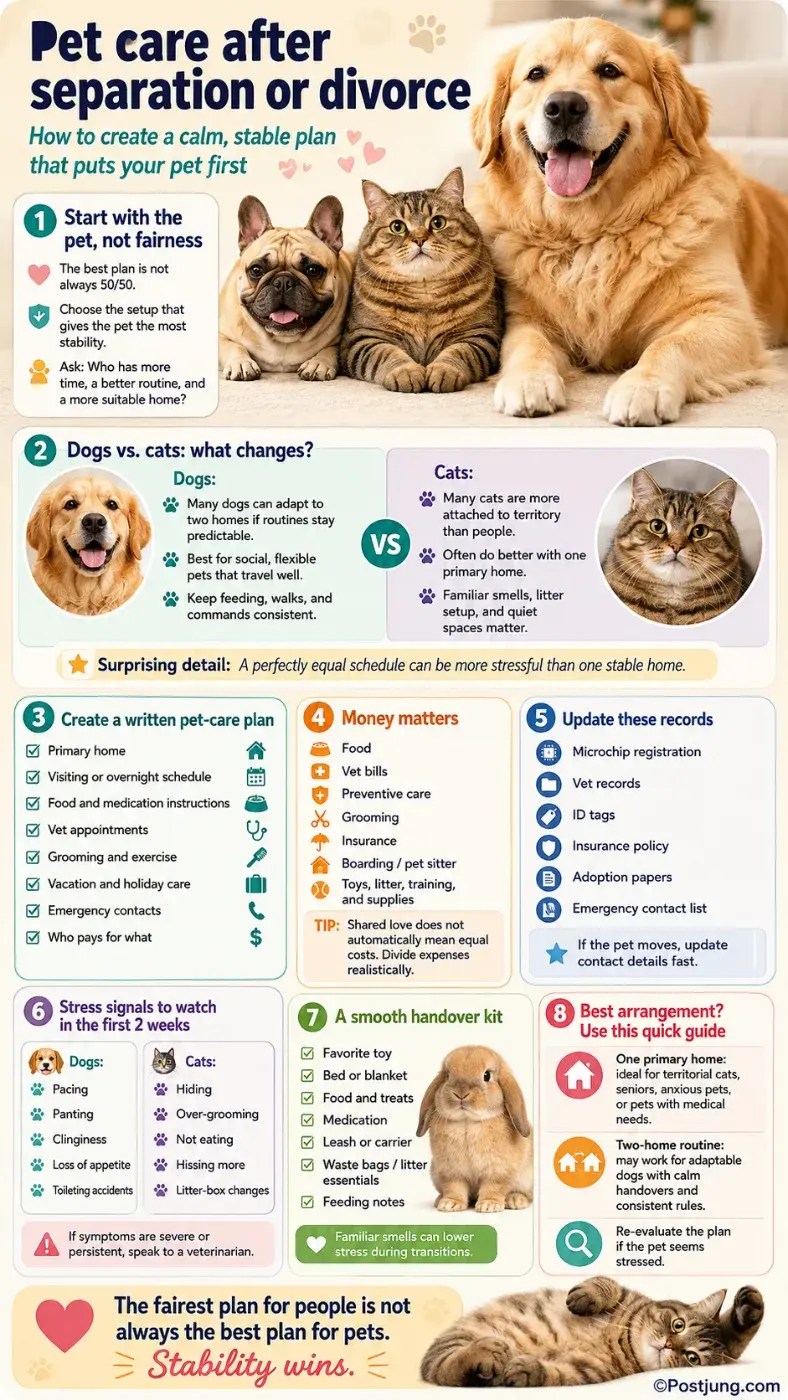
Shared care works for some pets, but not all
Alternating homes may be manageable for a confident dog that already spends substantial time in both places and travels comfortably. For another animal, repeated transitions may create unnecessary stress.
There is no universal schedule that suits every dog. Signs of anxiety can include panting, pacing, trembling, excessive salivation, or unusually intense greetings, according to the ASPCA’s guidance on separation-related anxiety. The organization recommends adjusting changes according to the individual dog’s response rather than following a fixed timeline.
That makes observation important during the first weeks of a new arrangement. A schedule that seems fair on paper may need to change if the animal consistently struggles after handovers.
Cats deserve a separate calculation.
Cats are highly influenced by territory, familiar smells, and environmental predictability. Cats Protection notes that moving can be stressful because cats feel safer among familiar sights, sounds, and scents. Its current moving guidance recommends introducing a new home gradually and surrounding the cat with familiar bedding and other scent-bearing objects.
For some cats, remaining primarily in one familiar home may therefore be less disruptive than regularly moving between two addresses. Blue Cross similarly advises considering a cat’s attachment to its environment when couples separate.
This does not mean that every cat must stay with whoever keeps the former family home. Temperament, relationships, safety, existing routines, and the quality of each environment still matter.
Build a written care plan before problems appear
Even when former partners remain friendly, putting arrangements in writing can prevent future misunderstandings.
A useful plan can record:
- where the pet primarily lives
- any planned visits or overnight stays
- feeding instructions and medication
- who schedules routine veterinary care
- who may authorize emergency treatment
- how veterinary, grooming, insurance, boarding, and other expenses are divided
- who keeps the carrier, medications, records, and other essential supplies
- holiday and travel arrangements
- what happens if one person moves, changes jobs, becomes ill, or can no longer provide care
- when the arrangement will be reviewed
The plan does not need to imitate a child-custody calendar. In fact, designing it around the animal’s routines may produce a much simpler arrangement.
If the pet has a chronic medical condition, disability, behavioral problem, or complex medication schedule, continuity may deserve even greater weight.
Do not forget records and identification
A separation can also leave basic administrative details scattered between two people.
Check whose contact information appears on the pet’s microchip registration, veterinary records, insurance policy, licensing documents, adoption paperwork, and emergency contacts. Where appropriate and legally permitted, update records after the living arrangement changes.
Cats Protection specifically recommends updating microchip information and arranging veterinary records when a cat moves to a new home.
Keeping a shared copy of vaccination records, prescriptions, medication doses, allergies, insurance information, and the regular veterinarian’s contact details can also make emergencies easier to manage.
The law may not treat a pet like a family member
Emotional attachment and legal ownership are not always the same thing.
Pet ownership rules vary substantially by country and jurisdiction. Even within the United States, approaches differ. The American Bar Association notes that companion animals have traditionally been treated as property in many legal disputes, although a growing number of jurisdictions have adopted rules that allow courts to consider an animal’s well-being or care in divorce proceedings.
By 2026, several U.S. jurisdictions had enacted provisions requiring or allowing courts to consider an animal’s welfare or best interests in divorce-related decisions, but there is no single nationwide pet-custody rule.
Couples should therefore avoid assuming that registration, payment of veterinary bills, daily caregiving, or even an informal shared arrangement will have the same legal significance everywhere.
If ownership is disputed, significant money is involved, there are safety concerns, or one person threatens to take or withhold the animal, local legal advice may be necessary.
Make the first move as calm as possible
If the pet will relocate, reducing the number of simultaneous changes can help.
Keep familiar bedding, toys, feeding times, and routines when practical. For cats, Cats Protection recommends establishing a quiet safe room in the new home with familiar belongings, food, water, litter, hiding options, and familiar smells before gradually allowing access to more of the property.
Dogs may also need time to learn a new routine, particularly if the move changes how long they are left alone.
Monitor eating, drinking, toileting, sleep, activity, social behavior, and signs of distress. Cats under stress, for example, may hide, change their eating habits, scratch more, hiss, or toilet outside the litter box. Persistent or concerning behavioral changes should be discussed with a veterinarian.
A fair arrangement is one the pet can actually live with
Separation often creates pressure to divide everything evenly. Pet care does not always fit that model.
One stable primary home with regular contact with another loved caregiver may work beautifully for one animal. Another may transition comfortably between two homes. A third may need a completely different arrangement because of age, health, temperament, or territory.
The strongest plan is therefore not the one that looks most equal between two people. It is the one that remains safe, predictable, financially sustainable, and realistic enough to keep working long after the breakup itself is over.
SOURCES USED:
- Blue Cross — How to deal with a breakup as a pet owner Blue Cross guidance
- ASPCA — Separation Anxiety ASPCA separation-anxiety guidance
- Cats Protection — Moving House With a Cat Cats Protection moving guidance
- Cats Protection — Tips for moving home with cats Cats Protection 2026 advice
- American Bar Association — Does Living Property Have a Heartbeat? ABA discussion of pets and divorce law
- American Bar Association — Pet Ownership Disputes ABA pet ownership and custody overview

เขียนโดย Postjung Insights
 รู้หรือไม่? เปิดรายได้พนักงานส่งพัสดุของแต่ละแอป วันหนึ่งได้เท่าไร
 เจาะลึกรายได้พนักงานส่งอาหารแต่ละวันได้เท่าไร/หักค่าใช้จ่ายอะไรบ้าง
 สุดระทึก! ไฟไหม้รางรถไฟฟ้า MRT สถานีเตาปูน-บางโพ..หยุดให้บริการชั่วคราวทุกสถานี
 เปิด 5 โรงเรียนหญิงล้วนเก่าแก่ของไทย ที่มีประวัติยาวนานกว่าศตวรรษ
 โรงเรียนที่มีนักเรียนมากที่สุดในไทย
 เลขเด็ดไพ่ยิปซี งวด 1 ตุลาคม 2569 รวมเลขเด่นและเลขท้าย 2 ตัว
 อำเภอที่มีชื่ออำเภอสั้นที่สุด 3 อำเภอเท่านั้นในประเทศไทย
 เปิดศึกเลขเด็ดงวดนี้! เจ้าพ่อปากแดง ปะทะ เจ้าแม่ตะเคียนทอง งวด 1 ต.ค. 59 คัดมาให้เน้นๆ พร้อมลุ้นรวย
 โรงเรียนเพียงแห่งเดียวของประเทศไทย ที่อยู่มาตั้งแต่ยุครัชกาลที่ 4
 เกษียณแล้วทำอะไรดี เปิด 4 กลุ่มอาชีพที่ผู้สูงวัยไทยทำกันน้อย จากข้อมูล 5.26 ล้านคน
 ส่องเลข 3 สำนักพิมพ์ งวด 1 ต.ค. 69 ตัวไหนมีข้อมูลตรงกัน
 ตาราง “เด่นเหนือเด่นใต้” งวด 1 ต.ค. 69 เปิดข้อมูลตามโพย เลขไหนอยู่ตรงไหนสุดระทึก! ไฟไหม้รางรถไฟฟ้า MRT สถานีเตาปูน-บางโพ..หยุดให้บริการชั่วคราวทุกสถานีเจาะลึกรายได้พนักงานส่งอาหารแต่ละวันได้เท่าไร/หักค่าใช้จ่ายอะไรบ้างเปิด 5 โรงเรียนหญิงล้วนเก่าแก่ของไทย ที่มีประวัติยาวนานกว่าศตวรรษ
 เปิด 5 สินค้าส่งออกของลาวที่คนไทยอาจคาดไม่ถึง หนึ่งในนั้นทำเงินเกือบ 1 พันล้านดอลลาร์เกษียณแล้วทำอะไรดี เปิด 4 กลุ่มอาชีพที่ผู้สูงวัยไทยทำกันน้อย จากข้อมูล 5.26 ล้านคนโรงเรียนเพียงแห่งเดียวของประเทศไทย ที่อยู่มาตั้งแต่ยุครัชกาลที่ 4
 English Edition