When a Pet's Cough Deserves a Veterinary Call

An occasional cough is different from coughing that keeps returning or comes with breathing trouble, weakness, or loss of appetite. The pattern—and whether your pet can breathe comfortably—can help determine how quickly veterinary care is needed.
A single cough from a dog or cat does not automatically signal an emergency. But coughing that continues, keeps returning, or appears alongside changes in breathing, appetite, energy, or gum color deserves closer attention.
The most important distinction is not whether the cough sounds frightening. It is whether the animal is breathing comfortably. Difficulty breathing, shallow breathing, or abnormal gum color can indicate a potentially serious problem that needs immediate veterinary attention. The Merck Veterinary Manual lists continuous coughing as a reason to see a veterinarian within 24 hours, while difficulty breathing and bluish or white gums or tongue warrant immediate care.
Breathing trouble changes the situation
A coughing pet that can settle comfortably, breathe normally, eat, drink, and behave much like usual is in a very different situation from one that is struggling for air.
The American Animal Hospital Association identifies gasping, wheezing, excessive panting, noisy breathing, and blue, gray, or purple gums among signs of respiratory distress. These changes can occur with serious heart, lung, airway, or allergic problems and should not be treated as something to simply watch overnight.
Cats deserve particular caution. Open-mouth breathing is not a normal counterpart to the routine panting often seen in dogs. Cornell University's College of Veterinary Medicine notes that cats with respiratory difficulty may breathe rapidly, cough, wheeze, or breathe with their mouths open.
If a coughing pet is visibly struggling to breathe, collapses, becomes unresponsive, or develops blue, gray, purple, or unusually pale gums, seek emergency veterinary care rather than waiting for a routine appointment.
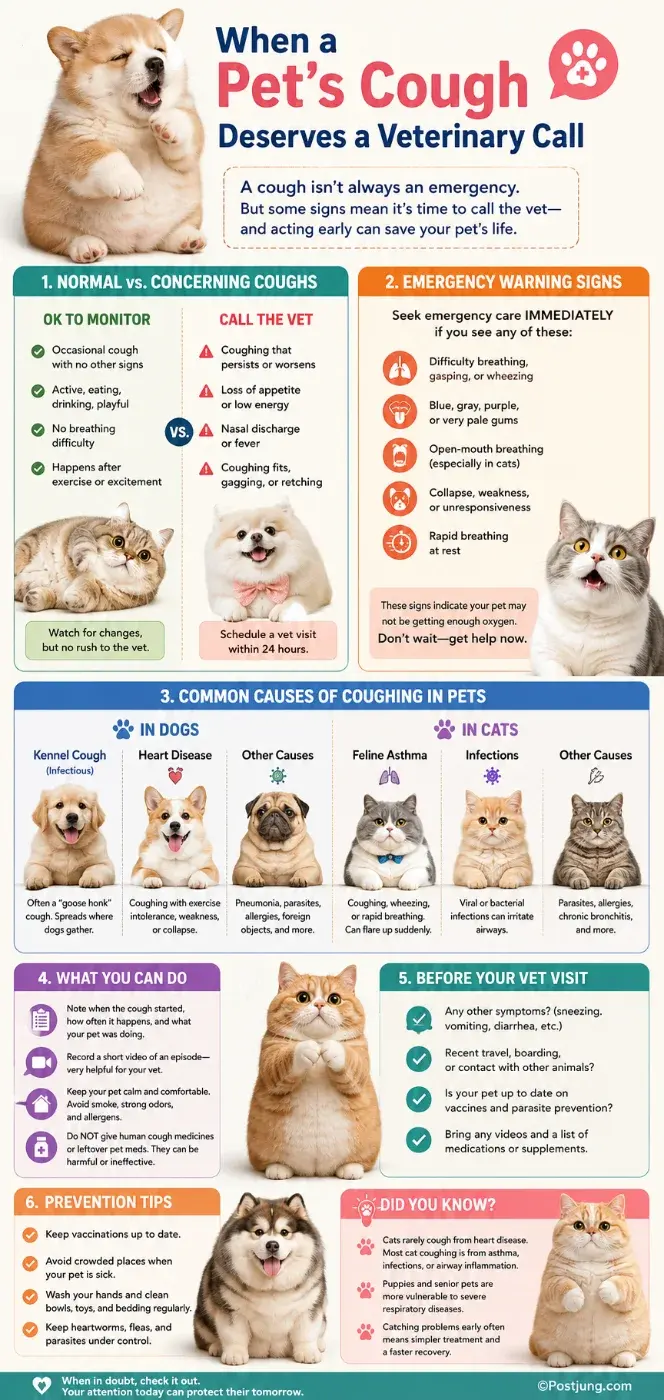
A cough has many possible causes
Coughing is a symptom, not a diagnosis, and its meaning differs considerably from one animal to another.
In dogs, one familiar cause is canine infectious tracheobronchitis, commonly called kennel cough. It often produces a harsh cough sometimes described as a "goose honk" and may be followed by gagging or retching. Exposure to other dogs at boarding facilities, daycare, veterinary hospitals, or kennels can increase the likelihood of transmission.
Many uncomplicated kennel-cough cases are relatively mild, but the picture changes if a dog develops fever, loss of appetite, marked lethargy, pus-like nasal discharge, or a productive cough. Merck notes that these more severe signs may indicate progression to bronchopneumonia. Puppies are particularly vulnerable to more serious disease.
A dog's cough can also accompany heart disease. Cornell lists coughing along with rapid or difficult breathing, weakness, lethargy, exercise intolerance, and collapse among signs associated with canine heart disease. That does not mean every coughing dog has a heart problem, but it explains why a persistent cough cannot reliably be diagnosed by sound alone.
Cats are different. Cornell notes that cats rarely cough because of heart disease. Coughing in a cat may instead lead a veterinarian to investigate conditions affecting the airways, including feline asthma.
Feline asthma can cause coughing or hacking, wheezing, rapid breathing, increased effort to breathe, and in more severe attacks, open-mouth breathing. Because infections, parasites, chronic bronchitis, and other diseases can create similar symptoms, Cornell emphasizes that there is no single test that automatically proves a cat has asthma; veterinary evaluation may involve the health history, imaging, and other diagnostic testing.
When should you make a veterinary appointment?
Persistent or repetitive coughing should move the situation from casual observation to a veterinary conversation.
Merck's guidance places continuous coughing in the category of signs that warrant veterinary attention within 24 hours. A sooner call is sensible if the cough is becoming more frequent or is accompanied by reduced appetite, unusual tiredness, nasal discharge, or another clear change from the pet's normal behavior.
Context can also be useful. Before speaking with the veterinarian, note when the coughing began, approximately how often it happens, whether it occurs during exercise, excitement, eating, drinking, or rest, and whether the pet recently spent time around other animals.
A short phone video of an episode may also help you accurately show what you are seeing and hearing, especially when the symptom does not occur during the examination.
Owners should avoid assuming that a familiar-sounding cough has a familiar cause. A harsh cough after boarding may suggest an infectious respiratory illness, for example, but other airway and cardiopulmonary conditions can produce overlapping signs.
For the same reason, do not start human cough medicine or leftover pet medication simply because coughing sounds uncomfortable. Treatment depends on the underlying problem. Merck notes, for example, that uncomplicated kennel cough often does not require antibiotics, while cough-suppressing drugs may be inappropriate when pneumonia is present.
The simplest rule: watch the breathing, not just the cough
A cough provides information, but breathing tells you much more about urgency.
If your pet coughs repeatedly but is breathing comfortably, contacting your regular veterinarian for guidance is a reasonable next step. If coughing comes with labored breathing, unusual gum color, collapse, or severe weakness, the situation belongs in emergency care.
That distinction can keep owners from panicking over every isolated cough while also reducing the risk of overlooking a respiratory problem that cannot safely wait.
SOURCES USED:
- American Animal Hospital Association — Help! Is This a Pet Emergency? Source page
- Merck Veterinary Manual — When to See a Veterinarian Source page
- Merck Veterinary Manual — Kennel Cough Source page
- Cornell University College of Veterinary Medicine — Feline Asthma: What You Need To Know Source page
- Cornell University College of Veterinary Medicine — Pets Get Heart Disease Too Source page

เขียนโดย Postjung Insights
 เจาะลึกรายได้พนักงานส่งอาหารแต่ละวันได้เท่าไร/หักค่าใช้จ่ายอะไรบ้าง
 อำเภอที่มีชื่ออำเภอสั้นที่สุด 3 อำเภอเท่านั้นในประเทศไทย
 เกษียณแล้วทำอะไรดี เปิด 4 กลุ่มอาชีพที่ผู้สูงวัยไทยทำกันน้อย จากข้อมูล 5.26 ล้านคน
 สุดระทึก! ไฟไหม้รางรถไฟฟ้า MRT สถานีเตาปูน-บางโพ..หยุดให้บริการชั่วคราวทุกสถานี
 รู้หรือไม่? เปิดรายได้พนักงานส่งพัสดุของแต่ละแอป วันหนึ่งได้เท่าไร
 เปิด 5 โรงเรียนหญิงล้วนเก่าแก่ของไทย ที่มีประวัติยาวนานกว่าศตวรรษ
 โรงเรียนที่มีนักเรียนมากที่สุดในไทย
 เลขเด็ดไพ่ยิปซี งวด 1 ตุลาคม 2569 รวมเลขเด่นและเลขท้าย 2 ตัว
 ความลับ 30 ล้านปีของ “แม่น้ำไนล์”: ทำไมสายน้ำสายนี้ถึงไม่เคยเหือดแห้งกลางทะเลทรายซาฮารา
 เปิดศึกเลขเด็ดงวดนี้! เจ้าพ่อปากแดง ปะทะ เจ้าแม่ตะเคียนทอง งวด 1 ต.ค. 59 คัดมาให้เน้นๆ พร้อมลุ้นรวย
 ตาราง “เด่นเหนือเด่นใต้” งวด 1 ต.ค. 69 เปิดข้อมูลตามโพย เลขไหนอยู่ตรงไหน
 ทำไมบ้านเลขที่ 23–24 Leinster Gardens จึงไม่มีห้องอยู่ด้านหลังสุดระทึก! ไฟไหม้รางรถไฟฟ้า MRT สถานีเตาปูน-บางโพ..หยุดให้บริการชั่วคราวทุกสถานีเจาะลึกรายได้พนักงานส่งอาหารแต่ละวันได้เท่าไร/หักค่าใช้จ่ายอะไรบ้างเปิด 5 โรงเรียนหญิงล้วนเก่าแก่ของไทย ที่มีประวัติยาวนานกว่าศตวรรษ
 เปิด 5 สินค้าส่งออกของลาวที่คนไทยอาจคาดไม่ถึง หนึ่งในนั้นทำเงินเกือบ 1 พันล้านดอลลาร์เกษียณแล้วทำอะไรดี เปิด 4 กลุ่มอาชีพที่ผู้สูงวัยไทยทำกันน้อย จากข้อมูล 5.26 ล้านคน
 โรงเรียนเพียงแห่งเดียวของประเทศไทย ที่อยู่มาตั้งแต่ยุครัชกาลที่ 4
 English Edition