Why separate feeding stations can reduce tension between pets
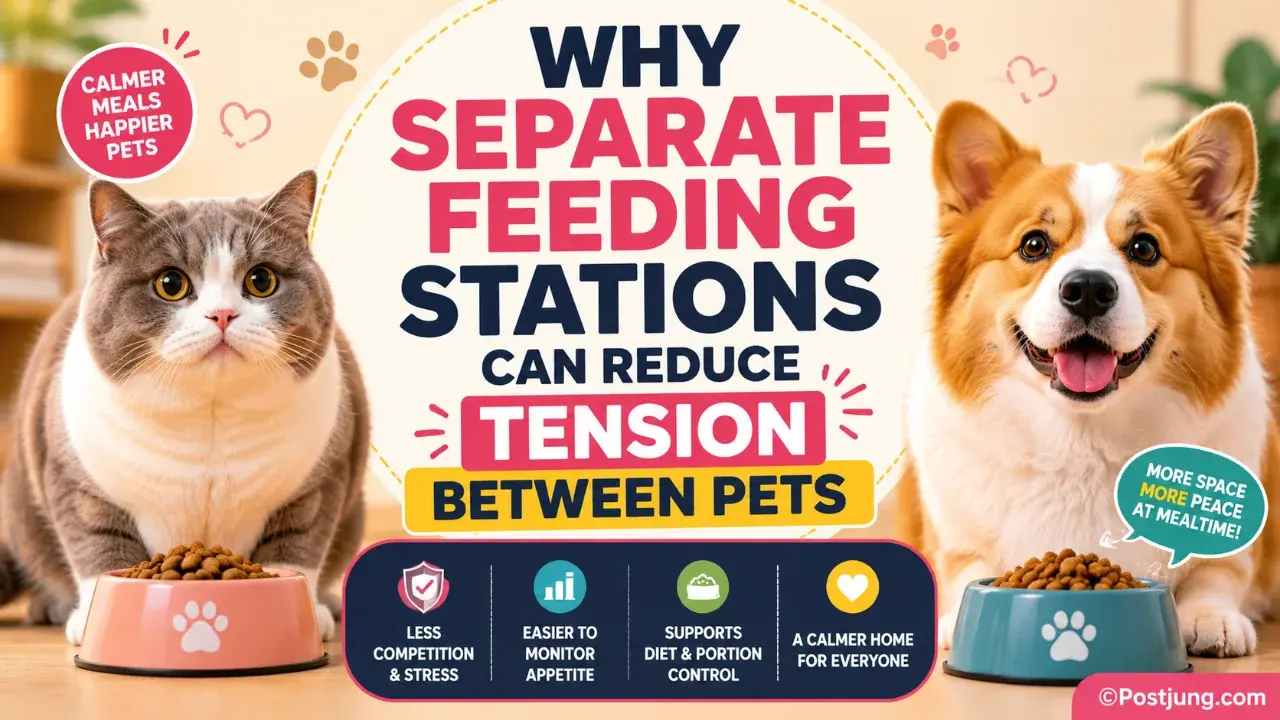
Sharing a home does not mean pets need to share a dining area. Giving each animal its own feeding space can reduce competition, make meals calmer, and help caregivers monitor individual eating habits more accurately.
A pair of pets can appear perfectly comfortable together until dinner arrives. Food is a valuable resource, and placing bowls too close together can create pressure that ranges from obvious growling to much quieter behaviors such as staring, blocking access, eating unusually fast, or simply waiting until another animal leaves.
Giving pets separate feeding stations can remove some of that pressure. The goal is not necessarily to isolate every animal at every meal, but to give each pet enough space to eat without feeling that another animal might approach, steal food, or control access to the bowl.
Tension around food does not always look like a fight
Resource guarding in dogs can include stiffening, freezing, growling, staring, snapping, or other defensive behavior around food. The American Society for the Prevention of Cruelty to Animals advises stopping behavior exercises and seeking qualified professional help if aggressive warning signs occur.
But competition can be subtler than aggression.
One pet may finish quickly and move toward another bowl. A smaller or less confident animal may back away. Another may eat faster whenever a housemate approaches. Over time, a feeding setup that appears peaceful to a person may still place one animal under repeated social pressure.
Veterinary guidance for homes with multiple pets therefore often focuses on managing access to food rather than waiting for a serious confrontation to develop.
Cats may benefit especially from having space to eat alone
Cats are an important example because their natural feeding behavior does not necessarily match the common household setup of several bowls arranged side by side.
The Feline Veterinary Medical Association's consensus guidance on feeding describes cats as naturally inclined to consume small meals in a solitary fashion. In multi-pet homes, feeding programs can be designed to let cats express that behavior rather than forcing them to eat in a group.
International Cat Care likewise recommends distributing resources in multi-cat homes rather than concentrating everything in one location. Its guidance on household conflict notes that food is a valuable resource and that bowls should be positioned so cats can eat without having to confront one another.
The ASPCA makes a similar recommendation for cats experiencing household aggression: providing multiple food bowls and other essential resources in different areas can reduce competition.
For some cats, simply moving bowls farther apart may be enough. Others may do better with visual separation, different rooms, elevated feeding locations, or feeding stations positioned so one cat cannot easily guard the route to another cat's food.
Dogs can need separation too
Dogs vary enormously in how comfortable they are around food.
Some will eat peacefully next to another dog for years. Others may become tense when another animal approaches a bowl, treat, chew, or other valued item. Resource guarding is a recognized behavior in dogs, and food is one of the resources that can trigger it.
Veterinary guidance from VCA recommends feeding a new puppy and an existing dog in separate areas as one way to help prevent conflict around meals. For dogs that already show aggression toward one another around food or treats, greater distance between them during feeding may be necessary.
Physical separation can also remove the temptation for a fast eater to finish first and immediately investigate someone else's bowl.
Separate bowls reveal information caregivers can otherwise miss
There is another advantage that has little to do with behavior.
When several animals eat from a shared bowl, it can be difficult to know who consumed what. Separate bowls make individual food intake much easier to observe.
VCA notes that when pets are fed individually, a reduction in one animal's appetite is easier to recognize. With shared feeding, a caregiver may see food disappearing without realizing that one pet is eating less than usual.
Individual stations are also useful when pets require different portion sizes or diets. A young animal, an older pet, and an animal receiving a veterinarian-prescribed diet may live happily together while having very different nutritional requirements.
What a calmer feeding setup can look like
There is no universal distance that works for every household.
Start by giving each pet its own bowl and enough room that another animal does not have to pass close by while it eats. In homes where pets still watch, rush, block, or approach one another, increase the distance or use separate rooms or a physical or visual barrier.
Watch the animals rather than the bowls. Relaxed eating, normal pacing, and the ability to walk away without being followed are more useful signs than simply measuring a fixed number of feet between feeding stations.
If one pet consistently steals food, prevents another from approaching, guards the feeding area, or shows stiffening, growling, snapping, or biting, the issue has moved beyond simple bowl placement. A veterinarian or qualified veterinary behavior professional can help assess the behavior and rule out medical factors that may be contributing to a sudden change.
Separate feeding stations are a small environmental adjustment, but they address an important principle: pets should be able to access essential resources without having to compete for them. In many multi-pet homes, giving each animal a little more space at dinner can make the entire meal easier to manage.
SOURCES USED:
- Feline Veterinary Medical Association — Feline Feeding Programs: Addressing Behavioral Needs to Improve Feline Health and Wellbeing
- ASPCA — Aggression Between Cats in Your Household
- International Cat Care — Multi-cat households
- VCA Animal Hospitals — Feeding Multiple Pets
- VCA Animal Hospitals — Preparing for a New Puppy
- American Veterinary Society of Animal Behavior — Preventing Food Guarding

เขียนโดย Postjung Insights
 เจาะลึกรายได้พนักงานส่งอาหารแต่ละวันได้เท่าไร/หักค่าใช้จ่ายอะไรบ้าง
 อำเภอที่มีชื่ออำเภอสั้นที่สุด 3 อำเภอเท่านั้นในประเทศไทย
 สุดระทึก! ไฟไหม้รางรถไฟฟ้า MRT สถานีเตาปูน-บางโพ..หยุดให้บริการชั่วคราวทุกสถานี
 โรงเรียนที่มีนักเรียนมากที่สุดในไทย
 รู้หรือไม่? เปิดรายได้พนักงานส่งพัสดุของแต่ละแอป วันหนึ่งได้เท่าไร
 เปิด 5 โรงเรียนหญิงล้วนเก่าแก่ของไทย ที่มีประวัติยาวนานกว่าศตวรรษ
 เลขเด็ดไพ่ยิปซี งวด 1 ตุลาคม 2569 รวมเลขเด่นและเลขท้าย 2 ตัว
 เกษียณแล้วทำอะไรดี เปิด 4 กลุ่มอาชีพที่ผู้สูงวัยไทยทำกันน้อย จากข้อมูล 5.26 ล้านคน
 ตาราง “เด่นเหนือเด่นใต้” งวด 1 ต.ค. 69 เปิดข้อมูลตามโพย เลขไหนอยู่ตรงไหน
 เปิดศึกเลขเด็ดงวดนี้! เจ้าพ่อปากแดง ปะทะ เจ้าแม่ตะเคียนทอง งวด 1 ต.ค. 59 คัดมาให้เน้นๆ พร้อมลุ้นรวย
 ความลับ 30 ล้านปีของ “แม่น้ำไนล์”: ทำไมสายน้ำสายนี้ถึงไม่เคยเหือดแห้งกลางทะเลทรายซาฮารา
 โรงเรียนเพียงแห่งเดียวของประเทศไทย ที่อยู่มาตั้งแต่ยุครัชกาลที่ 4สุดระทึก! ไฟไหม้รางรถไฟฟ้า MRT สถานีเตาปูน-บางโพ..หยุดให้บริการชั่วคราวทุกสถานีเจาะลึกรายได้พนักงานส่งอาหารแต่ละวันได้เท่าไร/หักค่าใช้จ่ายอะไรบ้างเปิด 5 โรงเรียนหญิงล้วนเก่าแก่ของไทย ที่มีประวัติยาวนานกว่าศตวรรษ
 เปิด 5 สินค้าส่งออกของลาวที่คนไทยอาจคาดไม่ถึง หนึ่งในนั้นทำเงินเกือบ 1 พันล้านดอลลาร์เกษียณแล้วทำอะไรดี เปิด 4 กลุ่มอาชีพที่ผู้สูงวัยไทยทำกันน้อย จากข้อมูล 5.26 ล้านคนโรงเรียนเพียงแห่งเดียวของประเทศไทย ที่อยู่มาตั้งแต่ยุครัชกาลที่ 4
 English Edition