Can rabbits learn to use a litter box? Yes—here’s how

Pet rabbits naturally prefer certain toilet areas, which makes litter training surprisingly achievable. The right box, safe litter, hay placement, patience, and realistic expectations can make a major difference.
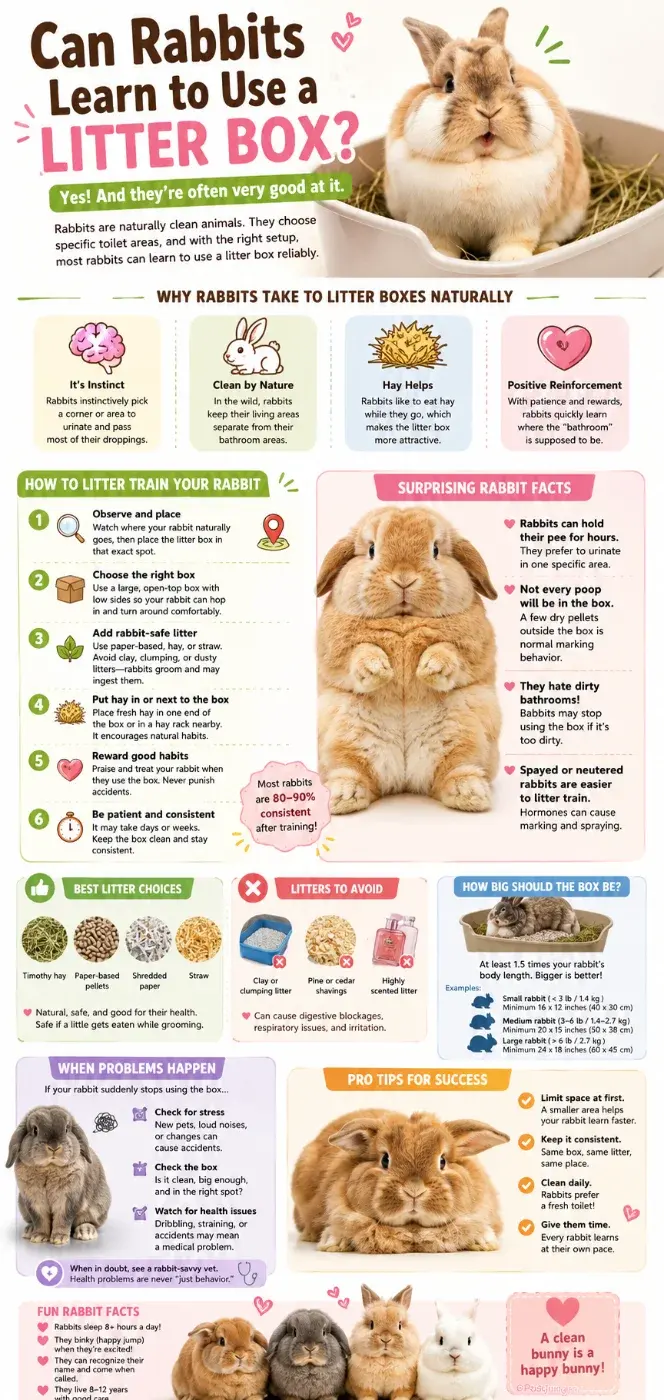
Yes, rabbits can learn to use a litter box—and many become remarkably consistent about it. Unlike a trick that depends entirely on repetition, litter training takes advantage of a behavior rabbits already have: they tend to choose particular places, often corners, for urination and much of their droppings.
That does not mean every rabbit will behave like a perfectly litter-trained cat. A rabbit may reliably urinate in its box while occasionally leaving a few hard, dry fecal pellets elsewhere. VCA Animal Hospitals notes that this can happen even in rabbits with otherwise reliable litter habits.
Start where your rabbit already wants to go
One of the simplest strategies is to observe which corner your rabbit naturally chooses as a toilet and place the litter box there.
The Rabbit.org Foundation says rabbits instinctively select specific locations for urine and most of their feces. The RSPCA similarly advises owners to train rabbits within their normal living area rather than trying to force them to use an arbitrary location elsewhere.
Adding a small amount of used litter or a few droppings to a fresh tray can help establish what the new box is for. The RSPCA recommends this approach and suggests providing, where practical, one tray per rabbit plus an additional tray in multi-rabbit households.
At first, giving a rabbit an enormous area to roam can make training more difficult. Rabbit.org notes that too much freedom too soon is one reason some rabbits struggle to establish consistent habits. Once the rabbit is reliably using its box, its accessible space can be expanded gradually.
The litter box needs to fit the rabbit
Tiny triangular “small animal” trays may look convenient, but they can be too cramped for comfortable use.
A rabbit should have enough room to enter easily, turn around and settle into the tray. Rabbit.org recommends roomy boxes and notes that larger rabbits or bonded pairs may need something considerably bigger than a typical small-animal toilet.
Accessibility also matters. Older rabbits or rabbits with mobility problems may do better with a low entrance that does not require a high hop.
Hay can make the box more attractive
One of the most useful differences between rabbit and cat litter training is the role of hay.
Rabbits commonly eat while they use their toilet area. Placing fresh hay at one end of the litter box, or positioning a hay rack beside it, can encourage the rabbit to spend time there and reinforce the desired routine.
The hay should stay fresh and available as part of the rabbit's normal diet rather than being treated simply as disposable bedding.
Choose litter carefully
Not every product sold as pet litter is suitable for rabbits.
VCA recommends materials such as hay, soft recycled-paper bedding or shredded paper and warns against clay litter because rabbits groom themselves and may ingest material from their feet or fur. Ingested clay can create a risk of intestinal blockage.
The RSPCA lists newspaper, hay or straw, shredded paper and paper-based non-clumping, non-expanding litter among suitable options. Rabbit.org also advises avoiding clumping litter and dusty clay products.
Highly aromatic softwood shavings are another material Rabbit.org advises against.
Spaying or neutering can affect litter habits
Hormones can make litter training more complicated, especially as young rabbits reach adolescence and begin territorial marking.
Rabbit.org says post-adolescent rabbits that have been spayed or neutered are generally easier to house train, while young rabbits may temporarily lose previously good habits as hormonal behavior develops. Older rabbits, meanwhile, can still learn successfully; youth is not a requirement for litter training.
Spaying or neutering should be discussed with a veterinarian experienced in rabbit care because the appropriate timing and individual health considerations can vary.
Reward success—don't punish accidents
Rabbit training works best with patience and positive reinforcement.
The RSPCA advises reward-based training and specifically warns against becoming angry with or punishing rabbits, because they may not understand the punishment and can instead become stressed or fearful.
If a rabbit chooses the box voluntarily, a small appropriate reward or gentle positive attention can help reinforce the habit.
And expectations matter. Rabbit.org cautions that rabbits may never keep every single fecal pellet inside the box. A few dry droppings around their territory can be part of normal marking behavior rather than evidence that training has completely failed.
When accidents suddenly start again
A rabbit that has never been perfectly consistent may simply need a better setup. A rabbit that was consistently trained and then abruptly stops is a different situation.
Environmental disruption, a new animal, unfamiliar people, relocation or other stressors can temporarily alter toileting behavior. Rabbit.org also notes that unexplained deterioration in litter habits can sometimes accompany a medical problem, especially when there is urinary dribbling or other unusual urination.
If an established litter-trained rabbit suddenly begins urinating outside its box repeatedly—particularly if there is straining, dribbling, reduced appetite, pain, lethargy or another physical change—contact a veterinarian experienced with rabbits rather than assuming it is simply bad behavior.
The larger lesson is that litter training succeeds because it works with a rabbit's instincts. Give the rabbit an accessible box in the place it already prefers, use rabbit-safe materials, make the area attractive with hay and build the habit gradually. Perfect housekeeping may be unrealistic, but a rabbit that reliably uses a designated toilet area is an entirely achievable goal for many households.
SOURCES USED:
- Rabbit.org Foundation — Rabbit Litter Training FAQ
https://rabbit.org/care/litter-training-faq/ - Rabbit.org Foundation — Natural Routines: Litterboxes
https://rabbit.org/care/litterboxes/ - VCA Animal Hospitals — Rabbits as Pets
https://vcahospitals.com/know-your-pet/rabbits-as-pets - RSPCA — Keeping rabbits in your home
https://www.rspca.org.uk/adviceandwelfare/pets/rabbits/indoors

เขียนโดย Postjung Insights
 สุดระทึก! ไฟไหม้รางรถไฟฟ้า MRT สถานีเตาปูน-บางโพ..หยุดให้บริการชั่วคราวทุกสถานี
 อำเภอที่มีชื่ออำเภอสั้นที่สุด 3 อำเภอเท่านั้นในประเทศไทย
 เจาะลึกรายได้พนักงานส่งอาหารแต่ละวันได้เท่าไร/หักค่าใช้จ่ายอะไรบ้าง
 เกษียณแล้วทำอะไรดี เปิด 4 กลุ่มอาชีพที่ผู้สูงวัยไทยทำกันน้อย จากข้อมูล 5.26 ล้านคน
 เลขเด็ดไพ่ยิปซี งวด 1 ตุลาคม 2569 รวมเลขเด่นและเลขท้าย 2 ตัว
 รู้หรือไม่? เปิดรายได้พนักงานส่งพัสดุของแต่ละแอป วันหนึ่งได้เท่าไร
 ตาราง “เด่นเหนือเด่นใต้” งวด 1 ต.ค. 69 เปิดข้อมูลตามโพย เลขไหนอยู่ตรงไหน
 เปิด 5 โรงเรียนหญิงล้วนเก่าแก่ของไทย ที่มีประวัติยาวนานกว่าศตวรรษ
 โรงเรียนเพียงแห่งเดียวของประเทศไทย ที่อยู่มาตั้งแต่ยุครัชกาลที่ 4
 เปิดศึกเลขเด็ดงวดนี้! เจ้าพ่อปากแดง ปะทะ เจ้าแม่ตะเคียนทอง งวด 1 ต.ค. 59 คัดมาให้เน้นๆ พร้อมลุ้นรวย
 โรงเรียนที่มีนักเรียนมากที่สุดในไทย
 แปลปกสลาก งวด 1 ต.ค. 69 ส่องตัวเลขจากภาพปกสลากกินแบ่งรัฐบาลสุดระทึก! ไฟไหม้รางรถไฟฟ้า MRT สถานีเตาปูน-บางโพ..หยุดให้บริการชั่วคราวทุกสถานีเจาะลึกรายได้พนักงานส่งอาหารแต่ละวันได้เท่าไร/หักค่าใช้จ่ายอะไรบ้างเปิด 5 โรงเรียนหญิงล้วนเก่าแก่ของไทย ที่มีประวัติยาวนานกว่าศตวรรษ
 เปิด 5 สินค้าส่งออกของลาวที่คนไทยอาจคาดไม่ถึง หนึ่งในนั้นทำเงินเกือบ 1 พันล้านดอลลาร์เกษียณแล้วทำอะไรดี เปิด 4 กลุ่มอาชีพที่ผู้สูงวัยไทยทำกันน้อย จากข้อมูล 5.26 ล้านคนโรงเรียนเพียงแห่งเดียวของประเทศไทย ที่อยู่มาตั้งแต่ยุครัชกาลที่ 4
 English Edition