Hairball or Vomiting? Why the Difference Matters for Cats
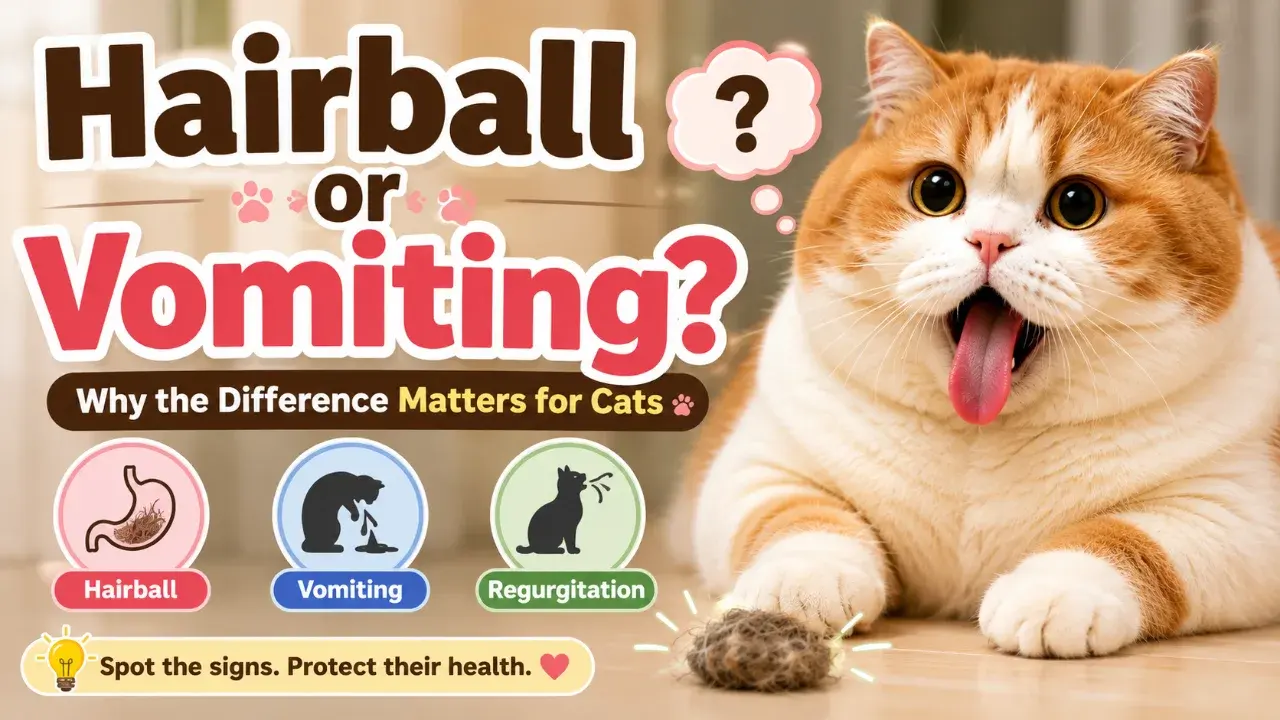
Cats often vomit hairballs, but repeated vomiting, empty retching, or episodes without obvious fur can signal something else. Watching what happens before, during, and after the episode can give your veterinarian valuable clues.
That familiar hacking sound does not always mean a cat is simply getting rid of a hairball. In fact, a hairball is usually expelled through vomiting, which means the more useful questions are what came up, how the episode happened, how often it occurs, and whether your cat seems normal afterward.
A one-off hairball in an otherwise bright, active cat may be relatively routine. Repeated vomiting, unsuccessful retching, appetite changes, weakness, diarrhea, weight loss, or other changes deserve more attention because vomiting can accompany many conditions that have nothing to do with fur.
What a hairball actually is
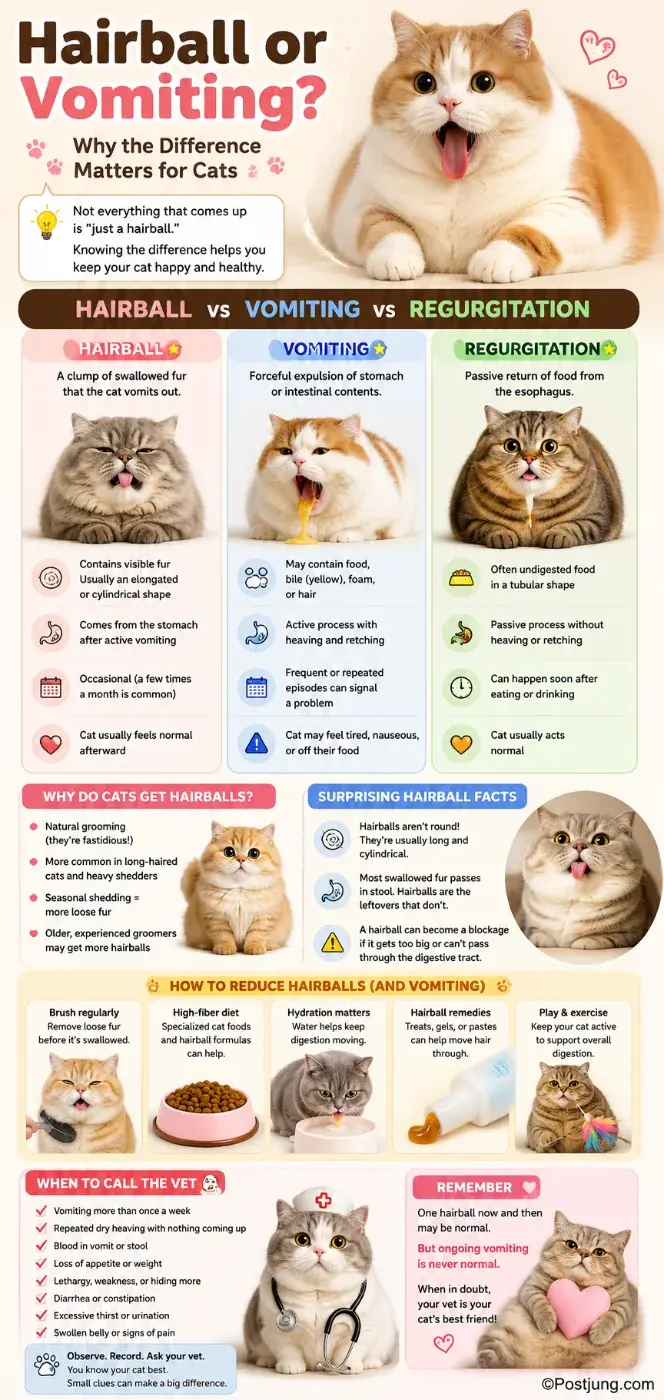
Cats swallow loose hair whenever they groom themselves. Hair cannot be digested, and although much of it normally moves through the gastrointestinal tract and leaves in the stool, some can remain in the stomach and collect into a mass known medically as a trichobezoar.
Despite the name, the object that comes up usually does not look like a round ball. Cornell University's Feline Health Center describes expelled hairballs as typically elongated or cylindrical because of the narrow passage they travel through on the way out.
A genuine hairball therefore usually contains an obvious concentration of fur, often mixed with digestive fluid or a small amount of food.
Long-haired cats may be more prone to hairballs, and regular brushing can reduce the amount of loose fur swallowed during grooming. Cornell also notes that older, more experienced groomers and cats shedding heavily may encounter hairballs more often.
Vomiting looks active for a reason
True vomiting is an active physical process.
The Merck Veterinary Manual defines feline vomiting as the forceful expulsion of material from the stomach or upper small intestine. A cat may salivate, swallow repeatedly, retch, and develop obvious contractions of the abdomen and diaphragm before material comes out.
What appears on the floor may be food, fluid, foam, bile, hair—or some combination of them.
That distinction matters because vomiting is a symptom rather than a disease by itself. Possible causes range from gastrointestinal inflammation and parasites to foreign objects, toxins, food-related problems, kidney or liver disease, pancreatitis, tumors, and other disorders.
A hairball is therefore one possible explanation for a vomiting episode, not an explanation for every episode of vomiting.
Regurgitation is different again
There is another behavior that owners may understandably describe as “throwing up”: regurgitation.
Unlike vomiting, regurgitation is generally passive. Merck notes that it does not involve the forceful abdominal contractions typical of vomiting. Material that comes back up may still be relatively undigested and can take on a tubular shape because it has been sitting in the esophagus.
That can make visual identification surprisingly tricky. A cylindrical object is not automatically a hairball; watching how it came out can be as useful as inspecting what is left behind.
If episodes are recurring, recording a short video for your veterinarian can be more informative than trying to describe the motion from memory.
When “just a hairball” deserves another look
Frequency is important, but there is no single universal cutoff that can diagnose illness at home.
Cornell advises prompt veterinary evaluation when vomiting occurs more frequently than once a week or is accompanied by signs such as lethargy, weakness, decreased appetite, blood in the vomit, changes in thirst or urination, or diarrhea.
The Feline Veterinary Medical Association also notes that cats repeatedly vomiting hairballs may have underlying nausea rather than a problem caused simply by swallowing fur.
Repeated attempts to bring up a hairball without producing one deserve particular attention. Cornell warns that persistent unproductive retching can be associated with another gastrointestinal problem or even a respiratory disorder such as asthma.
Hairballs themselves can occasionally become dangerous as well. A mass of hair that fails to move normally through the digestive tract can produce an obstruction, a potentially serious condition requiring veterinary treatment.
What to observe before calling your veterinarian
You do not need to diagnose the cause yourself. Instead, collect details that make the episode easier to interpret.
Notice whether your cat had obvious abdominal heaving, whether the material contained a dense wad of fur, whether recognizable undigested food came up, how soon the episode happened after eating, and whether your cat returned immediately to normal behavior.
Also keep track of frequency and changes in appetite, body weight, stool, thirst, activity, or grooming.
Those observations can help a veterinarian decide whether the pattern fits an occasional hairball or whether examination and testing are warranted. Cornell notes that investigation of frequent vomiting may involve the cat's history and physical examination followed, when necessary, by blood or fecal testing and diagnostic imaging such as X-rays or ultrasound.
Regular grooming can reduce loose hair intake, but repeated vomiting should not simply be managed indefinitely as a hairball problem. Merck specifically recommends veterinary evaluation for frequent hairballs or repeated vomiting because another disorder may be responsible.
The most useful takeaway is simple: finding fur tells you something, but the whole episode tells you more. How your cat behaves before and after vomiting, what comes up, and whether the pattern is changing can make the difference between an occasional messy inconvenience and an early clue that something needs medical attention.
SOURCES USED:
- Cornell University College of Veterinary Medicine — “Vomiting”
https://www.vet.cornell.edu/departments-centers-and-institutes/cornell-feline-health-center/health-information/feline-health-topics/vomiting - Cornell University College of Veterinary Medicine — “The Danger of Hairballs”
https://www.vet.cornell.edu/departments-centers-and-institutes/cornell-feline-health-center/health-information/feline-health-topics/danger-hairballs - Merck Veterinary Manual — “Vomiting in Cats”
https://www.merckvetmanual.com/cat-owners/digestive-disorders-of-cats/vomiting-in-cats - Feline Veterinary Medical Association — “Patient Support”
https://catvets.com/resource/chronic-pain-toolkit-patient-support/

เขียนโดย Postjung Insights
 เจาะลึกรายได้พนักงานส่งอาหารแต่ละวันได้เท่าไร/หักค่าใช้จ่ายอะไรบ้าง
 สุดระทึก! ไฟไหม้รางรถไฟฟ้า MRT สถานีเตาปูน-บางโพ..หยุดให้บริการชั่วคราวทุกสถานี
 เกษียณแล้วทำอะไรดี เปิด 4 กลุ่มอาชีพที่ผู้สูงวัยไทยทำกันน้อย จากข้อมูล 5.26 ล้านคน
 อำเภอที่มีชื่ออำเภอสั้นที่สุด 3 อำเภอเท่านั้นในประเทศไทย
 เลขเด็ดไพ่ยิปซี งวด 1 ตุลาคม 2569 รวมเลขเด่นและเลขท้าย 2 ตัว
 รู้หรือไม่? เปิดรายได้พนักงานส่งพัสดุของแต่ละแอป วันหนึ่งได้เท่าไร
 เปิด 5 โรงเรียนหญิงล้วนเก่าแก่ของไทย ที่มีประวัติยาวนานกว่าศตวรรษ
 ตาราง “เด่นเหนือเด่นใต้” งวด 1 ต.ค. 69 เปิดข้อมูลตามโพย เลขไหนอยู่ตรงไหน
 โรงเรียนที่มีนักเรียนมากที่สุดในไทย
 สถิติย้อนหลัง 10 ปี ออกเลขไหนบ้างมาดูกัน
 ส่องเลข 3 สำนักพิมพ์ งวด 1 ต.ค. 69 ตัวไหนมีข้อมูลตรงกัน
 เลขเด็ดงวด 1 ตุลาคม 2569: ตารางเลขชนจากหลายสำนัก เลขไหนซ้ำกันก่อนหวยออกสุดระทึก! ไฟไหม้รางรถไฟฟ้า MRT สถานีเตาปูน-บางโพ..หยุดให้บริการชั่วคราวทุกสถานีเจาะลึกรายได้พนักงานส่งอาหารแต่ละวันได้เท่าไร/หักค่าใช้จ่ายอะไรบ้างเปิด 5 โรงเรียนหญิงล้วนเก่าแก่ของไทย ที่มีประวัติยาวนานกว่าศตวรรษ
 เปิด 5 สินค้าส่งออกของลาวที่คนไทยอาจคาดไม่ถึง หนึ่งในนั้นทำเงินเกือบ 1 พันล้านดอลลาร์เกษียณแล้วทำอะไรดี เปิด 4 กลุ่มอาชีพที่ผู้สูงวัยไทยทำกันน้อย จากข้อมูล 5.26 ล้านคน
 โรงเรียนเพียงแห่งเดียวของประเทศไทย ที่อยู่มาตั้งแต่ยุครัชกาลที่ 4
 English Edition