How Pets May React When a Work-From-Home Owner Returns to the Office
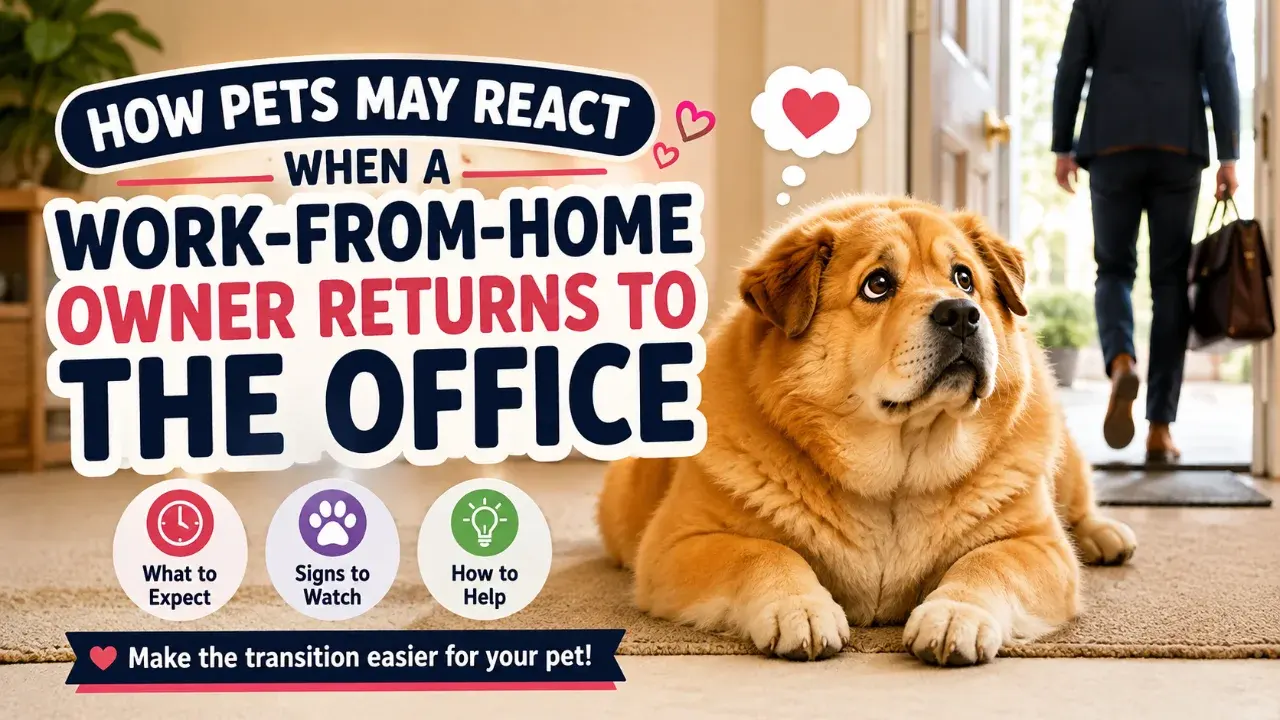
Dogs and cats can become accustomed to having their owners home throughout the day. A sudden return to long workday absences may change their behavior, but gradual preparation can make the new routine easier to handle.
For a pet that has spent months—or even years—with someone working a few feet away, a return to the office can change much more than the location of a laptop. Meals may happen at different times, walks move earlier or later, play sessions disappear from the middle of the day, and hours of human company can suddenly become hours alone.
That does not mean every dog or cat will develop separation anxiety. Some animals adjust with little difficulty. Others may become restless, vocal, destructive or unusually clingy, especially if they have had little practice being alone.
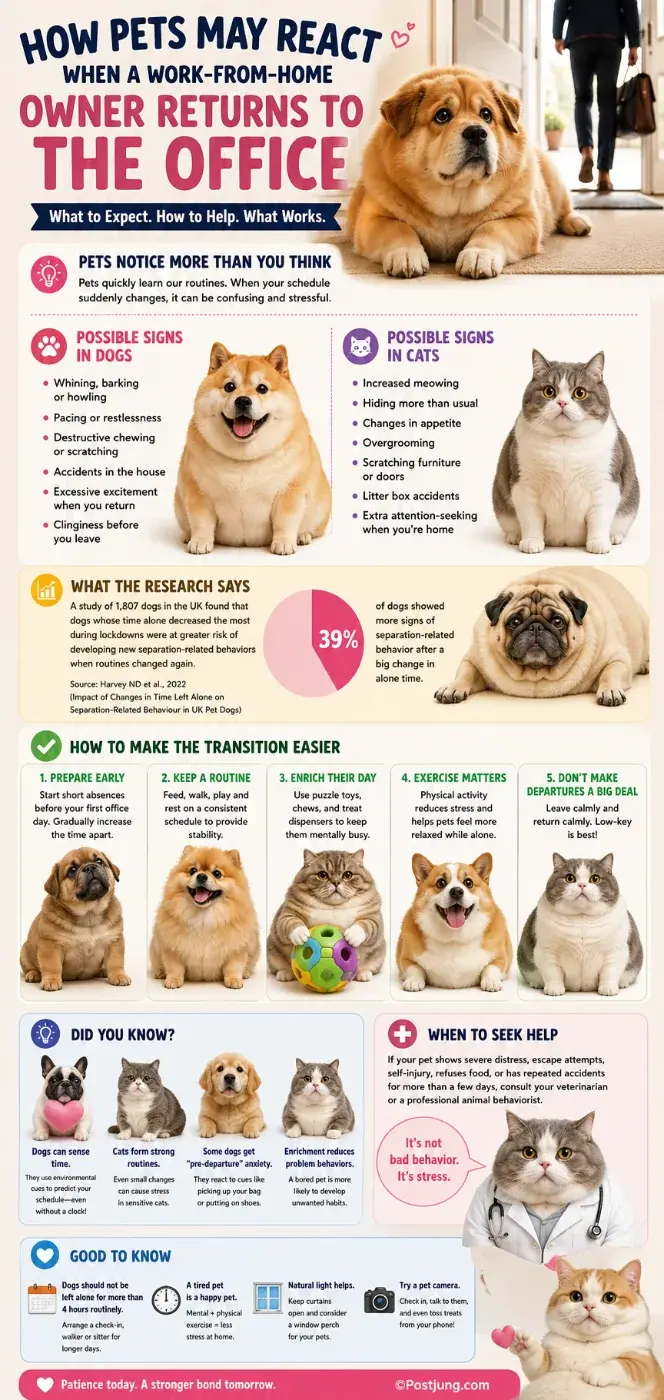
Research suggests that the size of the routine change can matter. In a study of 1,807 UK pet dogs conducted during the COVID-19 period, researchers found that dogs whose time alone had decreased the most during restrictions were at greater risk of developing new separation-related behaviors when circumstances changed again. The study did not show that returning to work inevitably causes behavioral problems, but it did identify changes in owner routines as a relevant risk factor.
What a dog may do when the house suddenly becomes quiet
Separation-related behavior can look dramatic: barking, howling, pacing, indoor toileting or damaging household items. But distress is not always obvious.
The RSPCA notes that some dogs may show quieter behaviors such as trembling, pacing or whining that owners never see because they happen only after the person has left. Recording a pet for part of an absence can therefore reveal behavior that would otherwise go unnoticed.
Dogs may also begin reacting before the owner actually leaves. Picking up keys, putting on work clothes or reaching for a bag can become signals that predict a long absence. The ASPCA describes dogs with separation-related distress that begin panting, pacing or whining during these pre-departure routines.
An enthusiastic greeting when someone returns home, however, is not by itself proof of an anxiety disorder. Dogs differ in temperament, attachment and previous experience, so behavior should be considered as a pattern rather than interpreted from a single reaction.
Cats can notice the change too
Cats are often portrayed as unaffected by human schedules, but that can be misleading.
Cats Protection notes that cats tend to rely heavily on familiar routines. A cat accustomed to having someone home may experience frustration or stress when that pattern suddenly changes, particularly if the animal has rarely been left alone for long periods in its current home.
Possible signs include increased meowing, restlessness, hiding, refusing food, scratching more than usual or eliminating outside the litter box. Some cats may simply become noticeably more attentive when their person comes home.
These behaviors should not automatically be labeled separation anxiety. A sudden behavioral change—including changes in eating or toileting—can also have a medical cause and warrants veterinary attention when it persists or is significant.
The easiest transition usually starts before the first office day
Going directly from constant companionship to an eight-hour absence can be a major adjustment. Animal-welfare organizations instead recommend practicing shorter periods apart and increasing them gradually according to the animal's response.
For a dog, that could begin with spending a short period in another room, progressing to stepping outside for a few moments, then slowly extending the absence. The important part is to increase the duration while the dog remains comfortable rather than pushing forward after signs of distress appear.
For cats, the same broad principle can apply. Cats Protection advises owners who know their work pattern will soon change to begin introducing short absences early and extend them at a pace the cat tolerates.
Keeping other parts of the day predictable can also help. Regular feeding, exercise, play and rest periods give an animal familiar reference points even when the owner's work location changes.
Give them something to do—not just something to wait for
An empty house does not have to be an empty experience.
Food puzzles, appropriate chew items and other safe enrichment can give dogs activities that are associated specifically with being alone. The ASPCA also recommends adequate physical and mental activity, while noting that severely anxious dogs may be too distressed to eat even highly valued food.
Cats can benefit from opportunities to climb, hide, observe their surroundings and play independently. Puzzle feeders, boxes and suitable toys can make the environment more engaging while the owner is away.
Owners should also think practically about the length of the workday. The RSPCA advises that dogs generally should not be routinely left alone for more than four hours, though individual needs differ. A family member, dog walker, sitter or other suitable arrangement may be necessary when the workday is longer.
Distress is not bad behavior
A chewed doorframe or accident on the floor can be frustrating, but punishment is unlikely to solve separation-related distress.
Both the ASPCA and RSPCA advise against punishing a dog for behavior that occurred while the owner was away. If anxiety is driving the behavior, punishment after the owner returns can add another source of stress rather than teaching the animal what to do differently.
Persistent panic, escape attempts, self-injury, prolonged vocalization, repeated house-soiling or major changes in appetite deserve professional attention. A veterinarian can first check for medical causes and, when appropriate, help owners find a qualified veterinary or clinical animal behavior professional.
The useful question is not whether pets "like" remote work or office work. It is whether they have been given enough time and experience to understand their new routine. For many animals, the gentlest return to the office begins before the commute does.
SOURCES USED:
- Harvey ND et al. — “Impact of Changes in Time Left Alone on Separation-Related Behaviour in UK Pet Dogs”
https://pubmed.ncbi.nlm.nih.gov/35203190/ - ASPCA — “Separation Anxiety”
https://www.aspca.org/pet-care/dog-care/common-dog-behavior-issues/separation-anxiety - RSPCA — “Training your dog to be left alone”
https://www.rspca.org.uk/adviceandwelfare/pets/dogs/training/leftalone - Cats Protection — “Cats and separation anxiety”
https://www.cats.org.uk/cats-blog/does-my-cat-have-separation-anxiety

เขียนโดย Postjung Insights
 รู้หรือไม่? เปิดรายได้พนักงานส่งพัสดุของแต่ละแอป วันหนึ่งได้เท่าไร
 เจาะลึกรายได้พนักงานส่งอาหารแต่ละวันได้เท่าไร/หักค่าใช้จ่ายอะไรบ้าง
 แปลปกสลาก งวด 1 ต.ค. 69 ส่องตัวเลขจากภาพปกสลากกินแบ่งรัฐบาล
 สุดระทึก! ไฟไหม้รางรถไฟฟ้า MRT สถานีเตาปูน-บางโพ..หยุดให้บริการชั่วคราวทุกสถานี
 เลขเด็ดไพ่ยิปซี งวด 1 ตุลาคม 2569 รวมเลขเด่นและเลขท้าย 2 ตัว
 สถิติย้อนหลัง 10 ปี ออกเลขไหนบ้างมาดูกัน
 เกษียณแล้วทำอะไรดี เปิด 4 กลุ่มอาชีพที่ผู้สูงวัยไทยทำกันน้อย จากข้อมูล 5.26 ล้านคน
 เปิด 5 โรงเรียนหญิงล้วนเก่าแก่ของไทย ที่มีประวัติยาวนานกว่าศตวรรษ
 อำเภอที่มีชื่ออำเภอสั้นที่สุด 3 อำเภอเท่านั้นในประเทศไทย
 ความลับ 30 ล้านปีของ “แม่น้ำไนล์”: ทำไมสายน้ำสายนี้ถึงไม่เคยเหือดแห้งกลางทะเลทรายซาฮารา
 ตาราง “เด่นเหนือเด่นใต้” งวด 1 ต.ค. 69 เปิดข้อมูลตามโพย เลขไหนอยู่ตรงไหน
 โรงเรียนที่มีนักเรียนมากที่สุดในไทยสุดระทึก! ไฟไหม้รางรถไฟฟ้า MRT สถานีเตาปูน-บางโพ..หยุดให้บริการชั่วคราวทุกสถานีเจาะลึกรายได้พนักงานส่งอาหารแต่ละวันได้เท่าไร/หักค่าใช้จ่ายอะไรบ้างเปิด 5 โรงเรียนหญิงล้วนเก่าแก่ของไทย ที่มีประวัติยาวนานกว่าศตวรรษ
 เปิด 5 สินค้าส่งออกของลาวที่คนไทยอาจคาดไม่ถึง หนึ่งในนั้นทำเงินเกือบ 1 พันล้านดอลลาร์เกษียณแล้วทำอะไรดี เปิด 4 กลุ่มอาชีพที่ผู้สูงวัยไทยทำกันน้อย จากข้อมูล 5.26 ล้านคน
 โรงเรียนเพียงแห่งเดียวของประเทศไทย ที่อยู่มาตั้งแต่ยุครัชกาลที่ 4
 English Edition