How an Emergency U-Turn Can Make Difficult Dog Walks Easier
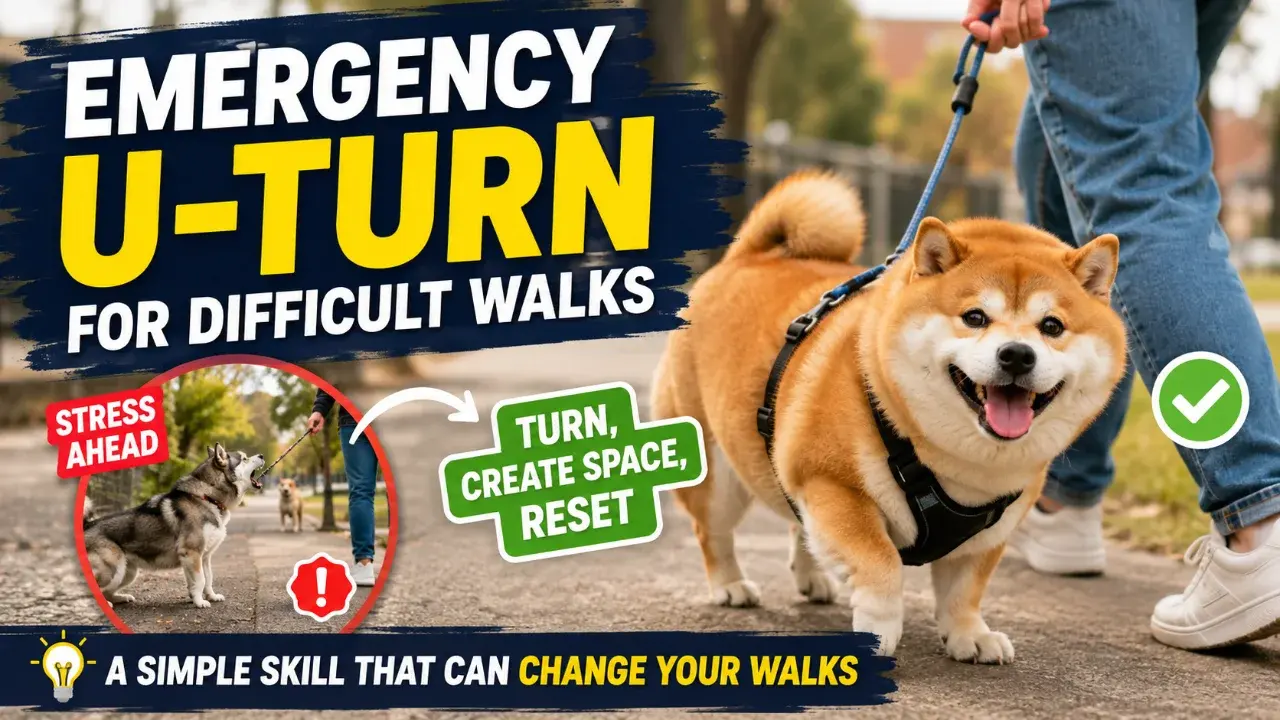
An emergency U-turn gives you a practiced way to change direction when another dog, person, vehicle, or other trigger suddenly appears. The goal is not to force a dog through a stressful encounter, but to create enough distance for both dog and handler to regain control.
A dog walk can change in seconds. Another dog appears around a corner, a skateboard approaches from behind, or a narrow sidewalk suddenly leaves little room to pass.
For dogs that are fearful, easily overwhelmed, or reactive on leash, one useful response is surprisingly simple: turn around and leave.
Often called an emergency U-turn, the skill teaches a dog to quickly change direction with their handler after a familiar cue. Fear Free Happy Homes specifically recommends practicing an emergency U-turn before an emergency occurs, with one example using the cue “Let’s go.”
The important part is not the wording. It is creating a predictable behavior that means: come with me; we’re moving this way now.
The U-turn creates something valuable: distance
When a dog reacts strongly to another dog or another trigger, the problem is not always a lack of obedience. Fear, anxiety, frustration, excitement, or several of those factors at once may be involved.
Distance can dramatically change the situation.
Veterinary behavior guidance from VCA Animal Hospitals recommends identifying the distance at which a dog can notice a trigger while remaining calm enough to respond and learn. During desensitization work, dogs are deliberately kept below the point where fear or stress becomes overwhelming.
That makes the U-turn useful as a management tool. If you see trouble developing before your dog becomes highly aroused, changing direction may give you the extra space needed to avoid barking, lunging, freezing, or a confrontation.
VCA similarly advises people whose dogs lunge at unfamiliar dogs to manage encounters by changing their route, adjusting walking times, avoiding close greetings, or guiding their dog away from the path when necessary.
Practice when nothing exciting is happening
Trying to introduce a new cue while your dog is already barking at another dog is asking a lot.
Start somewhere quiet instead.
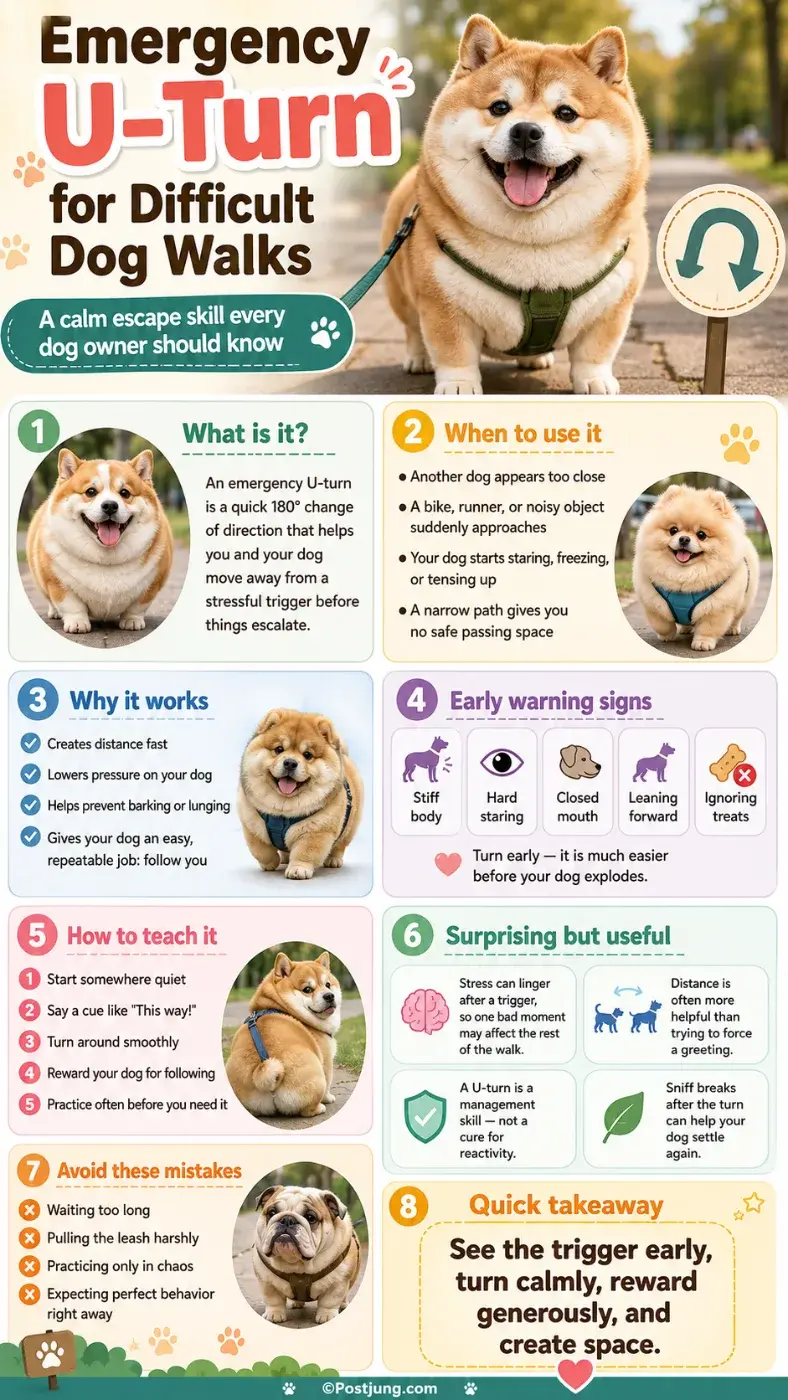
Choose a short cue that you can say naturally—“Let’s go,” “This way,” or another phrase you will remember. Say it cheerfully, turn approximately 180 degrees, encourage your dog to follow, and reward them once they move with you.
Repeat the exercise during easy walks and in low-distraction places. The movement should begin to feel familiar rather than alarming.
This follows the same general progression recommended for other walking and behavior skills: first teach the behavior away from stressful triggers, then gradually practice around manageable distractions. VCA notes that substitute behaviors work best when they have already been learned through positive reinforcement before they are needed in a difficult situation.
A high-value food reward can be especially useful during early practice. The objective is for the dog to learn that immediately following the handler is worthwhile.
Use it early, not after the explosion
Timing matters.
Imagine that your dog becomes uncomfortable around unfamiliar dogs. You notice one approaching half a block away. Your dog sees it but can still look back at you, eat a treat, and move normally.
That may be an excellent moment to U-turn.
Waiting until the dogs are a few feet apart—after your dog is staring, pulling, barking, or lunging—makes the exercise much more difficult.
VCA describes this distinction in terms of a dog’s behavioral “threshold.” Signs that a dog is becoming uncomfortable can include changes in ear position, staring, attempts to move away, snarling, or other shifts in body language. Training is generally easier when the trigger remains far enough away for the dog to stay responsive.
The U-turn therefore works best as an early exit rather than a last-second wrestling match.
It is not the same as avoiding everything forever
Turning away from a trigger can sometimes look like giving up on training. In reality, management and behavior modification can serve different purposes.
Management prevents situations that a dog currently cannot handle. Behavior modification can gradually change how the dog responds over time.
Desensitization, for example, involves exposing an animal to a trigger at an intensity low enough to avoid a fear response. Counterconditioning pairs that controlled exposure with something the animal enjoys, such as food. The intensity is increased gradually only while the animal remains comfortable.
An emergency U-turn can support that process by helping the handler retreat when an unexpected situation becomes too intense.
It does not, by itself, treat the underlying reason a dog reacts.
Equipment should help, not add another struggle
Secure walking equipment matters when a dog may suddenly pull or lunge. VCA recommends a properly fitted collar or other secure restraint and a sturdy leash for dogs displaying aggression toward unfamiliar dogs.
Some dogs may also be managed with a head halter under professional guidance. A head halter can make it easier to redirect a powerful dog, but it must be introduced gradually and should never be used with leash jerks or sudden snapping movements because of the risk of injury.
Equipment is a safety aid, not a substitute for teaching the dog what to do.
When a difficult walk needs more than a U-turn
Occasional barking or nervousness is different from repeated aggressive behavior or a serious bite risk.
If a dog regularly lunges, attempts to bite, cannot recover after seeing triggers, or suddenly develops behavior that was not present before, professional evaluation is appropriate. Pain or another medical problem can sometimes contribute to aggressive behavior, which is one reason VCA recommends veterinary assessment before beginning a treatment program for significant aggression.
A qualified reward-based trainer, veterinary behaviorist, or other appropriately credentialed behavior professional can also help identify the dog’s triggers and develop a structured plan.
For everyday management, though, the emergency U-turn has an appealing advantage: it is simple enough to practice on ordinary walks.
You are teaching your dog that turning away is an available option.
On a difficult walk, that small piece of communication can create something both dog and handler may desperately need: a little more space.
SOURCES USED:

เขียนโดย Postjung Insights
 รู้หรือไม่? เปิดรายได้พนักงานส่งพัสดุของแต่ละแอป วันหนึ่งได้เท่าไร
 เจาะลึกรายได้พนักงานส่งอาหารแต่ละวันได้เท่าไร/หักค่าใช้จ่ายอะไรบ้าง
 เลขเด็ดไพ่ยิปซี งวด 1 ตุลาคม 2569 รวมเลขเด่นและเลขท้าย 2 ตัว
 เปิดศึกเลขเด็ดงวดนี้! เจ้าพ่อปากแดง ปะทะ เจ้าแม่ตะเคียนทอง งวด 1 ต.ค. 59 คัดมาให้เน้นๆ พร้อมลุ้นรวย
 ตาราง “เด่นเหนือเด่นใต้” งวด 1 ต.ค. 69 เปิดข้อมูลตามโพย เลขไหนอยู่ตรงไหน
 อำเภอที่มีชื่ออำเภอสั้นที่สุด 3 อำเภอเท่านั้นในประเทศไทย
 สุดระทึก! ไฟไหม้รางรถไฟฟ้า MRT สถานีเตาปูน-บางโพ..หยุดให้บริการชั่วคราวทุกสถานี
 โรงเรียนที่มีนักเรียนมากที่สุดในไทย
 แปลปกสลาก งวด 1 ต.ค. 69 ส่องตัวเลขจากภาพปกสลากกินแบ่งรัฐบาล
 เกษียณแล้วทำอะไรดี เปิด 4 กลุ่มอาชีพที่ผู้สูงวัยไทยทำกันน้อย จากข้อมูล 5.26 ล้านคน
 สถิติย้อนหลัง 10 ปี ออกเลขไหนบ้างมาดูกัน
 โรงเรียนเพียงแห่งเดียวของประเทศไทย ที่อยู่มาตั้งแต่ยุครัชกาลที่ 4สุดระทึก! ไฟไหม้รางรถไฟฟ้า MRT สถานีเตาปูน-บางโพ..หยุดให้บริการชั่วคราวทุกสถานีเจาะลึกรายได้พนักงานส่งอาหารแต่ละวันได้เท่าไร/หักค่าใช้จ่ายอะไรบ้าง
 เปิด 5 โรงเรียนหญิงล้วนเก่าแก่ของไทย ที่มีประวัติยาวนานกว่าศตวรรษ
 เปิด 5 สินค้าส่งออกของลาวที่คนไทยอาจคาดไม่ถึง หนึ่งในนั้นทำเงินเกือบ 1 พันล้านดอลลาร์เกษียณแล้วทำอะไรดี เปิด 4 กลุ่มอาชีพที่ผู้สูงวัยไทยทำกันน้อย จากข้อมูล 5.26 ล้านคนโรงเรียนเพียงแห่งเดียวของประเทศไทย ที่อยู่มาตั้งแต่ยุครัชกาลที่ 4
 English Edition