How to Set Up Resources in a Multi-Cat Home
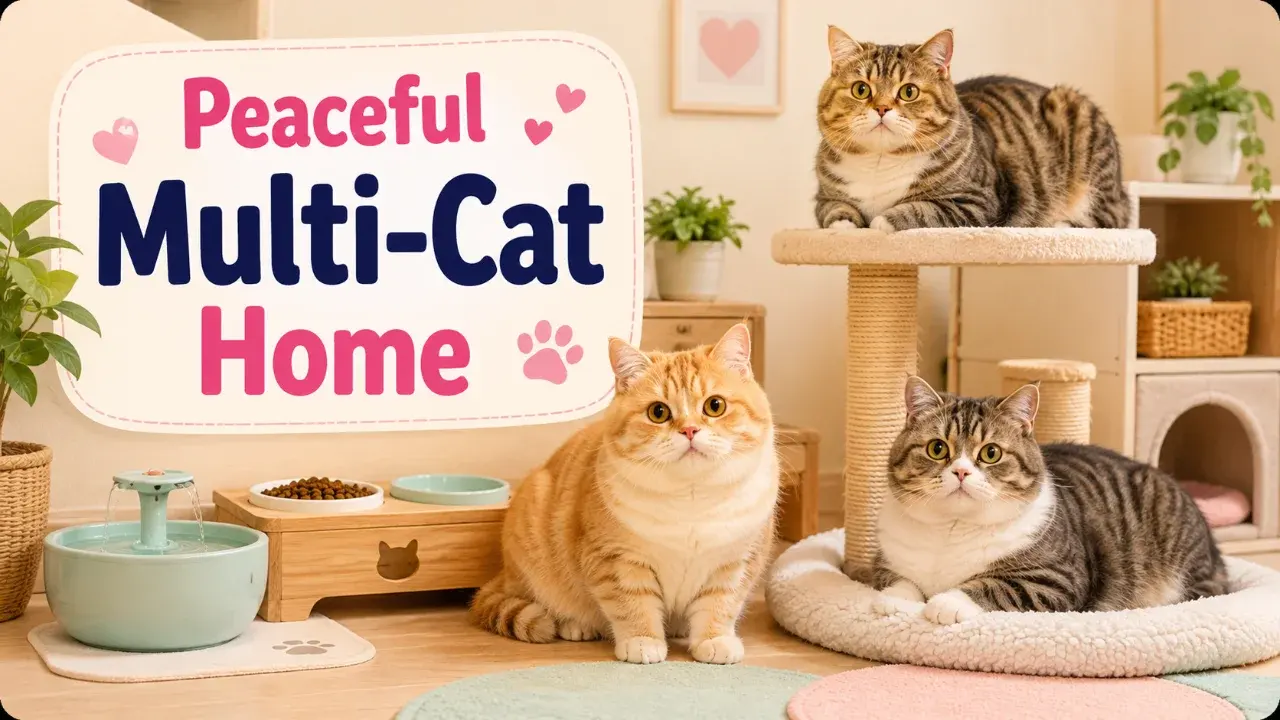
A peaceful multi-cat home needs more than enough bowls and litter boxes. Giving each cat multiple, separated routes to food, water, toilets, rest, scratching, hiding, and play can reduce competition before it turns into obvious conflict.
Living with several cats does not automatically mean they will happily share everything. Even cats that sleep together or groom one another may want distance at certain times, and veterinary behavior guidance emphasizes providing multiple, separated key resources so one cat cannot easily control another cat’s access.
The practical goal is not to give every cat an identical private apartment. It is to design the home so that eating, drinking, toileting, sleeping, scratching, hiding, climbing, and playing do not all depend on access to the same few locations.
Think in resource stations, not one “cat corner”
Putting every bowl, bed, toy, and scratching post together may look organized to a person, but it concentrates things cats value into a single zone.
Feline Veterinary Medical Association guidance recommends multiple and separated resources, including food, water, toileting areas, scratching surfaces, resting spaces, and opportunities for play. Its 2024 intercat-tension guidelines specifically address households with two or more cats and emphasize environmental management as part of preventing and reducing tension.
A more cat-friendly layout spreads resources through the home. Two food bowls sitting inches apart, for example, are technically two bowls but may still function like one feeding location if a confident cat can intimidate another simply by occupying the area.
When possible, give cats separate feeding spots with some visual distance between them. The same principle can be applied to water bowls, beds, perches, scratching posts, and hiding places. Current FelineVMA caregiver guidance says each cat should have its own basic resources and recommends visually separating those resources from those used by other cats.
Litter boxes need both numbers and good locations
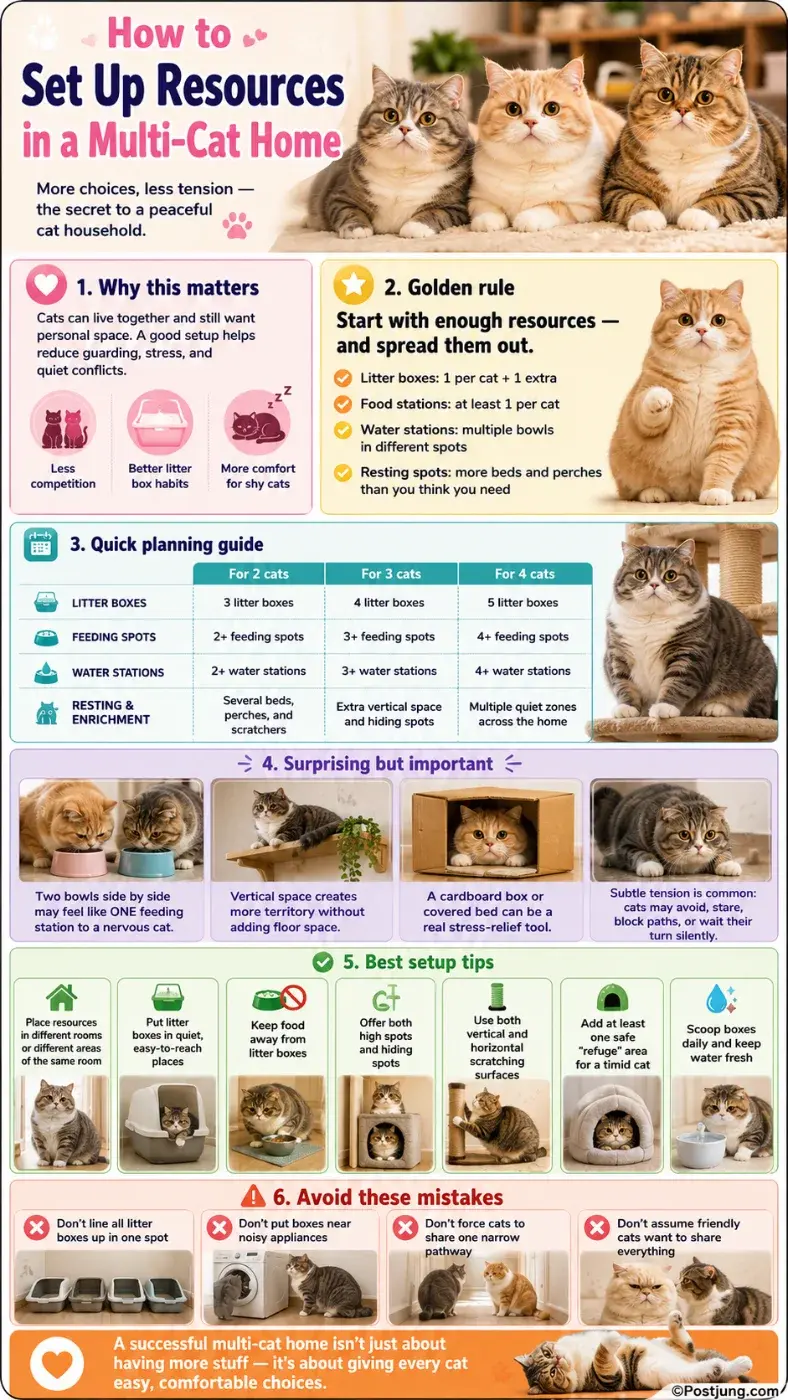
The commonly recommended starting point is one litter box for every cat, plus one additional box. That means three cats would begin with four boxes. The Ohio State University Indoor Pet Initiative also recommends distributing boxes appropriately rather than treating quantity alone as the solution.
Location matters because cats are vulnerable while eliminating. Boxes should be easy to reach and placed where a cat is unlikely to be startled or cornered by another animal. In a multi-level home, distributing boxes across floors can be particularly useful.
Cleanliness matters too. Ohio State recommends scooping litter boxes daily and notes that many cats prefer large, uncovered boxes and fine-grained, unscented litter. Individual preferences vary, so sudden wholesale changes to a litter setup that already works may backfire.
A row of several boxes side by side may also provide less separation than boxes located in different parts of the home. The broader objective is to give a cat another realistic option if access to one area feels uncomfortable.
Add territory upward
Floor space is only part of a cat’s usable environment.
Cat trees, stable shelves, window perches, furniture, and other elevated resting spots effectively create additional territory. Safe elevated areas can allow one cat to remain in a room without having to pass directly beside another.
Hiding places serve a related purpose. A cardboard box, covered bed, carrier left open in a quiet location, or secluded resting spot can give a cat somewhere to withdraw when social contact becomes too much.
Ohio State describes a feline “refuge” as a quieter part of the home containing necessities such as food, water, a litter box, scratching area, perch, and toys. Crucially, a cat using that refuge should be able to rest without being disturbed by people or other pets.
Do not forget scratching resources
Scratching is normal feline behavior used for stretching, claw maintenance, and scent marking. In multi-cat households, several scratching surfaces placed around the home can give cats more appropriate places to perform that behavior.
Placement is more useful than simply buying more scratching posts. Ohio State recommends considering locations near resting areas, room entrances, gathering areas, and routes cats use to reach resources. Some cats prefer vertical posts, while others use horizontal scratching surfaces, so offering different orientations can help accommodate individual preferences.
Watch the cats, not just the floor plan
A setup that looks generous on paper can still fail if one cat controls important routes.
Intercat tension is not always a dramatic fight. The FelineVMA warns that conflict between household cats can be subtle and may go unrecognized. Environmental resources are therefore part of both prevention and management, rather than something to consider only after fighting starts.
Pay attention to whether every cat actually uses the available resources comfortably. A cat that routinely avoids a feeding station, waits for another cat to leave before approaching a litter box, abandons favorite resting areas, or changes its normal routine deserves closer attention.
Persistent changes in eating, drinking, toileting, grooming, activity, or social behavior can also have medical causes. A veterinarian should evaluate new or ongoing behavioral changes rather than assuming another cat is always responsible.
The most successful multi-cat homes therefore are not necessarily the biggest. They are homes with choices: several places to eat, drink, eliminate, scratch, climb, hide, rest, and play — connected by routes that let cats move without repeatedly confronting one another.
That simple shift from “enough stuff” to enough accessible choices can make a shared home considerably easier for cats to navigate.
SOURCES USED:
- Feline Veterinary Medical Association — 2024 AAFP Intercat Tension Guidelines: Recognition, Prevention, and Management
https://catvets.com/resource/2024-intercat-tension-guidelines/ - Feline Veterinary Medical Association — Client Education: Welcome Your New Cat or Kitten and Be a Cat Friendly Caregiver
https://catvets.com/resource/client-education-2/ - The Ohio State University Indoor Pet Initiative — Litter Boxes
https://indoorpet.osu.edu/cats/basic-indoor-cat-needs/litter-boxes - The Ohio State University Indoor Pet Initiative — Scratching
https://indoorpet.osu.edu/node/449 - The Ohio State University Indoor Pet Initiative — Refuge
https://indoorpet.osu.edu/cats/basic-indoor-cat-needs/refuge

เขียนโดย Postjung Insights
 รู้หรือไม่? เปิดรายได้พนักงานส่งพัสดุของแต่ละแอป วันหนึ่งได้เท่าไร
 สุดระทึก! ไฟไหม้รางรถไฟฟ้า MRT สถานีเตาปูน-บางโพ..หยุดให้บริการชั่วคราวทุกสถานี
 อำเภอที่มีชื่ออำเภอสั้นที่สุด 3 อำเภอเท่านั้นในประเทศไทย
 เกษียณแล้วทำอะไรดี เปิด 4 กลุ่มอาชีพที่ผู้สูงวัยไทยทำกันน้อย จากข้อมูล 5.26 ล้านคน
 เจาะลึกรายได้พนักงานส่งอาหารแต่ละวันได้เท่าไร/หักค่าใช้จ่ายอะไรบ้าง
 เลขเด็ดไพ่ยิปซี งวด 1 ตุลาคม 2569 รวมเลขเด่นและเลขท้าย 2 ตัว
 โรงเรียนที่มีนักเรียนมากที่สุดในไทย
 แปลปกสลาก งวด 1 ต.ค. 69 ส่องตัวเลขจากภาพปกสลากกินแบ่งรัฐบาล
 เปิดศึกเลขเด็ดงวดนี้! เจ้าพ่อปากแดง ปะทะ เจ้าแม่ตะเคียนทอง งวด 1 ต.ค. 59 คัดมาให้เน้นๆ พร้อมลุ้นรวย
 เปิด 5 โรงเรียนหญิงล้วนเก่าแก่ของไทย ที่มีประวัติยาวนานกว่าศตวรรษ
 เลขเด็ดงวด 1 ตุลาคม 2569: ตารางเลขชนจากหลายสำนัก เลขไหนซ้ำกันก่อนหวยออก
 ตาราง “เด่นเหนือเด่นใต้” งวด 1 ต.ค. 69 เปิดข้อมูลตามโพย เลขไหนอยู่ตรงไหนสุดระทึก! ไฟไหม้รางรถไฟฟ้า MRT สถานีเตาปูน-บางโพ..หยุดให้บริการชั่วคราวทุกสถานีเจาะลึกรายได้พนักงานส่งอาหารแต่ละวันได้เท่าไร/หักค่าใช้จ่ายอะไรบ้างเปิด 5 โรงเรียนหญิงล้วนเก่าแก่ของไทย ที่มีประวัติยาวนานกว่าศตวรรษ
 เปิด 5 สินค้าส่งออกของลาวที่คนไทยอาจคาดไม่ถึง หนึ่งในนั้นทำเงินเกือบ 1 พันล้านดอลลาร์เกษียณแล้วทำอะไรดี เปิด 4 กลุ่มอาชีพที่ผู้สูงวัยไทยทำกันน้อย จากข้อมูล 5.26 ล้านคน
 โรงเรียนเพียงแห่งเดียวของประเทศไทย ที่อยู่มาตั้งแต่ยุครัชกาลที่ 4
 English Edition