Why a pet’s shelter personality may change after adoption

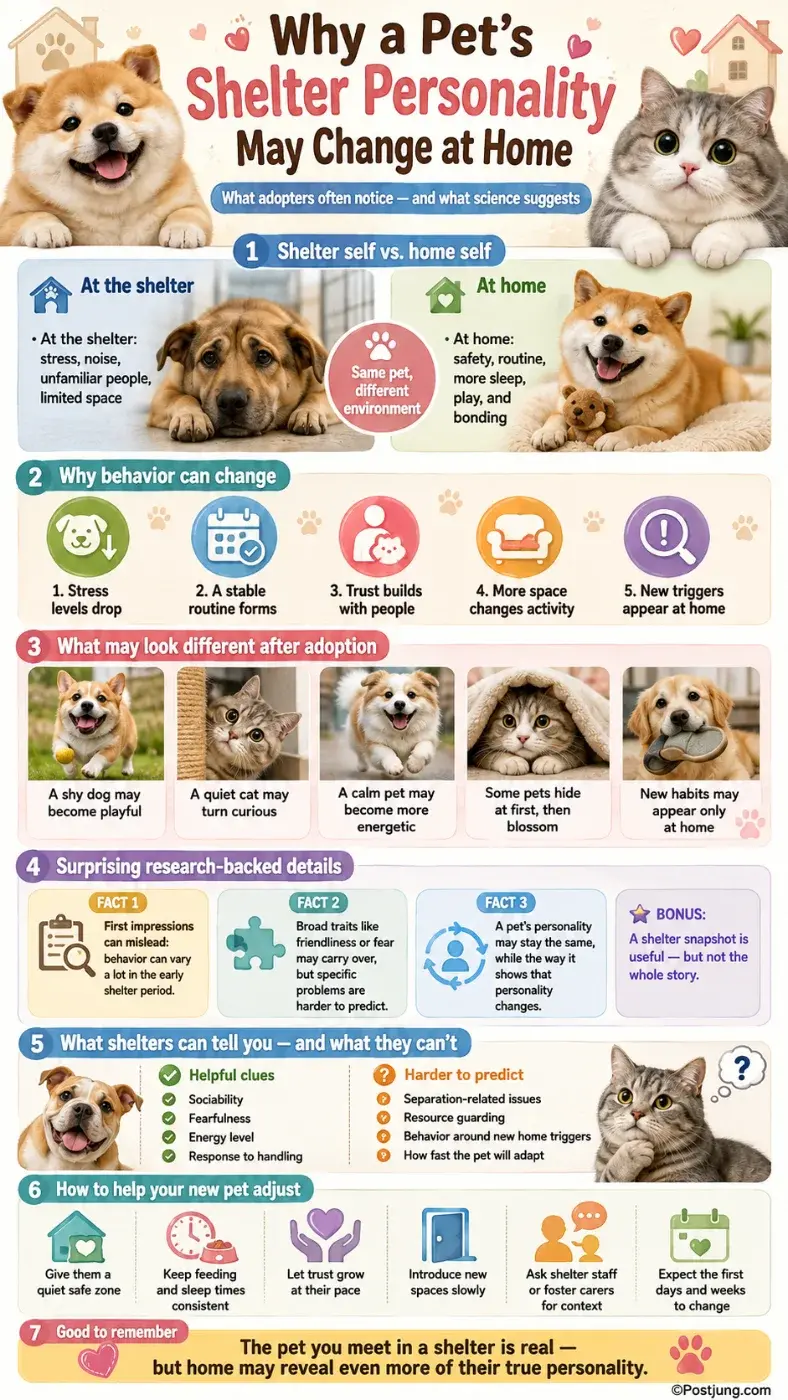
A shy shelter dog may become playful at home, while a seemingly relaxed pet may reveal new behaviors weeks later. Research suggests that personality matters, but environment, stress and adjustment can strongly affect how that personality is expressed.
A pet’s behavior at an animal shelter can be genuine without being the complete picture of who that animal will become at home.
Dogs and cats arrive at shelters under highly unusual circumstances: unfamiliar smells, strange people, other animals nearby, disrupted routines and limited control over their surroundings. After adoption, almost all of those conditions change again. Research increasingly suggests that this shift can alter how an animal expresses fear, playfulness, sociability, excitement and other behaviors.
That means the quiet dog curled in the back of a kennel is not necessarily a naturally quiet dog. Likewise, an outgoing cat that eagerly approaches visitors may still need time to adjust to a new household.
Personality can persist while behavior changes
Personality and behavior are related, but they are not identical.
Animal-behavior researchers generally use personality to describe individual behavioral tendencies that show some consistency over time or across situations. Yet an animal can retain those underlying tendencies while acting differently when its environment changes.
One study followed 34 shelter dogs after successful adoption and found substantial behavioral changes in their homes. Dogs classified as bolder in the shelter tended to become more active, excitable and playful after adoption, while shyer dogs followed a different pattern of behavioral change. The researchers concluded that personality appeared to influence how dogs responded to the transition from shelter to home.
Another large study illustrates why timing matters. Researchers analyzed more than 19,000 observations involving 3,263 shelter dogs and found considerable day-to-day behavioral variation. Behavior became more repeatable after dogs had spent about a week in the shelter than it was on their arrival day.
In practical terms, a snapshot taken during an animal’s first stressful hours in a shelter may tell less than observations gathered repeatedly over time.
Shelter assessments have limits
Behavior assessments can still be useful. They may help shelter workers notice fear, sociability and other characteristics, and they can contribute to adoption matching.
But they should not be treated as a crystal ball.
A study of 123 adopted dogs compared standardized shelter assessments with owner reports one month after adoption. Some traits — including friendliness, fear and anxiousness — showed predictive value. More specific problems, including aggression, food guarding and separation-related behavior, were not reliably predicted.
An earlier evaluation similarly found that shelter testing did not predict dogs’ responses to people particularly well after rehoming.
That is one reason information gathered by foster caregivers, shelter staff and volunteers over multiple situations can be especially valuable. Each setting provides another piece of the animal’s behavioral history rather than relying on a single test.
Cats are affected by context, too
The same basic caution applies to cats.
Researchers have found repeatable individual behavioral differences among shelter cats, supporting the idea that cats do have recognizable individual personalities.
But those personalities are expressed within an environment.
A 2026 study involving 113 cats across six shelters in southern France found significant differences in behavioral scores and personality-profile distributions between shelters. The researchers cautioned that the observational study could not establish that shelter conditions caused those differences, but the findings reinforce the importance of context when interpreting a cat’s shelter behavior.
Another study comparing cats in homes and shelters found that privately housed cats displayed more exploration and play in the tested situations, while shelter cats showed less play and more passive behavior. The living environment and relationship with familiar caregivers were associated with how the cats behaved.
There can be dramatic individual examples as well. Research involving cats rescued from hoarding situations found that many cats rated as tense when entering the shelter later appeared social or highly social in adoptive homes.
New behaviors after adoption are not automatically a bad sign
Adopters sometimes expect the animal they met at the shelter to arrive home with exactly the same temperament on day one.
Reality is often messier.
A dog that barely played in the shelter may discover toys once it feels secure. A previously subdued dog may become energetic. A cat that immediately sought human attention at the shelter may spend its first days in a new home hiding.
Other behaviors can emerge only after an animal encounters situations that simply did not exist in the shelter — being left alone in a house, hearing the doorbell, seeing neighborhood dogs through a window, sharing a couch or protecting a favorite resting place.
Research following shelter dogs after adoption has documented behavioral changes across the first months in the home, reinforcing that post-adoption behavior is dynamic rather than fixed immediately after departure from the shelter.
One study also found that about two-thirds of surveyed adopters reported some behavioral problems after adoption, while difficulties including training problems and some forms of fear declined over time.
Think of the shelter personality as evidence, not a promise
None of this means shelter observations should be ignored.
A better approach is to view them as useful evidence gathered under one particular set of circumstances.
Ask how an animal behaves with staff members it already knows. Ask whether foster-home information exists. Find out whether behaviors have changed since intake. If possible, interact with the animal away from its kennel rather than judging it only through a cage door.
Research involving 1,491 shelter adopters found that people considered interaction with an animal more important than simply viewing it in a kennel, while information supplied by shelter staff or volunteers was also highly valued.
Most importantly, leave room for the animal to reveal more of itself after adoption.
A shelter can show you something real about a pet. A stable home may simply give you the chance to see much more.
SOURCES USED:
- National Library of Medicine / Animals — “How Different Personalities Affect the Reaction to Adoption of Dogs Adopted from a Shelter”
https://pmc.ncbi.nlm.nih.gov/articles/PMC8234085/ - National Library of Medicine / Animals — “Do Behaviour Assessments in a Shelter Predict the Behaviour of Dogs Post-Adoption?”
https://pmc.ncbi.nlm.nih.gov/articles/PMC7401658/ - National Library of Medicine / Royal Society Open Science — “Modelling personality, plasticity and predictability in shelter dogs”
https://pmc.ncbi.nlm.nih.gov/articles/PMC5627104/ - National Library of Medicine / Animals — “Shelter dog behavior after adoption: Using the C-BARQ to track dog behavior changes through the first six months after adoption”
https://pmc.ncbi.nlm.nih.gov/articles/PMC10431636/ - National Library of Medicine / Animals — “Evaluation of Factors Impacting Shelter Cats’ Personalities”
https://pmc.ncbi.nlm.nih.gov/articles/PMC12842891/ - National Library of Medicine — “Impact of Living Environment on Attachment Behaviour in Domestic Cats from Private Homes and Shelters”
https://pmc.ncbi.nlm.nih.gov/articles/PMC12729804/

เขียนโดย Postjung Insights
 รู้หรือไม่? เปิดรายได้พนักงานส่งพัสดุของแต่ละแอป วันหนึ่งได้เท่าไร
 อำเภอที่มีชื่ออำเภอสั้นที่สุด 3 อำเภอเท่านั้นในประเทศไทย
 เปิด 5 โรงเรียนหญิงล้วนเก่าแก่ของไทย ที่มีประวัติยาวนานกว่าศตวรรษ
 เจาะลึกรายได้พนักงานส่งอาหารแต่ละวันได้เท่าไร/หักค่าใช้จ่ายอะไรบ้าง
 โรงเรียนที่มีนักเรียนมากที่สุดในไทย
 เกษียณแล้วทำอะไรดี เปิด 4 กลุ่มอาชีพที่ผู้สูงวัยไทยทำกันน้อย จากข้อมูล 5.26 ล้านคน
 เลขเด็ดไพ่ยิปซี งวด 1 ตุลาคม 2569 รวมเลขเด่นและเลขท้าย 2 ตัว
 สุดระทึก! ไฟไหม้รางรถไฟฟ้า MRT สถานีเตาปูน-บางโพ..หยุดให้บริการชั่วคราวทุกสถานี
 เปิดศึกเลขเด็ดงวดนี้! เจ้าพ่อปากแดง ปะทะ เจ้าแม่ตะเคียนทอง งวด 1 ต.ค. 59 คัดมาให้เน้นๆ พร้อมลุ้นรวย
 โรงเรียนหญิงล้วนของรัฐบาล ที่เด็กอยากเข้าเรียนที่สุด
 แปลปกสลาก งวด 1 ต.ค. 69 ส่องตัวเลขจากภาพปกสลากกินแบ่งรัฐบาล
 ตาราง “เด่นเหนือเด่นใต้” งวด 1 ต.ค. 69 เปิดข้อมูลตามโพย เลขไหนอยู่ตรงไหนสุดระทึก! ไฟไหม้รางรถไฟฟ้า MRT สถานีเตาปูน-บางโพ..หยุดให้บริการชั่วคราวทุกสถานีเจาะลึกรายได้พนักงานส่งอาหารแต่ละวันได้เท่าไร/หักค่าใช้จ่ายอะไรบ้างเปิด 5 โรงเรียนหญิงล้วนเก่าแก่ของไทย ที่มีประวัติยาวนานกว่าศตวรรษ
 เปิด 5 สินค้าส่งออกของลาวที่คนไทยอาจคาดไม่ถึง หนึ่งในนั้นทำเงินเกือบ 1 พันล้านดอลลาร์เกษียณแล้วทำอะไรดี เปิด 4 กลุ่มอาชีพที่ผู้สูงวัยไทยทำกันน้อย จากข้อมูล 5.26 ล้านคน
 โรงเรียนเพียงแห่งเดียวของประเทศไทย ที่อยู่มาตั้งแต่ยุครัชกาลที่ 4
 English Edition