How to Spot Unsafe Pet Advice on Social Media
A confident video, thousands of likes, or a dramatic before-and-after story does not prove that pet-health advice is safe. These warning signs can help you decide what deserves further checking — and what should never replace a veterinarian.
Social media can be genuinely useful for pet owners. Veterinarians and credentialed veterinary professionals use it to explain behavior, nutrition, preventive care, common illnesses, and signs that an animal needs medical attention.
The problem is that reliable education appears in the same feed as unsupported home remedies, misleading nutrition claims, improvised drug doses, and highly confident advice from people whose qualifications may be impossible to verify. Veterinary professionals have specifically identified misinformation about pet nutrition, unproven “natural” remedies and misleading behavioral advice as recurring online problems.
Before acting on a viral recommendation, look beyond how convincing the person sounds.
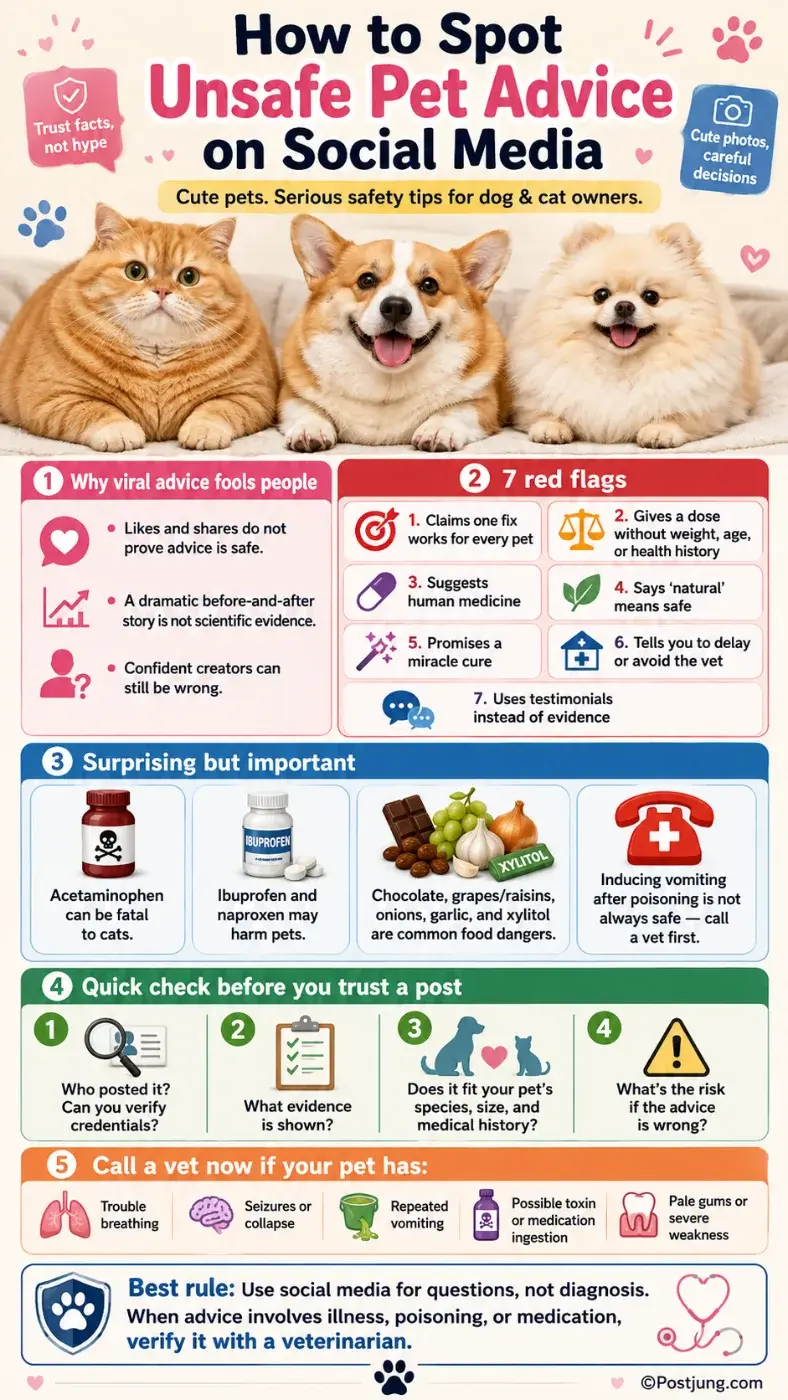
1. The advice gives every pet the same answer
One of the clearest warning signs is universal language: “Every dog needs this,” “Never feed a cat that,” or “This works for all pets.”
Animals are not interchangeable. Species, breed, age, weight, existing diseases, pregnancy status, medications and diet can all affect whether a treatment or product is appropriate.
That becomes especially important when medication is involved. The U.S. Food and Drug Administration advises owners not to give human medications to animals unless directed by a veterinarian, and not to share one animal's medication with another without veterinary direction.
A post that provides an exact drug or supplement dose without knowing anything about the individual animal deserves particular caution.
2. It recommends human medicine as an easy home treatment
“Just give your dog one of these” can be dangerous advice.
Some medications commonly used by people can seriously harm animals. The FDA warns that human pain relievers including ibuprofen and naproxen may be harmful to pets, while acetaminophen can be fatal to cats.
Even medications veterinarians sometimes use in animals require appropriate selection and dosing. The fact that a substance is sold over the counter for people does not make it safe for a dog, cat or other species.
The same rule applies to medications left over from another pet.
3. The creator promises a cure — especially a “natural” one
Words such as “guaranteed,” “detox,” “miracle cure,” or “works every time” should immediately raise questions.
“Natural” does not mean harmless. Foods, plants, supplements and household ingredients can all cause poisoning. The ASPCA, for example, lists foods including chocolate, grapes and raisins, onions, garlic and products containing xylitol among important hazards for pets.
A trustworthy educator should be willing to discuss limitations, uncertainty and situations in which professional assessment is needed.
4. The evidence is a dramatic personal story
A pet improving after a particular food, supplement or home remedy can be a sincere story. It still does not demonstrate that the treatment caused the improvement or that another animal will respond the same way.
VCA Animal Hospitals recommends treating social-media posts and other pet-owner anecdotes as experiences rather than substitutes for scientific or medical information, and looking for qualified sources backed by evidence.
Be especially careful when a creator moves directly from “this worked for my pet” to “you should do it too.”
5. There is no way to check the source
Credentials should be specific enough to verify.
A profile description such as “pet expert,” “nutrition specialist” or “animal wellness professional” may sound authoritative without telling you what training the person actually has.
For nutrition in particular, the World Small Animal Veterinary Association warns pet owners that online information can contain substantial myth and misinformation and provides tools for evaluating nutrition information more objectively.
Useful questions include: Who wrote this? What are their qualifications? Do they identify the evidence behind the recommendation? Is the source trying to sell the exact product it claims will solve the problem?
A commercial interest does not automatically make information false, but it is something readers should know.
6. The post tells you not to see a veterinarian
This is one of the strongest danger signals.
Be wary of claims that veterinarians “don't want you to know” about a remedy, that veterinary care is unnecessary for a potentially serious problem, or that an online treatment should be tried for days before seeking help.
Social media is poorly suited to diagnosing an individual animal. A short video may not reveal medical history, hydration, temperature, pain, laboratory findings, toxin exposure or other information needed to distinguish a minor problem from an emergency.
Even veterinarians who educate people through social media may deliberately avoid diagnosing individual animals online. AAHA has highlighted veterinary creators who use social platforms for education while drawing a clear line between general information and medical advice for a particular patient.
7. An emergency “hack” could make the situation worse
Online emergency advice deserves the highest level of skepticism.
For example, inducing vomiting after a suspected poisoning is not automatically appropriate. ASPCA Poison Control advises contacting a veterinarian or poison-control professional after a toxin exposure and notes that even hydrogen peroxide, sometimes used to make dogs vomit, should only be given under professional guidance because improper use can cause problems.
If a pet may have swallowed medication, a toxin or another dangerous substance, do not spend valuable time testing multiple social-media remedies. Contact a veterinarian or an appropriate animal poison service in your country.
A quick check before you follow pet advice online
Before changing a pet's medication, diet or treatment because of something you saw online, ask four questions:
Who is giving the advice? Look for credentials you can independently verify.
What evidence is offered? A scientific source or established veterinary guidance carries more weight than likes, comments or testimonials.
Does the advice account for individual differences? Safe medical guidance rarely assumes that one dose, product or treatment suits every animal.
What happens if the advice is wrong? The greater the potential harm — poisoning, delayed emergency treatment, medication reactions or serious illness — the stronger the evidence should be before you act.
Social media does not have to be avoided. Good veterinary educators can make complicated topics easier to understand and can help owners recognize when something deserves attention.
The safest approach is to use those posts as a starting point for questions, not as a substitute for diagnosis. When advice involves medication, poisoning, significant symptoms or treatment of an illness, verify it with a veterinarian who can evaluate the animal in front of them.
SOURCES USED:
- U.S. Food and Drug Administration — Medication Errors Happen to Pets, Too
- U.S. Food and Drug Administration — Potentially Dangerous Items for Your Pet
- ASPCA — People Foods to Avoid Feeding Your Pets
- ASPCA — Is It Ever Safe to Induce Vomiting?
- World Small Animal Veterinary Association — Global Nutrition Guidelines
- VCA Animal Hospitals — Finding Reliable Internet Sources for Pet Care Information

เขียนโดย Postjung Insights
 เจาะลึกรายได้พนักงานส่งอาหารแต่ละวันได้เท่าไร/หักค่าใช้จ่ายอะไรบ้าง
 เกษียณแล้วทำอะไรดี เปิด 4 กลุ่มอาชีพที่ผู้สูงวัยไทยทำกันน้อย จากข้อมูล 5.26 ล้านคน
 โรงเรียนที่มีนักเรียนมากที่สุดในไทย
 อำเภอที่มีชื่ออำเภอสั้นที่สุด 3 อำเภอเท่านั้นในประเทศไทย
 เปิด 5 โรงเรียนหญิงล้วนเก่าแก่ของไทย ที่มีประวัติยาวนานกว่าศตวรรษ
 รู้หรือไม่? เปิดรายได้พนักงานส่งพัสดุของแต่ละแอป วันหนึ่งได้เท่าไร
 แปลปกสลาก งวด 1 ต.ค. 69 ส่องตัวเลขจากภาพปกสลากกินแบ่งรัฐบาล
 ตาราง “เด่นเหนือเด่นใต้” งวด 1 ต.ค. 69 เปิดข้อมูลตามโพย เลขไหนอยู่ตรงไหน
 เลขเด็ดไพ่ยิปซี งวด 1 ตุลาคม 2569 รวมเลขเด่นและเลขท้าย 2 ตัว
 สุดระทึก! ไฟไหม้รางรถไฟฟ้า MRT สถานีเตาปูน-บางโพ..หยุดให้บริการชั่วคราวทุกสถานี
 โรงเรียนเพียงแห่งเดียวของประเทศไทย ที่อยู่มาตั้งแต่ยุครัชกาลที่ 4
 เปิดศึกเลขเด็ดงวดนี้! เจ้าพ่อปากแดง ปะทะ เจ้าแม่ตะเคียนทอง งวด 1 ต.ค. 59 คัดมาให้เน้นๆ พร้อมลุ้นรวยสุดระทึก! ไฟไหม้รางรถไฟฟ้า MRT สถานีเตาปูน-บางโพ..หยุดให้บริการชั่วคราวทุกสถานีเจาะลึกรายได้พนักงานส่งอาหารแต่ละวันได้เท่าไร/หักค่าใช้จ่ายอะไรบ้างเปิด 5 โรงเรียนหญิงล้วนเก่าแก่ของไทย ที่มีประวัติยาวนานกว่าศตวรรษ
 เปิด 5 สินค้าส่งออกของลาวที่คนไทยอาจคาดไม่ถึง หนึ่งในนั้นทำเงินเกือบ 1 พันล้านดอลลาร์เกษียณแล้วทำอะไรดี เปิด 4 กลุ่มอาชีพที่ผู้สูงวัยไทยทำกันน้อย จากข้อมูล 5.26 ล้านคนโรงเรียนเพียงแห่งเดียวของประเทศไทย ที่อยู่มาตั้งแต่ยุครัชกาลที่ 4
 English Edition