How to Give Kids Age-Appropriate Pet Care Responsibilities
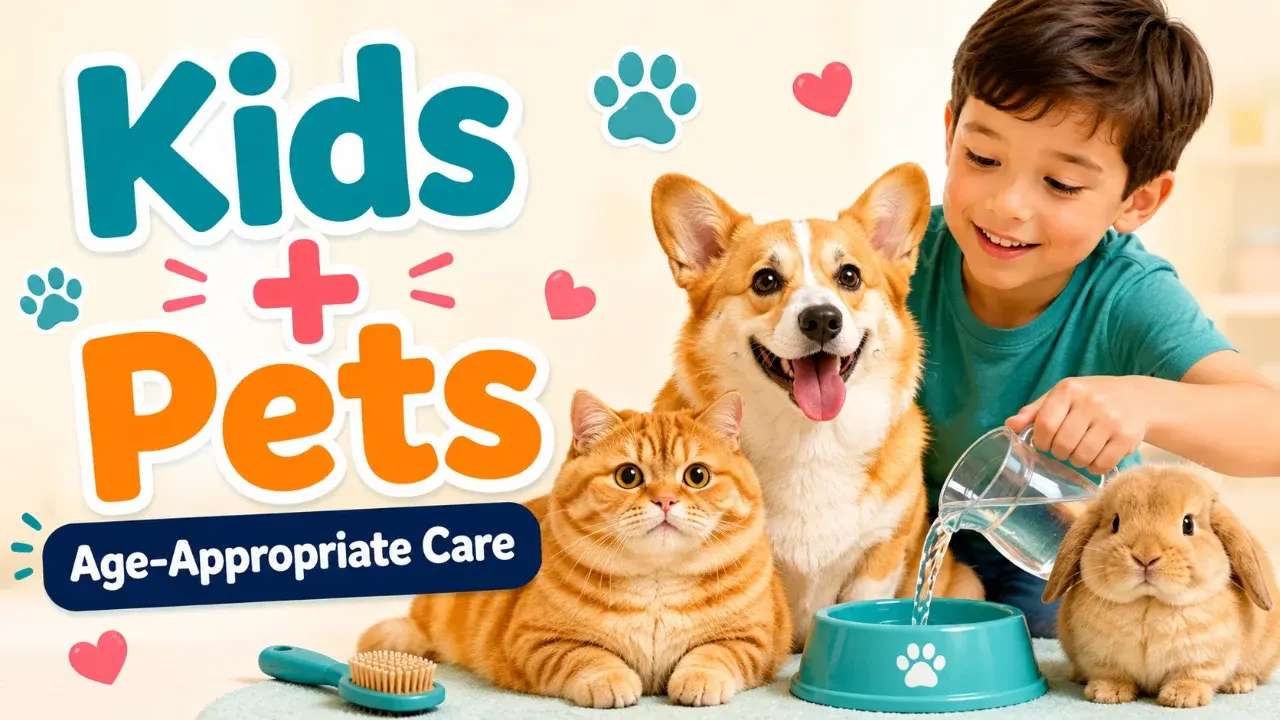
Children can learn responsibility by helping care for a family pet, but the job should grow with their maturity and skills. Adults still need to supervise safety and make sure the animal’s essential needs are met.
Giving a child a pet-care job can be a practical way to teach consistency, empathy and responsibility. The key is to give them a task they can actually manage—not to make the animal dependent on a child remembering everything.
The American Academy of Pediatrics says children around age 5 and older can generally begin helping with simple pet-care chores, while parents should expect to continue doing most of the work. It also recommends considering a child’s developmental stage, not simply their birthday, when deciding what they are ready to handle.
That distinction matters: a child can participate in caring for a pet without becoming the person ultimately responsible for the pet.
Under 5: Focus on gentle participation
For preschoolers, pet care is better treated as a supervised learning experience than an independent chore.
A young child might help an adult place a food bowl on the floor, hand over a grooming brush or watch while fresh water is provided. The goal is to practice gentle behavior and begin understanding that animals have needs of their own.
Adults should remain within reach during interactions. The AAP notes that younger children can have difficulty distinguishing an animal from a toy and recommends never leaving a young child alone with an animal.
There is also a hygiene consideration. The U.S. Centers for Disease Control and Prevention says children under 5 are more susceptible to certain germs carried by animals and recommends adult supervision around animals and during handwashing.
At this stage, success might simply mean learning rules such as:
- Touch gently.
- Leave the pet alone while it is eating or sleeping.
- Do not pull ears, tails or fur.
- Wash hands after interacting with the animal.
- Tell an adult if the pet seems sick, frightened or upset.
-
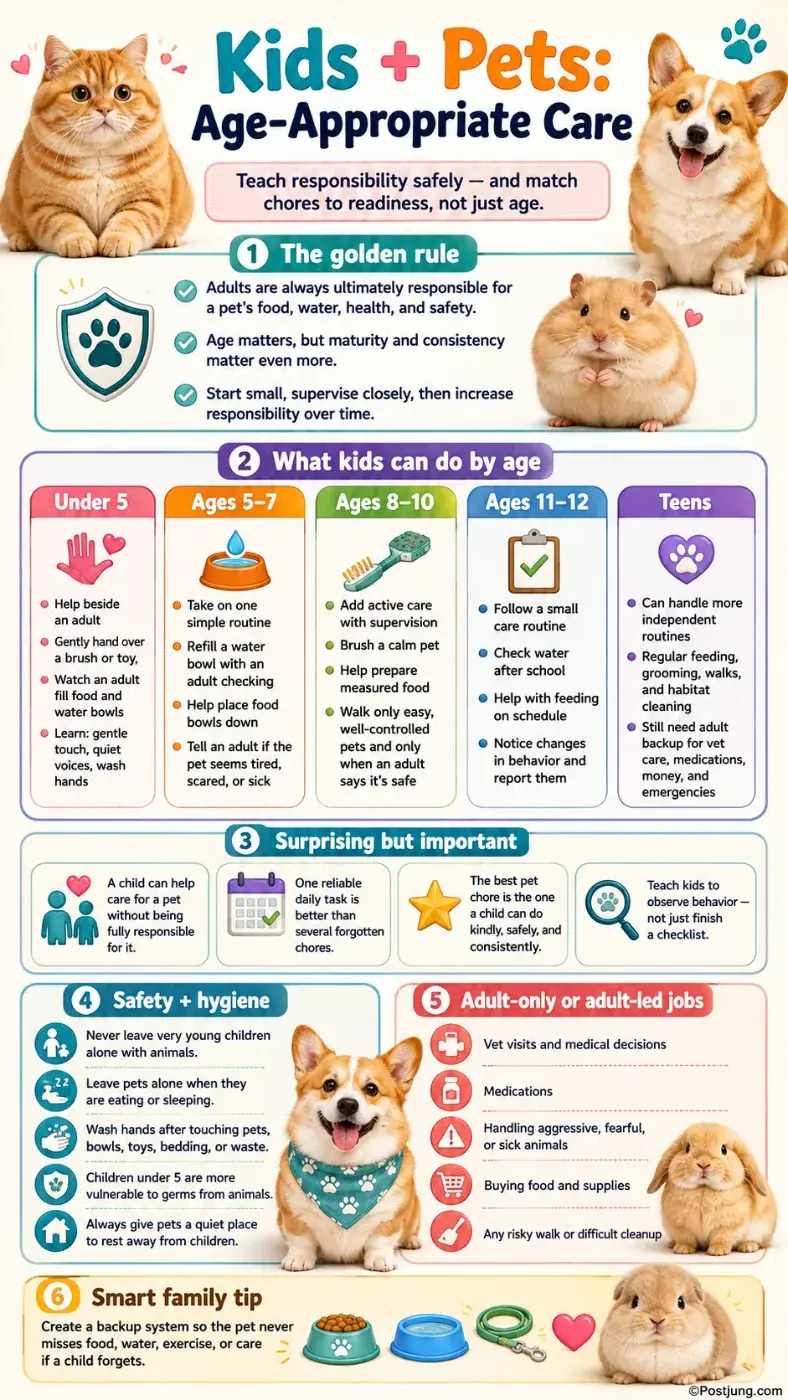
Ages 5–7: Start with one simple routine
Around age 5, many children can begin helping with straightforward, repeatable jobs.
The AAP specifically lists filling a pet’s food dish among appropriate chores for children ages 5–7. Its guidance on adopting pets also suggests that children roughly 5 and older may help with simple jobs such as refilling a water bowl or helping with a dog’s leash.
Instead of assigning several jobs at once, start with one.
For example, a child might refill a water bowl with an adult checking it afterward. Once that becomes routine, another responsibility can be added.
This is also a good age to teach children to observe the animal rather than simply complete a checklist: Does the water bowl need cleaning? Is the cat hiding rather than coming for breakfast? Is the dog backing away instead of wanting to play?
The child can notice and report. The adult decides what action is needed.
Ages 8–10: Add active care with supervision
Older elementary-school children can often take on more involved routines when they have demonstrated that they can follow instructions consistently.
AAP chore guidance lists walking a pet as an example of a responsibility children ages 8–10 may be able to perform.
Whether that is appropriate for a particular child depends on the animal, however. A calm small dog walking in a secure area is very different from a large or reactive dog that could pull a child into traffic or toward another animal.
This age group may also be ready to help with tasks such as brushing a cooperative pet, preparing measured food that an adult has portioned or approved, cleaning food and water dishes, and helping adults organize pet supplies.
Supervision should reflect the risk of the task rather than disappearing simply because a child is older.
Ages 11–12: Give them a routine, not total responsibility
Preteens may be able to manage a sequence of daily pet-care duties with less prompting, particularly if they have already spent several years learning the routine.
A useful progression is to move from individual chores to a predictable schedule: check water after school, help with feeding at a set time, brush the pet on designated days and tell an adult immediately when something seems unusual.
Adults should still verify essential care. Missing homework is inconvenient; repeatedly forgetting an animal’s food, water, medication or necessary exercise can affect a living creature.
That makes pet care different from many ordinary household chores. The family needs a backup system so that the animal never pays the price for a child forgetting.
Teens: More independence, with adults as the safety net
Teenagers can often take on substantial portions of routine pet care. The AAP includes feeding and grooming pets among suitable household responsibilities for teens.
Depending on the pet and the teenager’s maturity, that might expand to regular walks, cleaning habitats, helping track supplies or participating in training.
But some responsibilities should remain with an adult or be closely overseen, particularly veterinary decisions, medications, financial commitments and situations involving an animal that is sick, aggressive, unusually fearful or difficult to control.
Older does not automatically mean ready. A reliable 12-year-old may handle a routine better than a distracted 15-year-old. Assign responsibilities based on demonstrated behavior, then adjust them as needed.
Build habits around safety and hygiene
Pet chores should include the cleanup that follows them.
The CDC recommends washing hands thoroughly with soap and water after touching or playing with pets, feeding them, handling their dishes or equipment, cleaning habitats, or dealing with animal waste. Adults should supervise handwashing for young children.
Families should also teach children that an animal needs personal space.
For dogs in particular, the RSPCA advises adults to supervise children, avoid disturbing dogs while they are eating or sleeping, teach gentle interaction, and provide dogs with a quiet place where children leave them alone.
Those rules are not simply another set of chores. They teach children that caring for an animal includes respecting what the animal communicates.
The best pet chore grows with the child
The most useful responsibility is not necessarily the biggest one. It is the task a child can perform consistently, safely and kindly.
Start small, demonstrate the job, supervise it, and gradually step back as the child shows they can handle it. If they repeatedly forget, reduce the responsibility or add reminders rather than allowing the pet’s care to suffer.
The long-term lesson is bigger than remembering to fill a bowl. Children learn that caring for another living creature means noticing its needs, respecting its boundaries and following through—even on days when the chore is no longer exciting.
SOURCES USED:
- American Academy of Pediatrics / HealthyChildren.org — Age-Appropriate Chores for Children
https://www.healthychildren.org/English/family-life/family-dynamics/communication-discipline/Pages/Chores-and-Responsibility.aspx - American Academy of Pediatrics / HealthyChildren.org — How to Choose the Right Pet for Your Family
https://www.healthychildren.org/English/safety-prevention/at-home/Pages/Before-Choosing-a-Pet.aspx - American Academy of Pediatrics / HealthyChildren.org — How old should our children be before we adopt a pet?
https://www.healthychildren.org/English/tips-tools/ask-the-pediatrician/Pages/How-old-should-my-children-be-before-we-adopt-a-pet.aspx - Centers for Disease Control and Prevention — Hygiene Practices Around Animals
https://www.cdc.gov/hygiene/about/hygiene-practices-around-animals.html - Centers for Disease Control and Prevention — People at Increased Risk for Illness from Animals
https://www.cdc.gov/healthy-pets/risk-factors/index.html - RSPCA — Children & Dogs: How They Can Live Together
https://www.rspca.org.uk/adviceandwelfare/pets/dogs/company/children

เขียนโดย Postjung Insights
 รู้หรือไม่? เปิดรายได้พนักงานส่งพัสดุของแต่ละแอป วันหนึ่งได้เท่าไร
 โรงเรียนที่มีนักเรียนมากที่สุดในไทย
 เปิดศึกเลขเด็ดงวดนี้! เจ้าพ่อปากแดง ปะทะ เจ้าแม่ตะเคียนทอง งวด 1 ต.ค. 59 คัดมาให้เน้นๆ พร้อมลุ้นรวย
 เกษียณแล้วทำอะไรดี เปิด 4 กลุ่มอาชีพที่ผู้สูงวัยไทยทำกันน้อย จากข้อมูล 5.26 ล้านคน
 สุดระทึก! ไฟไหม้รางรถไฟฟ้า MRT สถานีเตาปูน-บางโพ..หยุดให้บริการชั่วคราวทุกสถานี
 แปลปกสลาก งวด 1 ต.ค. 69 ส่องตัวเลขจากภาพปกสลากกินแบ่งรัฐบาล
 เลขเด็ดไพ่ยิปซี งวด 1 ตุลาคม 2569 รวมเลขเด่นและเลขท้าย 2 ตัว
 ความลับ 30 ล้านปีของ “แม่น้ำไนล์”: ทำไมสายน้ำสายนี้ถึงไม่เคยเหือดแห้งกลางทะเลทรายซาฮารา
 เจาะลึกรายได้พนักงานส่งอาหารแต่ละวันได้เท่าไร/หักค่าใช้จ่ายอะไรบ้าง
 อำเภอที่มีชื่ออำเภอสั้นที่สุด 3 อำเภอเท่านั้นในประเทศไทย
 โรงเรียนหญิงล้วนของรัฐบาล ที่เด็กอยากเข้าเรียนที่สุด
 เปิด 5 โรงเรียนหญิงล้วนเก่าแก่ของไทย ที่มีประวัติยาวนานกว่าศตวรรษสุดระทึก! ไฟไหม้รางรถไฟฟ้า MRT สถานีเตาปูน-บางโพ..หยุดให้บริการชั่วคราวทุกสถานีเจาะลึกรายได้พนักงานส่งอาหารแต่ละวันได้เท่าไร/หักค่าใช้จ่ายอะไรบ้างเปิด 5 โรงเรียนหญิงล้วนเก่าแก่ของไทย ที่มีประวัติยาวนานกว่าศตวรรษ
 เปิด 5 สินค้าส่งออกของลาวที่คนไทยอาจคาดไม่ถึง หนึ่งในนั้นทำเงินเกือบ 1 พันล้านดอลลาร์เกษียณแล้วทำอะไรดี เปิด 4 กลุ่มอาชีพที่ผู้สูงวัยไทยทำกันน้อย จากข้อมูล 5.26 ล้านคน
 โรงเรียนเพียงแห่งเดียวของประเทศไทย ที่อยู่มาตั้งแต่ยุครัชกาลที่ 4
 English Edition