Why a Reliable Recall Must Be Practiced in Stages

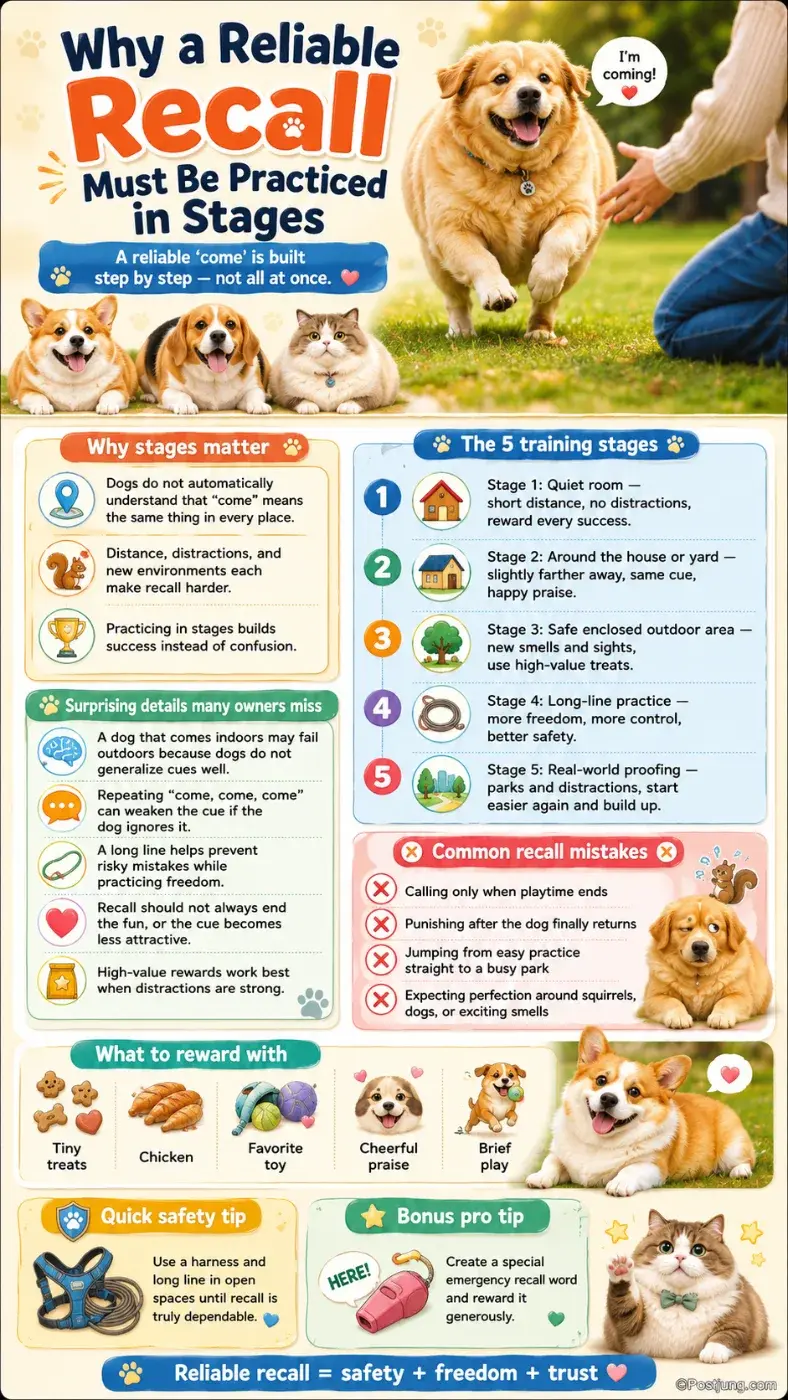
Coming when called is not a skill dogs learn once and automatically use everywhere. Reliable recall develops by gradually adding distance, distractions, and new environments while keeping practice rewarding and safe.
A dog that races toward you every time you call from across the living room may seem to have mastered recall. Move the same dog into a park filled with smells, people, wildlife, and other dogs, however, and the response can suddenly fall apart.
That does not necessarily mean the dog is stubborn or has forgotten the cue. Recall has to be practiced under progressively more difficult conditions before it becomes dependable in the situations where owners need it most. Major animal-training organizations recommend beginning in low-distraction settings and gradually adding distance and competing attractions.
Dogs do not automatically generalize a cue
Humans can easily understand that “come” means the same thing whether they are standing in a kitchen, backyard, or crowded park. Dogs must learn to respond to that cue despite everything else changing around them.
That is why early recall practice is usually deliberately easy.
The American Kennel Club recommends beginning in a quiet, low-distraction environment such as the home, rewarding the dog for moving toward the handler and only gradually increasing distance and difficulty. Dogs Trust similarly advises starting indoors, in a garden, or another enclosed area before progressing to more distracting environments.
Each successful repetition helps strengthen a simple association: hearing the recall cue and returning to the person leads to something worthwhile.
Distance and distraction are separate challenges
One of the most useful ways to think about recall training is that difficulty has several dimensions.
Calling a dog from three meters away in a silent room is very different from calling from 20 meters away. Calling from three meters away while another dog is playing nearby may be harder still.
Dogs Trust recommends gradually increasing both recall distance and the intensity of distractions rather than expecting a dog to perform immediately in the hardest possible environment. The RSPCA follows a similar progression, beginning around the house and garden before moving practice into safe outdoor spaces.
In practice, it is often helpful to make only one part of the exercise substantially harder at a time.
If the location suddenly becomes much more distracting, shorten the distance. If you want to practice a longer recall, choose somewhere relatively quiet.
Success gives the dog another chance to rehearse the response you actually want.
A long line creates a useful middle stage
There is a large gap between practicing in an enclosed yard and unclipping the leash in an open environment.
A long training line can help fill that gap.
Dogs Trust recommends attaching a long line to a harness as dogs begin practicing farther away and around distractions. The RSPCA also suggests long training leads for outdoor recall work because they give dogs additional freedom without complete free range. The AKC recommends similar management when moving into larger, more distracting areas.
The line is primarily a safety measure, not a way to drag the dog back after issuing the cue.
It allows a dog to explore farther away while preventing an unsuccessful training repetition from becoming a dangerous escape.
That matters because repeatedly calling a dog in situations where it is unlikely to respond can weaken the usefulness of the cue. Dogs Trust specifically advises using the recall signal sparingly rather than repeatedly calling when the dog is unlikely to return.
Returning should continue to feel worthwhile
Recall competes with whatever the dog is doing at that moment.
At home, the competition may be almost nothing. Outdoors, returning to the owner could mean abandoning an interesting smell, another dog, or a moving animal.
Rewards therefore matter most precisely when the decision to return is difficult.
Dogs Trust recommends particularly appealing rewards when a dog leaves something interesting to return, while the AKC advises using valuable treats or toys during recall training. The RSPCA similarly recommends taking favorite rewards on walks and praising the dog after successful returns.
Owners should also be careful about what happens immediately after the dog arrives.
If “come” consistently means playtime ends, the leash goes on, or something unpleasant happens, the cue can acquire an unwanted association. Both the AKC and RSPCA caution against using recall only to end enjoyable activities, and they advise against punishing a dog after it finally returns.
Sometimes calling the dog, rewarding the return, and then releasing them to resume playing can help prevent that pattern.
Progress is more useful than a perfect test
Recall training is not about discovering whether a dog will obey under maximum distraction. It is about creating enough successful repetitions that returning becomes a well-practiced response across many situations.
A dog struggling at a particular stage is useful information. The environment may simply be harder than the dog's current training level.
Instead of repeatedly testing the same failed recall, reduce the distance, move farther from the distraction, return to a safer setting, or use a long line.
Then build the difficulty again.
Even a strong recall does not eliminate the need for sensible management. The AKC notes that owners may choose to keep dogs leashed outside secure areas, and local leash rules should always be followed.
The goal is not to reach a magical point at which distraction no longer exists. It is to give the dog a long history of successful choices — first when returning is easy, then when it becomes progressively harder.
That is what turns “come” from a familiar word into a genuinely useful skill.
SOURCES USED:
- American Kennel Club — Reliable Recall: Teaching Your Dog to Always Come When Called
https://www.akc.org/expert-advice/training/reliable-recall-train-dogs-to-come-when-called/ - Dogs Trust — Recall Training: Come Back When Called
https://www.dogstrust.org.uk/dog-advice/training/basics/recall-training - RSPCA — Train Your Dog To Come When Called
https://www.rspca.org.uk/adviceandwelfare/pets/dogs/training/come

เขียนโดย Postjung Insights
 รู้หรือไม่? เปิดรายได้พนักงานส่งพัสดุของแต่ละแอป วันหนึ่งได้เท่าไร
 โรงเรียนที่มีนักเรียนมากที่สุดในไทย
 เจาะลึกรายได้พนักงานส่งอาหารแต่ละวันได้เท่าไร/หักค่าใช้จ่ายอะไรบ้าง
 อำเภอที่มีชื่ออำเภอสั้นที่สุด 3 อำเภอเท่านั้นในประเทศไทย
 สุดระทึก! ไฟไหม้รางรถไฟฟ้า MRT สถานีเตาปูน-บางโพ..หยุดให้บริการชั่วคราวทุกสถานี
 เลขเด็ดไพ่ยิปซี งวด 1 ตุลาคม 2569 รวมเลขเด่นและเลขท้าย 2 ตัว
 เกษียณแล้วทำอะไรดี เปิด 4 กลุ่มอาชีพที่ผู้สูงวัยไทยทำกันน้อย จากข้อมูล 5.26 ล้านคน
 แปลปกสลาก งวด 1 ต.ค. 69 ส่องตัวเลขจากภาพปกสลากกินแบ่งรัฐบาล
 เปิด 5 โรงเรียนหญิงล้วนเก่าแก่ของไทย ที่มีประวัติยาวนานกว่าศตวรรษ
 ตาราง “เด่นเหนือเด่นใต้” งวด 1 ต.ค. 69 เปิดข้อมูลตามโพย เลขไหนอยู่ตรงไหน
 ความลับ 30 ล้านปีของ “แม่น้ำไนล์”: ทำไมสายน้ำสายนี้ถึงไม่เคยเหือดแห้งกลางทะเลทรายซาฮารา
 สถิติย้อนหลัง 10 ปี ออกเลขไหนบ้างมาดูกันสุดระทึก! ไฟไหม้รางรถไฟฟ้า MRT สถานีเตาปูน-บางโพ..หยุดให้บริการชั่วคราวทุกสถานีเจาะลึกรายได้พนักงานส่งอาหารแต่ละวันได้เท่าไร/หักค่าใช้จ่ายอะไรบ้างเปิด 5 โรงเรียนหญิงล้วนเก่าแก่ของไทย ที่มีประวัติยาวนานกว่าศตวรรษ
 เปิด 5 สินค้าส่งออกของลาวที่คนไทยอาจคาดไม่ถึง หนึ่งในนั้นทำเงินเกือบ 1 พันล้านดอลลาร์เกษียณแล้วทำอะไรดี เปิด 4 กลุ่มอาชีพที่ผู้สูงวัยไทยทำกันน้อย จากข้อมูล 5.26 ล้านคน
 โรงเรียนเพียงแห่งเดียวของประเทศไทย ที่อยู่มาตั้งแต่ยุครัชกาลที่ 4
 English Edition