How Activity Trackers Can Support Better Questions at the Vet

A pet activity tracker cannot diagnose illness, but changes in movement, rest, or certain behaviors can give owners more specific observations to bring to a veterinary appointment.
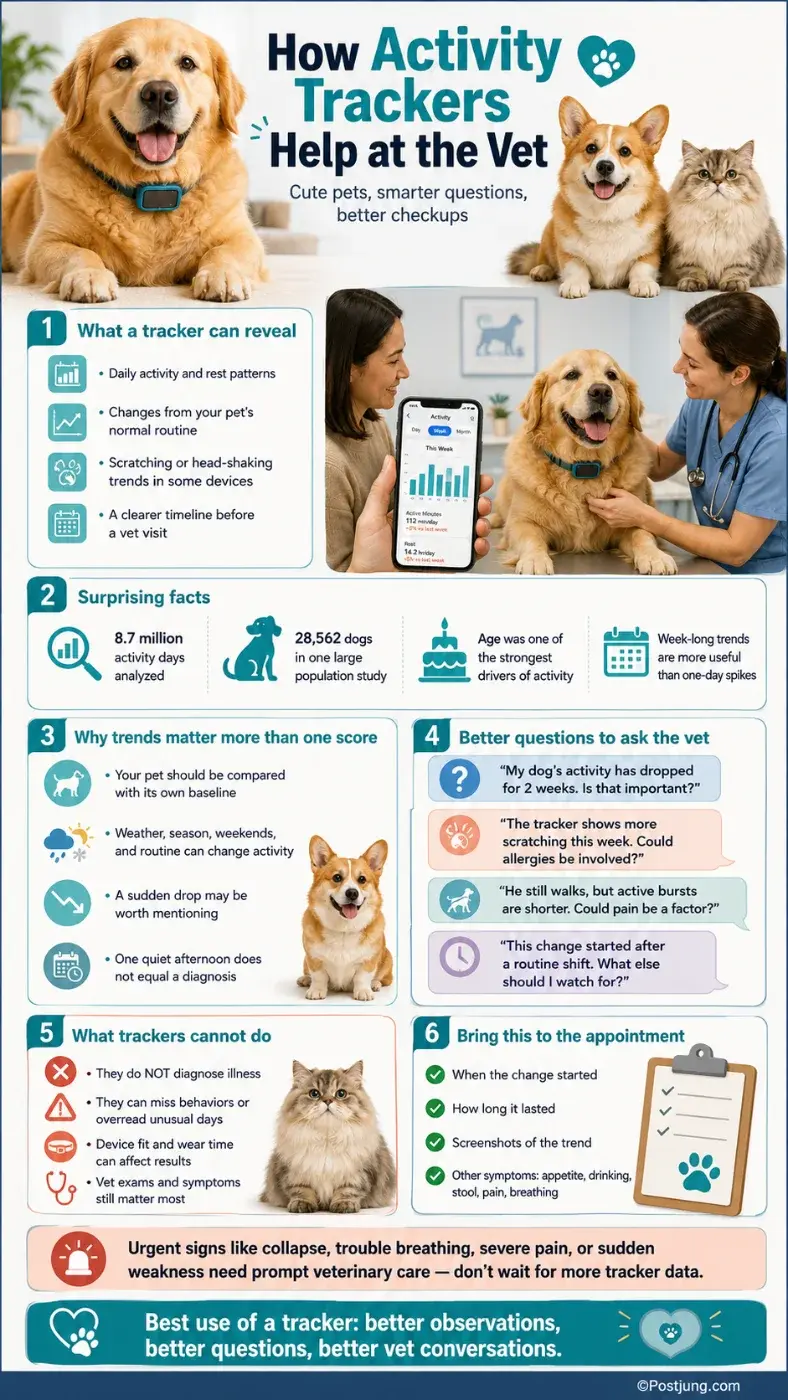
A dog’s activity tracker can produce thousands of data points between veterinary visits. The useful part is not chasing a perfect daily score. It is noticing when your dog’s usual pattern changes — and using that change to ask a veterinarian a more specific question.
Research supports the idea that accelerometers can provide objective measurements of canine activity. In a validation study involving 30 dogs, researchers at the University of Glasgow found that accelerometer readings could distinguish different intensities of activity. A separate group of 20 dogs wore the devices for up to a week, with researchers reporting high measurement reliability over several days.
That does not turn a collar into a medical test. It does, however, give owners another way to describe what has been happening at home.
A trend can be more useful than “he seems less active”
Owners naturally rely on memory when a veterinarian asks questions such as whether a dog has slowed down, started sleeping more, or changed its routine. Tracker history can add dates and patterns to those impressions.
Instead of saying, “She hasn’t seemed like herself lately,” an owner might be able to ask:
- Her activity has been consistently lower for the past two weeks. Is that change worth investigating?
- She still wants to walk, but her active periods are shorter. Could discomfort be playing a role?
- Her activity dropped after we changed her routine. Should I be looking for other symptoms?
- Her activity is normal on some days but much lower on others. Is that pattern useful to you?
The distinction matters because there is no single activity number that defines a healthy dog.
A 2025 study combining commercial accelerometer data with electronic health records analyzed more than 8.7 million days of activity from 28,562 dogs in North America. Activity varied with factors including age, breed size, sex, climate, season, location, and whether it was a weekday or weekend. Age showed one of the strongest relationships with activity.
In other words, comparing your dog with its own established pattern may often be more informative than comparing its score with another dog’s.
Some trackers can detect more than movement
Certain wearable systems have been designed to classify individual behaviors rather than simply calculate general activity.
In one validation study using data from 361 dogs, a wearable sensor system was tested against video observations for scratching and head shaking. The researchers reported very high specificity for detected events, although sensitivity was lower, meaning the system could still miss some episodes.
That kind of information can help transform a vague observation into a practical veterinary question: “The tracker shows scratching has increased this week — could this be significant?”
There is also real-world evidence that alerts can affect what owners notice.
A 2023 retrospective observational study examined activity-monitor and electronic health-record data associated with more than 1,000 Banfield veterinary clinics in the United States. During a period when owners could receive alerts about increased scratching or licking, veterinary visits occurring within four weeks of such alerts were more likely than during the comparison period before those alerts were visible. The researchers cautioned that the observational design could not prove that the alerts caused the increase in visits.
The study also had industry involvement, including authors affiliated with Mars and Zoetis, which is useful context when interpreting the findings.
Why a single tracker number needs context
Consumer wearables should not be assumed to measure activity identically.
A 2024 pilot study compared a commercially available FitBark 2 with the previously validated Actical accelerometer in 20 dogs. Agreement was very strong when activity was assessed across the entire week but only moderate at several shorter time points. The researchers specifically concluded that the length of the measurement period matters when interpreting the data.
So a dramatic-looking hour or isolated day should not automatically be interpreted as evidence that something is wrong.
Equipment fit, device algorithms, missing wear time, unusual routines, travel, weather, boarding, and changes in who walks the dog may all affect what appears on a dashboard. The veterinarian still needs the animal’s history, physical examination, symptoms, and, when appropriate, diagnostic testing.
What to bring to the appointment
If you use a pet tracker, a concise summary is likely to be more useful than scrolling through months of graphs.
Note when the change began, whether it persisted, and what else happened around the same time. Bring screenshots of the relevant period if the app makes that easy. Also mention changes the tracker cannot reliably capture — appetite, drinking, urination, stool, breathing, pain behaviors, medications, injuries, or changes at home.
Most importantly, frame tracker information as an observation.
“The device says my dog has arthritis” overstates what a wearable can establish.
“My dog’s activity has fallen from his normal pattern for three weeks, and he is hesitating before climbing stairs — could those changes be related?” gives a veterinarian something much more useful to investigate.
That is where pet wearables may offer their biggest practical benefit. They do not replace veterinary judgment. They can help owners arrive with a clearer timeline, more specific observations, and better questions.
If a dog develops sudden weakness, collapse, difficulty breathing, severe pain, inability to stand, or another urgent change, owners should contact a veterinarian promptly rather than waiting for additional tracker data.
SOURCES USED:
- PubMed — Validity, practical utility and reliability of Actigraph accelerometry for the measurement of habitual physical activity in dogs
https://pubmed.ncbi.nlm.nih.gov/21265847/ - PubMed — Commercially available wearable health monitors in dogs only had a very strong correlation during longer durations of time: a pilot study
https://pubmed.ncbi.nlm.nih.gov/39134026/ - Frontiers in Veterinary Science — Response of pet owners to Whistle FIT activity monitor digital alerts of increased pruritic activity in their dogs
https://www.frontiersin.org/journals/veterinary-science/articles/10.3389/fvets.2023.1123266/full - PubMed — Wearable sensor shown to specifically quantify pruritic behaviors in dogs
https://pubmed.ncbi.nlm.nih.gov/29615019/ - Frontiers in Veterinary Science — Estimated activity levels in dogs at population scale with linear and causal modeling
https://www.frontiersin.org/journals/veterinary-science/articles/10.3389/fvets.2025.1572794/full

เขียนโดย Postjung Insights
 รู้หรือไม่? เปิดรายได้พนักงานส่งพัสดุของแต่ละแอป วันหนึ่งได้เท่าไร
 เกษียณแล้วทำอะไรดี เปิด 4 กลุ่มอาชีพที่ผู้สูงวัยไทยทำกันน้อย จากข้อมูล 5.26 ล้านคน
 แปลปกสลาก งวด 1 ต.ค. 69 ส่องตัวเลขจากภาพปกสลากกินแบ่งรัฐบาล
 อำเภอที่มีชื่ออำเภอสั้นที่สุด 3 อำเภอเท่านั้นในประเทศไทย
 สุดระทึก! ไฟไหม้รางรถไฟฟ้า MRT สถานีเตาปูน-บางโพ..หยุดให้บริการชั่วคราวทุกสถานี
 เจาะลึกรายได้พนักงานส่งอาหารแต่ละวันได้เท่าไร/หักค่าใช้จ่ายอะไรบ้าง
 ความลับ 30 ล้านปีของ “แม่น้ำไนล์”: ทำไมสายน้ำสายนี้ถึงไม่เคยเหือดแห้งกลางทะเลทรายซาฮารา
 โรงเรียนที่มีนักเรียนมากที่สุดในไทย
 เลขเด็ดไพ่ยิปซี งวด 1 ตุลาคม 2569 รวมเลขเด่นและเลขท้าย 2 ตัว
 เปิด 5 โรงเรียนหญิงล้วนเก่าแก่ของไทย ที่มีประวัติยาวนานกว่าศตวรรษ
 เปิดศึกเลขเด็ดงวดนี้! เจ้าพ่อปากแดง ปะทะ เจ้าแม่ตะเคียนทอง งวด 1 ต.ค. 59 คัดมาให้เน้นๆ พร้อมลุ้นรวย
 ตาราง “เด่นเหนือเด่นใต้” งวด 1 ต.ค. 69 เปิดข้อมูลตามโพย เลขไหนอยู่ตรงไหนสุดระทึก! ไฟไหม้รางรถไฟฟ้า MRT สถานีเตาปูน-บางโพ..หยุดให้บริการชั่วคราวทุกสถานีเจาะลึกรายได้พนักงานส่งอาหารแต่ละวันได้เท่าไร/หักค่าใช้จ่ายอะไรบ้างเปิด 5 โรงเรียนหญิงล้วนเก่าแก่ของไทย ที่มีประวัติยาวนานกว่าศตวรรษ
 เปิด 5 สินค้าส่งออกของลาวที่คนไทยอาจคาดไม่ถึง หนึ่งในนั้นทำเงินเกือบ 1 พันล้านดอลลาร์เกษียณแล้วทำอะไรดี เปิด 4 กลุ่มอาชีพที่ผู้สูงวัยไทยทำกันน้อย จากข้อมูล 5.26 ล้านคน
 โรงเรียนเพียงแห่งเดียวของประเทศไทย ที่อยู่มาตั้งแต่ยุครัชกาลที่ 4
 English Edition