How to Teach a Dog to Relax Without Constant Entertainment

Dogs need exercise, play, social contact, and mental stimulation—but they can also learn that nothing happening is perfectly okay. Reward-based “settle” training can turn quiet downtime into a skill your dog practices voluntarily.
A dog that follows you from room to room, drops toys at your feet, or demands another game whenever the house becomes quiet may not simply need more entertainment. Sometimes, the missing skill is knowing how to switch off.
Dogs can be taught to settle and relax through positive reinforcement, according to veterinary behavior guidance from VCA Animal Hospitals. The aim is more than getting a dog to lie down: the dog should gradually become physically and emotionally relaxed.
That distinction matters. A dog lying rigidly on a bed while staring at a treat pouch is technically still, but not necessarily relaxed.
Start by making sure your dog's needs are actually met
Teaching downtime should never become a substitute for adequate care.
Dogs need appropriate physical exercise and opportunities for cognitive stimulation, and difficulty settling can also occur when a dog is excited, frightened, frustrated, anxious, or physically uncomfortable. VCA recommends giving a dog an opportunity to exercise, play, and eliminate before beginning a calm-training session.
Think of relaxation training as one part of a balanced day rather than a strategy for keeping an under-stimulated dog quiet.
Once those needs have been addressed, deliberately practicing inactivity becomes much more reasonable.
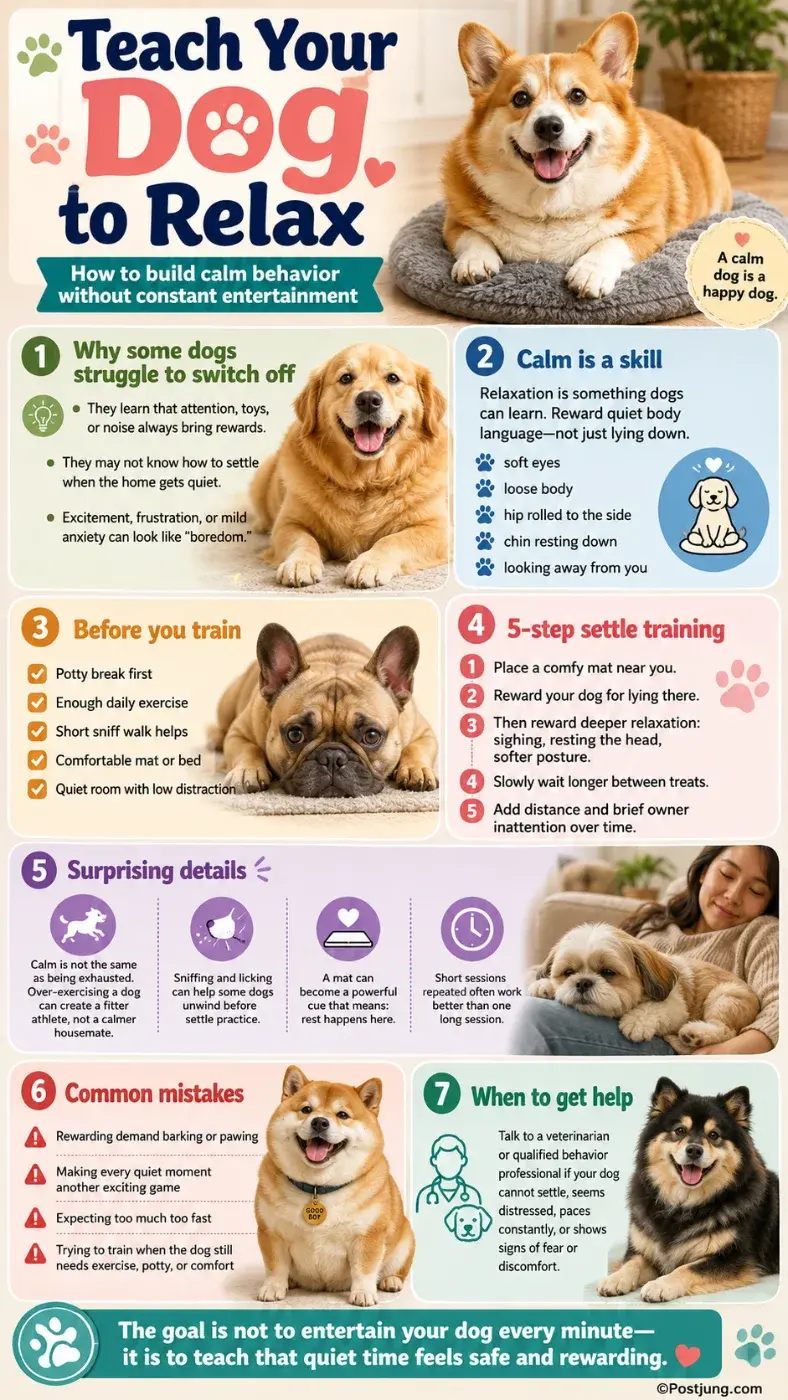
Give relaxation a physical location
Choose a comfortable dog bed or mat and place it near where you normally sit.
At first, the assignment is almost comically simple: you sit there, and your dog does very little.
When your dog lies on the mat, quietly place a small treat between the front paws. In the beginning, rewards can arrive fairly frequently. Then begin increasing the time between them.
The interesting part is what you reward next.
Instead of rewarding only the down position, watch for signs that your dog is becoming less interested in you: looking away, resting on one hip, lowering the chin, or adopting another loose, comfortable posture.
Those tiny changes are the behavior you want.
VCA specifically recommends gradually rewarding increasingly relaxed postures rather than merely rewarding a dog for remaining in position.
Reward disengagement, not constant attention
This can feel backward at first.
Owners naturally notice a dog when the dog does something—nudges a hand, delivers a toy, paws a leg, barks, or follows them into another room. A dog quietly resting in the corner is easy to overlook.
Relaxation training reverses that pattern.
Your dog looks away from you? Quietly reward it.
Your dog rests their head? Reward it.
Your dog remains comfortable while you read, work, or watch television? That is exactly the behavior worth reinforcing.
Keep your own behavior deliberately boring. VCA's calm-training guidance recommends a quiet demeanor and avoiding interactions that unnecessarily excite the dog during the exercise.
Once the relaxed behavior is happening predictably, you can associate it with a cue such as “settle.”
Make the rewards less predictable
You do not want to spend the rest of your dog's life dropping a piece of kibble every 20 seconds.
As your dog succeeds, gradually stretch the interval between rewards.
The long-term goal is a dog that looks as though a nap would be a perfectly acceptable outcome. VCA describes successful settling as relaxed waiting rather than intensely watching the owner in anticipation of another reward.
This is an important progression because the food is teaching the behavior; it is not supposed to become the activity itself.
Once your dog can remain relaxed for a short period, slowly increase the duration. Later, move the mat farther from you.
Eventually, the bed or mat itself can become a strong cue: this is where exciting things stop and resting begins.
The American Kennel Club similarly recommends building a dog's “place” behavior progressively, increasing duration before adding distance and distractions rather than making everything harder at once.
Practice being unavailable while you are still home
One of the most useful stages is teaching your dog that your presence does not automatically mean access to your attention.
You might answer email while your dog rests nearby. Later, you might move around the room while the dog remains on the mat. Eventually, you can practice being farther away.
Veterinary guidance on enrichment and scheduling recommends starting independent mat-rest sessions at roughly five to 10 minutes, then gradually increasing the time between rewards and moving the mat farther from the owner after successful sessions.
This creates an important distinction in a dog's daily life:
Sometimes you do things together.
Sometimes you are nearby but busy.
And sometimes the dog rests.
All three can be normal.
Don't make every quiet moment another enrichment project
Food puzzles, sniffing games, chews, training sessions, walks, and interactive play can all have useful roles in a dog's life.
But replacing every moment of inactivity with another activity can miss the point if the skill you are trying to develop is genuine relaxation.
A food-filled toy can be useful during independent periods, particularly early in training, but eventually you also want your dog to discover that lying down without a project is safe and rewarding. VCA's guidance on scheduling specifically includes teaching dogs to accept periods when an owner's attention is unavailable.
The destination is not boredom as punishment. It is comfort with ordinary downtime.
Watch the dog in front of you
There is no universal timetable.
A dog that has practiced demanding interaction for years may take longer than one that naturally naps between activities. Puppies, adolescents, highly energetic dogs, and dogs experiencing anxiety may also need different pacing.
Increase difficulty gradually. If adding a distraction makes your dog repeatedly get up, stare at you, vocalize, or become agitated, make the exercise easier again.
Most importantly, persistent inability to settle should not automatically be treated as a training failure. Excitement and frustration can interfere with settling, but so can fear, anxiety, and physical discomfort. VCA recommends veterinary or veterinary-behavior evaluation when a dog is not making steady progress.
A genuinely relaxed dog should look relaxed.
Over time, that may become the biggest reward of the exercise: your dog learns that a quiet house doesn't mean something is missing.
Sometimes, nothing happening is exactly what is supposed to happen.
SOURCES USED:
- VCA Animal Hospitals — Dog Behavior and Training: Teaching Settle and Calm
VCA calm and settle training guide - VCA Animal Hospitals — Using Enrichment, Predictability and Scheduling to Train Your Dog
VCA enrichment and scheduling guide - American Kennel Club — How To Teach Your Dog To Go to Their Place
AKC place training guide

เขียนโดย Postjung Insights
 อำเภอที่มีชื่ออำเภอสั้นที่สุด 3 อำเภอเท่านั้นในประเทศไทย
 เจาะลึกรายได้พนักงานส่งอาหารแต่ละวันได้เท่าไร/หักค่าใช้จ่ายอะไรบ้าง
 แปลปกสลาก งวด 1 ต.ค. 69 ส่องตัวเลขจากภาพปกสลากกินแบ่งรัฐบาล
 รู้หรือไม่? เปิดรายได้พนักงานส่งพัสดุของแต่ละแอป วันหนึ่งได้เท่าไร
 สุดระทึก! ไฟไหม้รางรถไฟฟ้า MRT สถานีเตาปูน-บางโพ..หยุดให้บริการชั่วคราวทุกสถานี
 เกษียณแล้วทำอะไรดี เปิด 4 กลุ่มอาชีพที่ผู้สูงวัยไทยทำกันน้อย จากข้อมูล 5.26 ล้านคน
 เปิดศึกเลขเด็ดงวดนี้! เจ้าพ่อปากแดง ปะทะ เจ้าแม่ตะเคียนทอง งวด 1 ต.ค. 59 คัดมาให้เน้นๆ พร้อมลุ้นรวย
 โรงเรียนที่มีนักเรียนมากที่สุดในไทย
 เลขเด็ดไพ่ยิปซี งวด 1 ตุลาคม 2569 รวมเลขเด่นและเลขท้าย 2 ตัว
 เปิด 5 โรงเรียนหญิงล้วนเก่าแก่ของไทย ที่มีประวัติยาวนานกว่าศตวรรษ
 สถิติย้อนหลัง 10 ปี ออกเลขไหนบ้างมาดูกัน
 ส่องเลข 3 สำนักพิมพ์ งวด 1 ต.ค. 69 ตัวไหนมีข้อมูลตรงกันสุดระทึก! ไฟไหม้รางรถไฟฟ้า MRT สถานีเตาปูน-บางโพ..หยุดให้บริการชั่วคราวทุกสถานีเจาะลึกรายได้พนักงานส่งอาหารแต่ละวันได้เท่าไร/หักค่าใช้จ่ายอะไรบ้างเปิด 5 โรงเรียนหญิงล้วนเก่าแก่ของไทย ที่มีประวัติยาวนานกว่าศตวรรษ
 เปิด 5 สินค้าส่งออกของลาวที่คนไทยอาจคาดไม่ถึง หนึ่งในนั้นทำเงินเกือบ 1 พันล้านดอลลาร์เกษียณแล้วทำอะไรดี เปิด 4 กลุ่มอาชีพที่ผู้สูงวัยไทยทำกันน้อย จากข้อมูล 5.26 ล้านคน
 โรงเรียนเพียงแห่งเดียวของประเทศไทย ที่อยู่มาตั้งแต่ยุครัชกาลที่ 4
 English Edition