Why dogs lick their lips when there’s no food around

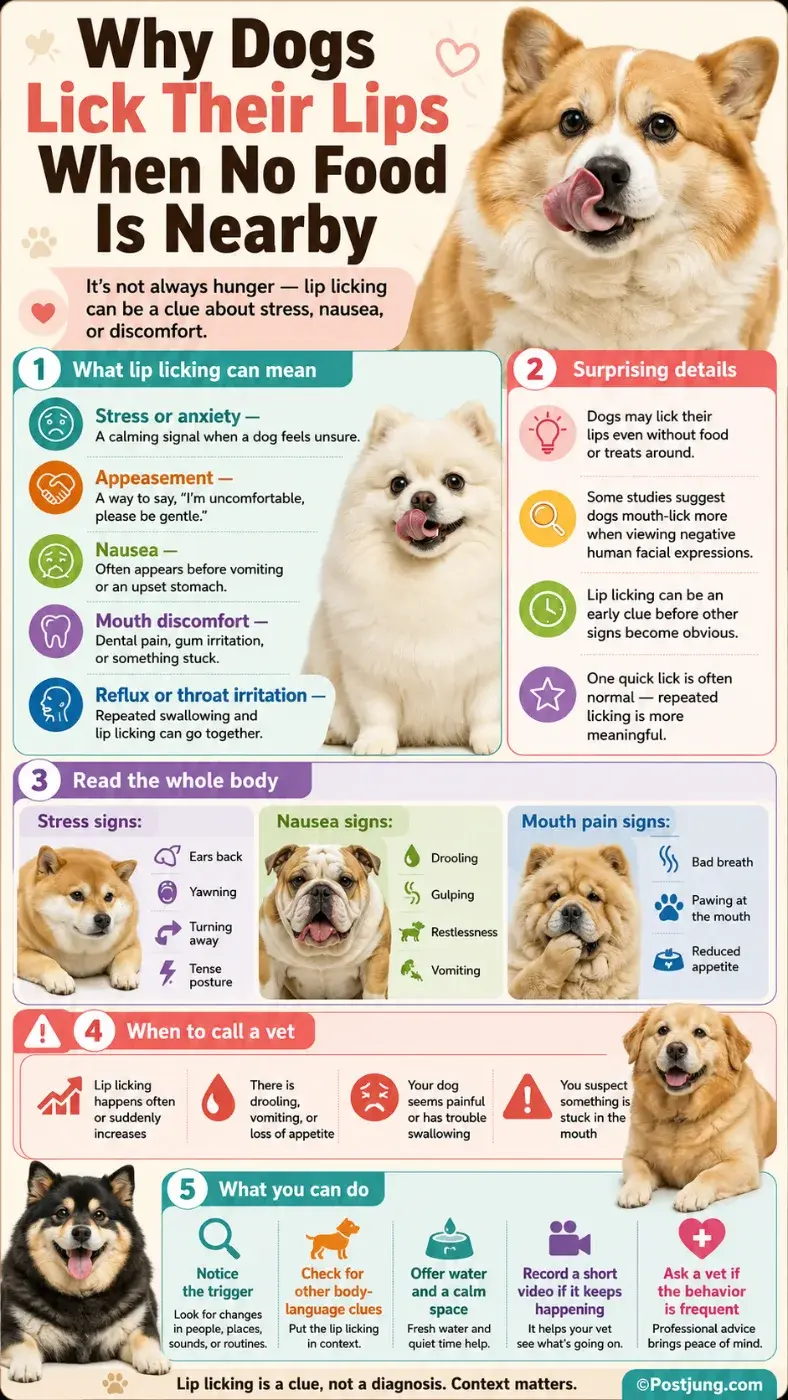
A quick tongue flick can be part of normal canine communication, but repeated lip licking may also accompany anxiety, nausea, reflux, or other physical discomfort. The surrounding context is usually more informative than the lick itself.
A dog licking its lips when dinner is being prepared is easy to understand. The same movement when there is no food nearby can be harder to interpret.
There is no single meaning. Veterinary guidance and behavioral research show that lip licking can appear during stress or heightened arousal, as part of social communication, or when a dog is experiencing nausea or physical discomfort. The useful clue is not the tongue flick by itself, but what is happening before, during, and after it.
Lip licking can be a response to stress
Veterinarians recognize lip licking as one of several displacement behaviors that may occur when a dog is frightened or anxious. Other signs can include changes in posture, excessive salivation, vocalizing, panting, avoidance, or difficulty settling.
That does not mean every lip lick proves a dog is anxious. A single behavior is rarely enough to identify an emotional state with certainty.
Instead, look at the situation. A dog that begins licking its lips when an unfamiliar person leans over it, during a veterinary examination, while being handled, or in another uncomfortable situation may be showing that its arousal or discomfort has increased.
Research offers an interesting clue about this behavior.
In an experiment involving 17 healthy adult family dogs, researchers presented dogs with positive and negative facial expressions while recording spontaneous mouth licking. Food was not used as a reward, and the dogs had not been food deprived. The dogs mouth-licked more frequently while looking at negative facial expressions than positive ones, with the effect particularly associated with human visual stimuli.
The study was small and does not turn lip licking into a universal “stress detector.” It does, however, demonstrate something important: dogs can perform this behavior when food and food anticipation are not responsible.
Sometimes the stomach is the reason
Lip licking can also have a medical explanation.
Dogs experiencing nausea may become restless, salivate, repeatedly swallow, and lick their lips before vomiting. Importantly, nausea does not always have to progress to vomiting.
This is why the pattern around the licking matters. A dog repeatedly licking its lips while also drooling, swallowing hard, appearing unsettled, refusing food, or developing vomiting deserves a different interpretation from a dog that gives one quick tongue flick when approached by a stranger.
Gastroesophageal reflux can produce a similar clue. VCA Animal Hospitals lists lip licking among possible signs of gastroesophageal reflux disease in dogs, along with decreased appetite, difficulty swallowing, coughing, generalized discomfort, and nighttime restlessness.
The mouth itself may be uncomfortable
The problem does not necessarily begin in the stomach.
Dental disease, painful gums, mouth injuries, growths, irritating substances, and foreign material caught in the mouth can all contribute to abnormal salivation and oral discomfort.
Problems farther back in the digestive tract can matter too. Esophageal inflammation or a foreign object lodged in the esophagus may cause excessive drooling, repeated swallowing, regurgitation, difficulty swallowing, or pain.
So if lip licking suddenly becomes frequent, it is worth looking beyond behavior—especially when the dog also has bad breath, reduced appetite, drooling, trouble swallowing, gagging, regurgitation, or apparent mouth pain.
Context is the best clue
One of the simplest ways to understand the behavior is to watch for patterns.
If lip licking repeatedly happens when a particular person approaches, during handling, around unfamiliar dogs, or in another tense situation, an emotional or behavioral explanation becomes more plausible. If it appears during car rides alongside drooling and restlessness, nausea or motion-related discomfort may be involved.
If it happens after meals, at night, alongside repeated swallowing, or without any obvious social trigger, a physical cause deserves more consideration.
Recording a short video can also be useful. Dogs do not always repeat subtle behaviors once they arrive at a veterinary clinic, and showing a veterinarian exactly what happens at home can provide useful context.
When repeated lip licking deserves attention
An occasional lip lick in an otherwise relaxed, healthy dog is not automatically a problem. Repeated or newly developed lip licking is more meaningful when it appears with other changes.
Contact a veterinarian if the behavior is persistent or is accompanied by excessive drooling, vomiting or regurgitation, difficulty swallowing, reduced appetite, apparent pain, or concern that something may be lodged in the mouth or esophagus. Those signs can have several possible causes and cannot be diagnosed from lip licking alone.
For everyday situations, the most useful habit is simply to observe the whole dog. Ears, eyes, posture, movement, appetite, swallowing, surroundings, and what happened immediately before the tongue flick all tell more of the story.
A dog licking its lips without food nearby may indeed be communicating something—but figuring out what requires reading the rest of the sentence.
SOURCES USED:
- Merck Veterinary Manual — Behavior Problems of Dogs
- University of São Paulo — Dogs’ behavioural strategies for responding and using emotional information
- VCA Animal Hospitals — Vomiting in Dogs
- VCA Animal Hospitals — Dealing with Drooling
- VCA Animal Hospitals — Gastroesophageal Reflux Disease in Dogs
- Merck Veterinary Manual — Disorders of the Esophagus in Dogs

เขียนโดย Postjung Insights
 เจาะลึกรายได้พนักงานส่งอาหารแต่ละวันได้เท่าไร/หักค่าใช้จ่ายอะไรบ้าง
 โรงเรียนที่มีนักเรียนมากที่สุดในไทย
 เกษียณแล้วทำอะไรดี เปิด 4 กลุ่มอาชีพที่ผู้สูงวัยไทยทำกันน้อย จากข้อมูล 5.26 ล้านคน
 สุดระทึก! ไฟไหม้รางรถไฟฟ้า MRT สถานีเตาปูน-บางโพ..หยุดให้บริการชั่วคราวทุกสถานี
 อำเภอที่มีชื่ออำเภอสั้นที่สุด 3 อำเภอเท่านั้นในประเทศไทย
 รู้หรือไม่? เปิดรายได้พนักงานส่งพัสดุของแต่ละแอป วันหนึ่งได้เท่าไร
 เลขเด็ดไพ่ยิปซี งวด 1 ตุลาคม 2569 รวมเลขเด่นและเลขท้าย 2 ตัว
 เปิด 5 โรงเรียนหญิงล้วนเก่าแก่ของไทย ที่มีประวัติยาวนานกว่าศตวรรษ
 ตาราง “เด่นเหนือเด่นใต้” งวด 1 ต.ค. 69 เปิดข้อมูลตามโพย เลขไหนอยู่ตรงไหน
 แปลปกสลาก งวด 1 ต.ค. 69 ส่องตัวเลขจากภาพปกสลากกินแบ่งรัฐบาล
 โรงเรียนเพียงแห่งเดียวของประเทศไทย ที่อยู่มาตั้งแต่ยุครัชกาลที่ 4
 สถิติย้อนหลัง 10 ปี ออกเลขไหนบ้างมาดูกันสุดระทึก! ไฟไหม้รางรถไฟฟ้า MRT สถานีเตาปูน-บางโพ..หยุดให้บริการชั่วคราวทุกสถานีเจาะลึกรายได้พนักงานส่งอาหารแต่ละวันได้เท่าไร/หักค่าใช้จ่ายอะไรบ้างเปิด 5 โรงเรียนหญิงล้วนเก่าแก่ของไทย ที่มีประวัติยาวนานกว่าศตวรรษ
 เปิด 5 สินค้าส่งออกของลาวที่คนไทยอาจคาดไม่ถึง หนึ่งในนั้นทำเงินเกือบ 1 พันล้านดอลลาร์เกษียณแล้วทำอะไรดี เปิด 4 กลุ่มอาชีพที่ผู้สูงวัยไทยทำกันน้อย จากข้อมูล 5.26 ล้านคนโรงเรียนเพียงแห่งเดียวของประเทศไทย ที่อยู่มาตั้งแต่ยุครัชกาลที่ 4
 English Edition