Why Parallel Walks Can Help Two Dogs Meet More Calmly
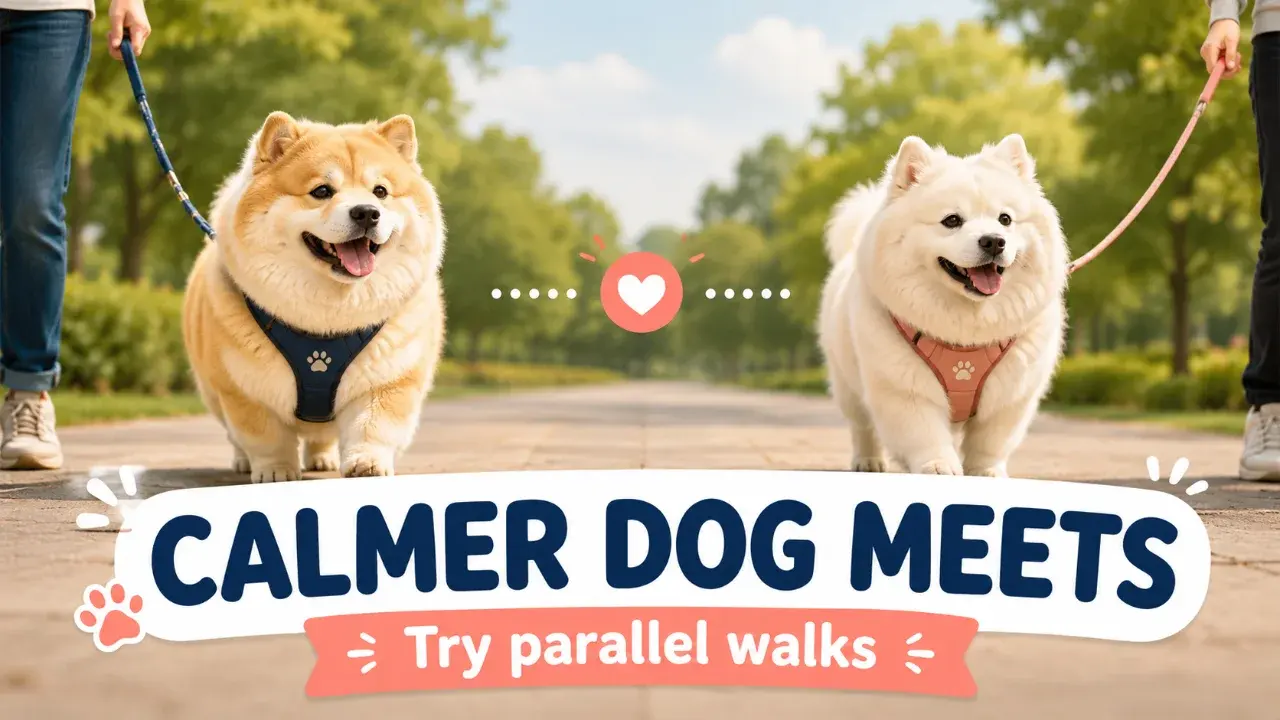
Instead of bringing unfamiliar dogs straight together, many animal-welfare organizations recommend beginning with space, movement, and separate handlers. The goal is not instant friendship but a controlled setting where both dogs can show whether they are comfortable getting closer.
A first meeting between two dogs does not have to begin nose to nose. One gentler option is a parallel walk: two handlers walk the dogs in the same direction, initially far enough apart that neither dog feels compelled to rush toward, stare at, or avoid the other.
The technique is recommended in dog-introduction guidance from organizations including Best Friends Animal Society, the RSPCA, Louisiana SPCA, and Seattle Humane. The common principle is simple: create enough distance for the dogs to notice each other without immediately requiring a close social interaction.
Why walking can make the meeting feel less intense
A stationary, face-to-face greeting puts both dogs' attention directly on each other. Parallel walking changes that picture.
The dogs are moving in the same direction, have more space to choose where to look, and can engage with the surrounding environment rather than being forced into continuous interaction. Bath Cats & Dogs Home, an RSPCA branch, describes parallel walking as a way to avoid face-on confrontation while giving dogs space and time to respond.
The RSPCA similarly recommends introducing dogs on neutral territory and taking them for a walk together, noting that the activity of walking can make the introduction less intense. It also recommends having at least two people so each dog can be handled separately.
That does not mean walking automatically makes two dogs compatible. It simply creates a more controlled environment in which handlers can observe what the dogs are communicating before allowing closer contact.
The right distance depends on the dogs
There is no magic number for how far apart two dogs should begin.
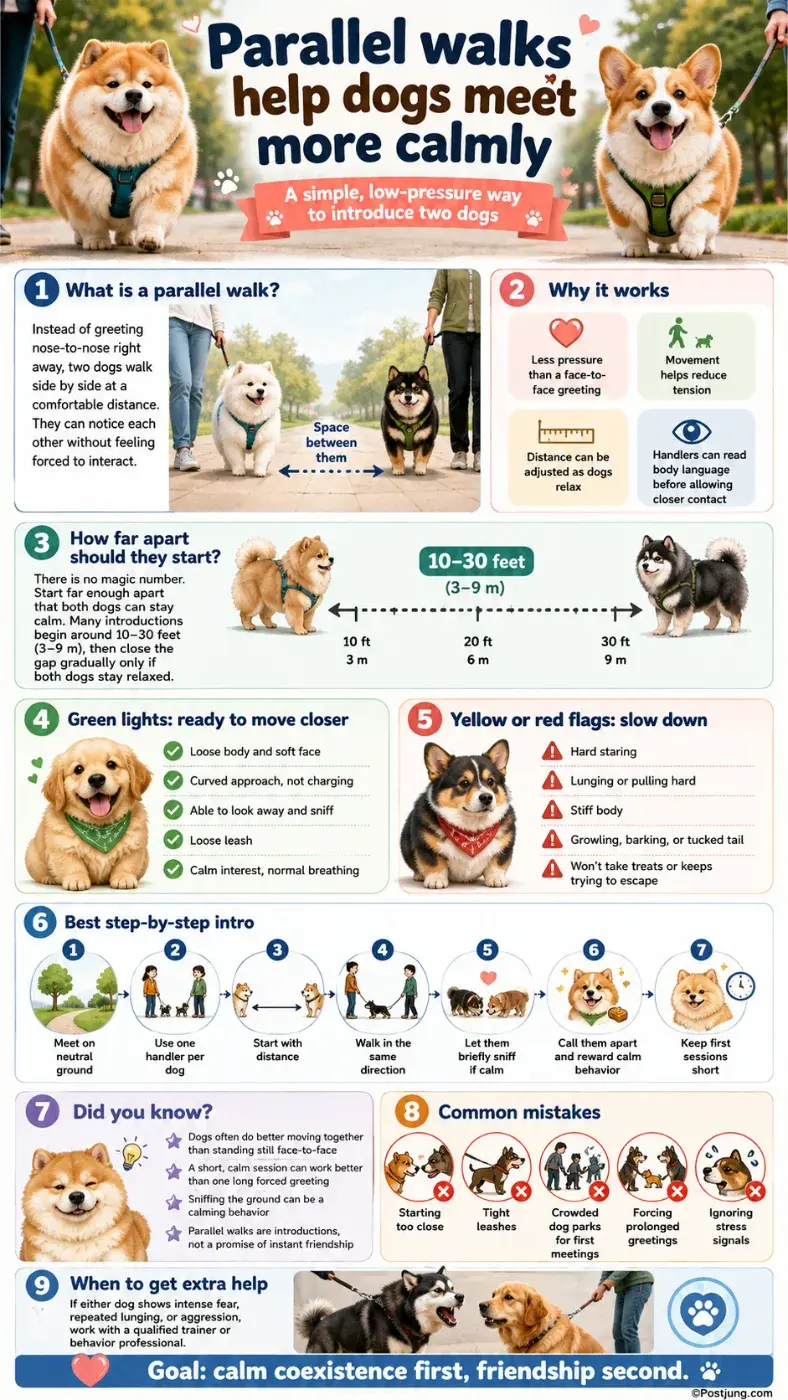
Louisiana SPCA suggests starting at about 10 feet (3 meters), Best Friends Animal Society gives an example of roughly 20 feet (6 meters), while updated PetMD guidance suggests that some introductions may begin around 30 feet (9 meters).
The useful lesson is not to choose one measurement and follow it rigidly. Start at a distance where both dogs can function comfortably.
If a dog is pulling hard toward the other, staring continuously, becoming increasingly excited, stiffening, growling, or trying to move away, creating more distance is generally more appropriate than pushing ahead with the greeting. Best Friends specifically advises moving farther apart when dogs are pulling toward one another, staring, or becoming overly excited.
Move closer only when both dogs are ready
As both dogs become more relaxed, the handlers can gradually reduce the space between them while continuing in the same direction.
Seattle Humane recommends beginning on neutral territory, keeping the leashes loose, moving closer gradually when the dogs remain comfortable, and allowing brief greetings rather than immediately turning the encounter into prolonged interaction.
Louisiana SPCA also recommends brief sniffing opportunities followed by calling the dogs apart and rewarding calm behavior.
Importantly, getting the dogs together as quickly as possible is not the objective. Some pairs may be ready to walk close together during one session; others may need several walks before the distance can safely shrink. Bath Cats & Dogs Home recommends short sessions rather than rushing dogs into proximity in a single attempt.
A parallel walk is an introduction, not a guarantee
Not every dog wants to socialize closely with every other dog. A successful first session might simply mean that both animals can walk in the same area without becoming distressed or excessively aroused.
Extra caution is needed when either dog has a history of lunging, intense leash reactivity, aggression, or significant fear around other dogs. Best Friends advises that its standard on-leash introduction procedure should not simply be applied to dogs showing leash or barrier reactivity, while Louisiana SPCA recommends professional assistance when introductions are not going smoothly.
For those dogs, increasing distance or working with a qualified behavior professional may be safer than trying to force a meeting.
Parallel walking works best as a way of giving dogs choices and giving people information. When the pace is determined by relaxed behavior rather than the desire to make the dogs become friends quickly, the first meeting has room to be exactly what it needs to be: calm, gradual, and uneventful.
SOURCES USED:
- Best Friends Animal Society — How to Introduce Dogs to Each Other
- RSPCA — Introducing Dogs
- Louisiana SPCA — Introducing a Dog to Other Pets
- Seattle Humane — Introducing Your New Dog to Your Resident Dog
- Bath Cats & Dogs Home — Introducing Dogs With Parallel Walking
- PetMD — How To Introduce Dogs to Each Other

เขียนโดย Postjung Insights
 7 บทเพลงไวรัลยุคโบราณ! เพลงงานวัดที่เปิดเมื่อไหร่ คนก็ลุกขึ้นรำวงเมื่อนั้น
 ตาราง “เด่นเหนือเด่นใต้” งวด 1 ต.ค. 69 เปิดข้อมูลตามโพย เลขไหนอยู่ตรงไหน
 รู้หรือไม่? เปิดรายได้พนักงานส่งพัสดุของแต่ละแอป วันหนึ่งได้เท่าไร
 อำเภอที่มีชื่ออำเภอสั้นที่สุด 3 อำเภอเท่านั้นในประเทศไทย
 รู้หรือไม่? ความทรงจำวัยเด็กอาจไม่ได้เหมือนที่เราเคยจำ! สมองสามารถ “เติมเรื่อง” ให้เราได้
 เปิด 5 โรงเรียนหญิงล้วนเก่าแก่ของไทย ที่มีประวัติยาวนานกว่าศตวรรษ
 เช็กด่วน ! ข่าวบัตรสวัสดิการแจก 10,000 บาท ก.ย. 69 จริงหรือ ? ก่อนเชื่อควรรู้อะไร
 โรงเรียนชายล้วนแห่งแรกของไทยคือที่ไหน? ย้อนดูจุดเริ่มต้นโรงเรียนสวนกุหลาบวิทยาลัย
 5 ไอเทมป้องกันความร้อนให้บ้านแบบโบราณ! ภูมิปัญญาเก่าที่ช่วยบ้านเย็นลงได้ 3-5 องศา
 โรงเรียนที่มีนักเรียนมากที่สุดในไทย
 7 คันเบ็ดตกปลาโบราณ สายเรโทรยอมทุ่มเงินซื้อ! ยิ่งเก่า ยิ่งหายาก ยิ่งมีเรื่องราว
 ส่องเลข 3 สำนักพิมพ์ งวด 1 ต.ค. 69 ตัวไหนมีข้อมูลตรงกันอำเภอที่มีชื่ออำเภอสั้นที่สุด 3 อำเภอเท่านั้นในประเทศไทย
 English Edition