Why cats purr when they do not seem obviously happy
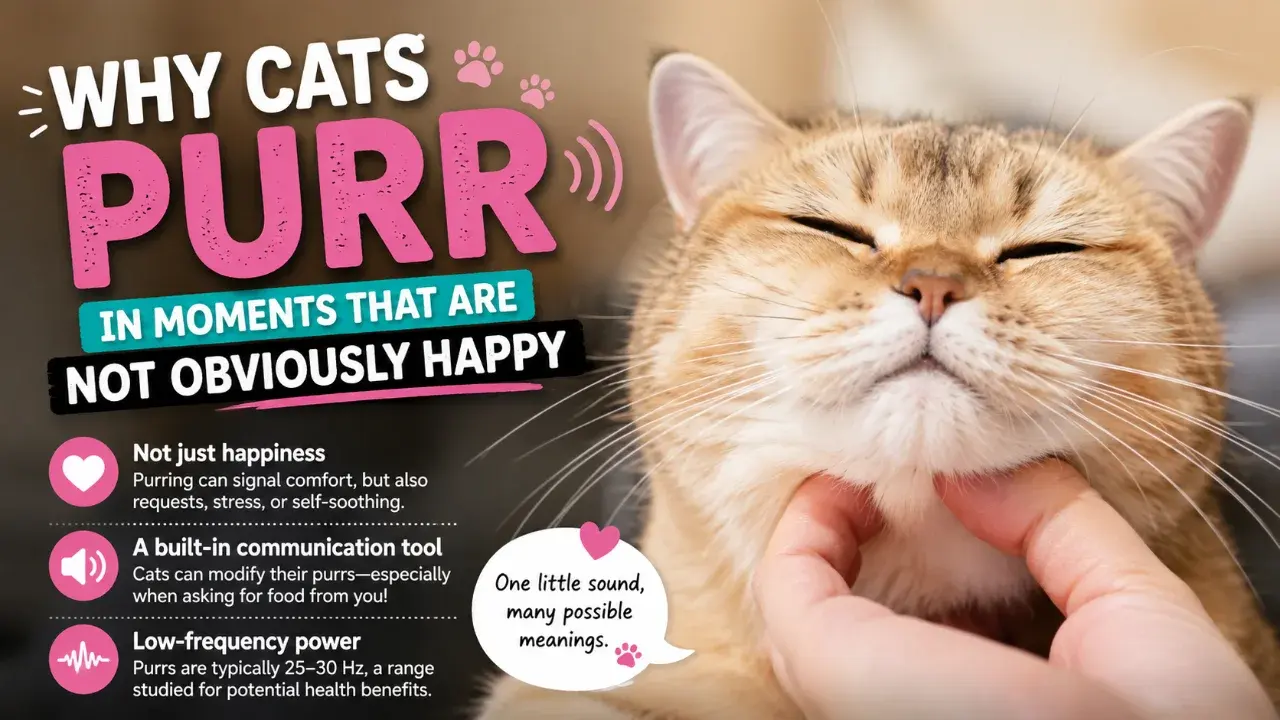
Purring is strongly associated with comfort, but research shows that cats can also use it as a flexible communication signal. The surrounding situation, body language, and individual cat matter more than the sound alone.
A softly purring cat curled up on a warm lap looks like an easy behavior to interpret: the cat is happy. Often, that probably is exactly what is happening.
But purring is not a one-word feline translation for “content.” Research suggests it is a flexible vocal behavior whose meaning can change with context — and scientists still do not have a complete explanation for every situation in which cats purr.
A purr can be part of a request
One of the clearest demonstrations that purring does more than express passive contentment came from researchers led by animal communication scientist Karen McComb.
In a 2009 study published in Current Biology, the researchers examined what they called “solicitation purrs”: sounds some domestic cats made while seeking food from their owners. Human listeners judged these purrs as more urgent and less pleasant than ordinary purring. Acoustic analysis found a higher-frequency vocal component embedded within the low purr.
That is an important distinction. A cat approaching its owner at breakfast and purring may be perfectly comfortable, but the sound can simultaneously function as a request.
In other words, purring does not have to represent a single emotional state. It can also be something a cat does to influence an interaction.
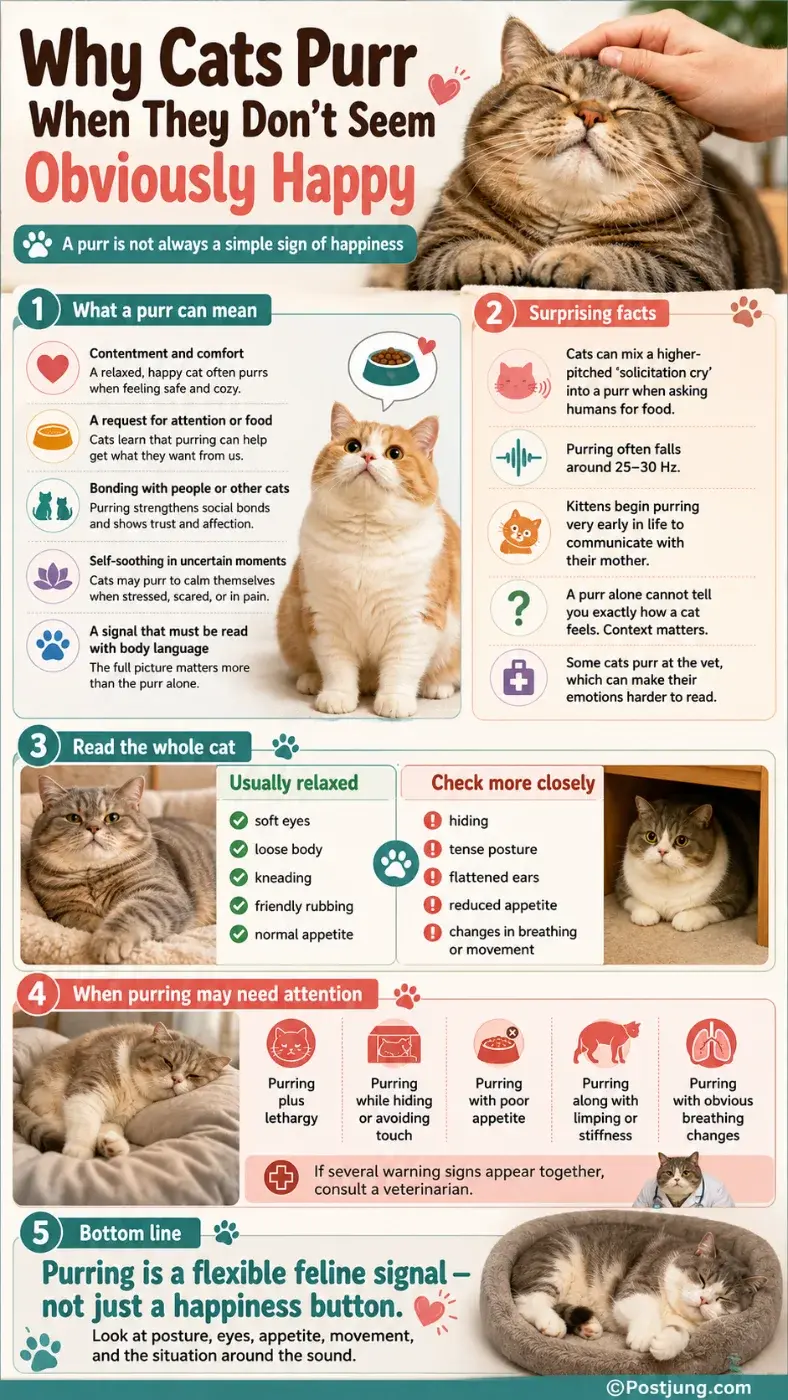
Context matters more than the sound alone
Another experiment highlights why broad claims about purring need caution.
A 2019 study involving 74 domestic cats in Curitiba, Brazil, compared vocal behavior in a pleasant situation, in which cats were offered a preferred snack, with an aversive situation involving simulated car transport. Vocalizations other than meowing — including some purring — appeared in the pleasant condition but not in the specific aversive condition tested.
That result supports a strong association between some forms of purring and positive experiences. But it does not establish a universal rule. The experiment examined two particular situations, and only some cats produced the vocalizations being studied.
This is why an isolated purr tells only part of the story.
If a cat is purring while rubbing against a familiar person, kneading, resting loosely, and voluntarily remaining nearby, those signals together create a much stronger picture of comfort than the purr by itself.
Likewise, hearing a cat purr in an unfamiliar setting does not automatically tell you whether the animal feels relaxed, wants contact, expects something, or is responding in another way.
Even the mechanics of purring are still being revised
Scientists have also been reconsidering how cats physically make their unusually low sound.
For decades, a leading explanation involved rapidly repeated contractions of muscles in the larynx, or voice box. But a 2023 Current Biology experiment tested eight excised domestic-cat larynges and found that all could produce self-sustaining oscillations in the typical purring range without neural input or active muscular contraction.
The researchers measured fundamental frequencies of roughly 25 to 30 hertz and identified connective-tissue structures within the vocal folds that could help make such low frequencies possible. They emphasized that their results did not completely eliminate a role for active muscular control in a living cat.
That study addressed how the sound can be produced, however — not why a particular cat decides to purr at a particular moment.
Those remain separate questions.
What about cats that purr at the veterinarian?
Purring during veterinary examinations is real enough to create a practical problem: it can make a cat’s heart and lungs difficult to hear through a stethoscope. Researchers have even tested techniques for temporarily stopping purring so veterinarians can perform auscultation more easily.
But a veterinary-clinic purr should not automatically be labeled either happiness or distress.
The clinic itself may be unfamiliar, yet individual cats respond differently to handling, attention, people, and new environments. The existence of purring in such a setting demonstrates why behavior needs to be interpreted as a package rather than from one sound.
If a cat suddenly begins purring while also showing a major change in appetite, movement, posture, hiding behavior, breathing, grooming, or social interaction, the broader change is more informative than trying to decode the purr itself.
The “healing purr” idea needs more evidence
One particularly appealing explanation is that cats purr because low-frequency vibration helps their bodies heal.
The idea is widely repeated, but evidence that certain mechanical frequencies can affect biological tissue is not the same as evidence that cats deliberately purr to repair bones or injuries.
Current research on the mechanics of purring does not establish that healing is its biological purpose. Treating the hypothesis as proven goes beyond what the evidence currently shows.
For now, communication and emotional context have much firmer experimental support.
Listen to the whole cat
A purr is meaningful, but it is not a standalone emotional diagnostic tool.
The strongest interpretation comes from combining the sound with the cat’s posture, facial expression, movement, environment, recent behavior, and relationship with the people or animals nearby.
Sometimes all those clues point toward uncomplicated pleasure. Sometimes the cat is asking for breakfast. And sometimes the situation remains ambiguous.
That complexity does not make purring less useful. It makes it more interesting: one of the most familiar sounds in our homes appears to be a flexible part of how cats navigate both their own emotional world and their relationships with us.
SOURCES USED:
- McComb K, Taylor AM, Wilson C, Charlton BD — The cry embedded within the purr, Current Biology
https://www.cell.com/current-biology/fulltext/S0960-9822(09)01168-3 - University of Sussex research repository — The cry embedded within the purr
https://sussex.figshare.com/articles/journal_contribution/The_cry_embedded_within_the_purr/23325722 - Fermo JL, Schnaider MA, Silva AHP, Molento CFM — Only When It Feels Good: Specific Cat Vocalizations Other Than Meowing, Animals
https://www.mdpi.com/2076-2615/9/11/878 - Herbst CT et al. — Domestic cat larynges can produce purring frequencies without neural input, Current Biology / University of Veterinary Medicine Vienna repository
https://phaidra.vetmeduni.ac.at/o:3419 - Little CJL et al. — Purring in cats during auscultation: how common is it, and how can it be stopped?, Journal of Small Animal Practice / PubMed
https://pubmed.ncbi.nlm.nih.gov/24329568/

เขียนโดย Postjung Insights
 7 บทเพลงไวรัลยุคโบราณ! เพลงงานวัดที่เปิดเมื่อไหร่ คนก็ลุกขึ้นรำวงเมื่อนั้น
 อำเภอที่มีชื่ออำเภอสั้นที่สุด 3 อำเภอเท่านั้นในประเทศไทย
 รู้หรือไม่? ความทรงจำวัยเด็กอาจไม่ได้เหมือนที่เราเคยจำ! สมองสามารถ “เติมเรื่อง” ให้เราได้
 รู้หรือไม่? เปิดรายได้พนักงานส่งพัสดุของแต่ละแอป วันหนึ่งได้เท่าไร
 5 ไอเทมป้องกันความร้อนให้บ้านแบบโบราณ! ภูมิปัญญาเก่าที่ช่วยบ้านเย็นลงได้ 3-5 องศา
 โรงเรียนที่มีนักเรียนมากที่สุดในไทย
 ตาราง “เด่นเหนือเด่นใต้” งวด 1 ต.ค. 69 เปิดข้อมูลตามโพย เลขไหนอยู่ตรงไหน
 เช็กด่วน ! ข่าวบัตรสวัสดิการแจก 10,000 บาท ก.ย. 69 จริงหรือ ? ก่อนเชื่อควรรู้อะไร
 ทำไมหนังสือบางเล่มถึงมีหน้าว่างทั้งหน้า? มันอาจไม่ได้พิมพ์พลาด
 เปิด 5 โรงเรียนหญิงล้วนเก่าแก่ของไทย ที่มีประวัติยาวนานกว่าศตวรรษ
 7 คันเบ็ดตกปลาโบราณ สายเรโทรยอมทุ่มเงินซื้อ! ยิ่งเก่า ยิ่งหายาก ยิ่งมีเรื่องราว
 AI วิเคราะห์สถิติ 20 ปีหวยงวด 1 ตุลาคม 69 ให้เลขท้าย 2 ตัวเน้นๆ!อำเภอที่มีชื่ออำเภอสั้นที่สุด 3 อำเภอเท่านั้นในประเทศไทย
 English Edition