Are pet breed identification apps accurate enough to trust?
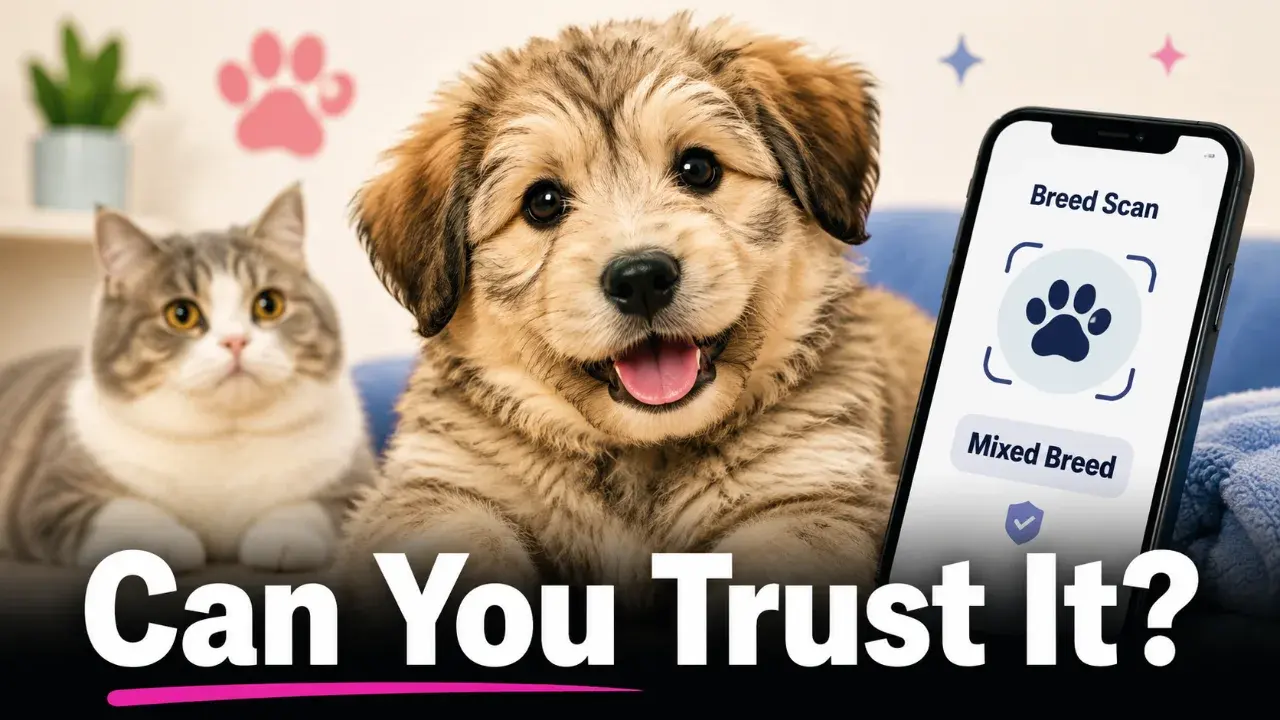
Breed-scanning apps can make surprisingly convincing guesses from a photo, particularly when an animal resembles a well-known pure breed. But research on dogs shows that appearance alone becomes far less dependable when the real question is genetic ancestry—especially for mixed breeds.
Point your phone at a dog or cat, take a picture, and within seconds an app may confidently announce a breed—sometimes with percentage estimates for several breeds.
The technology can be entertaining and genuinely impressive. But if "trust" means treating that result as proof of an animal's ancestry, the answer is much more cautious: a photograph can reveal visible traits, but it cannot directly reveal the DNA that produced them.
That distinction becomes especially important with mixed-breed dogs.
Breed recognition is not the same as ancestry testing
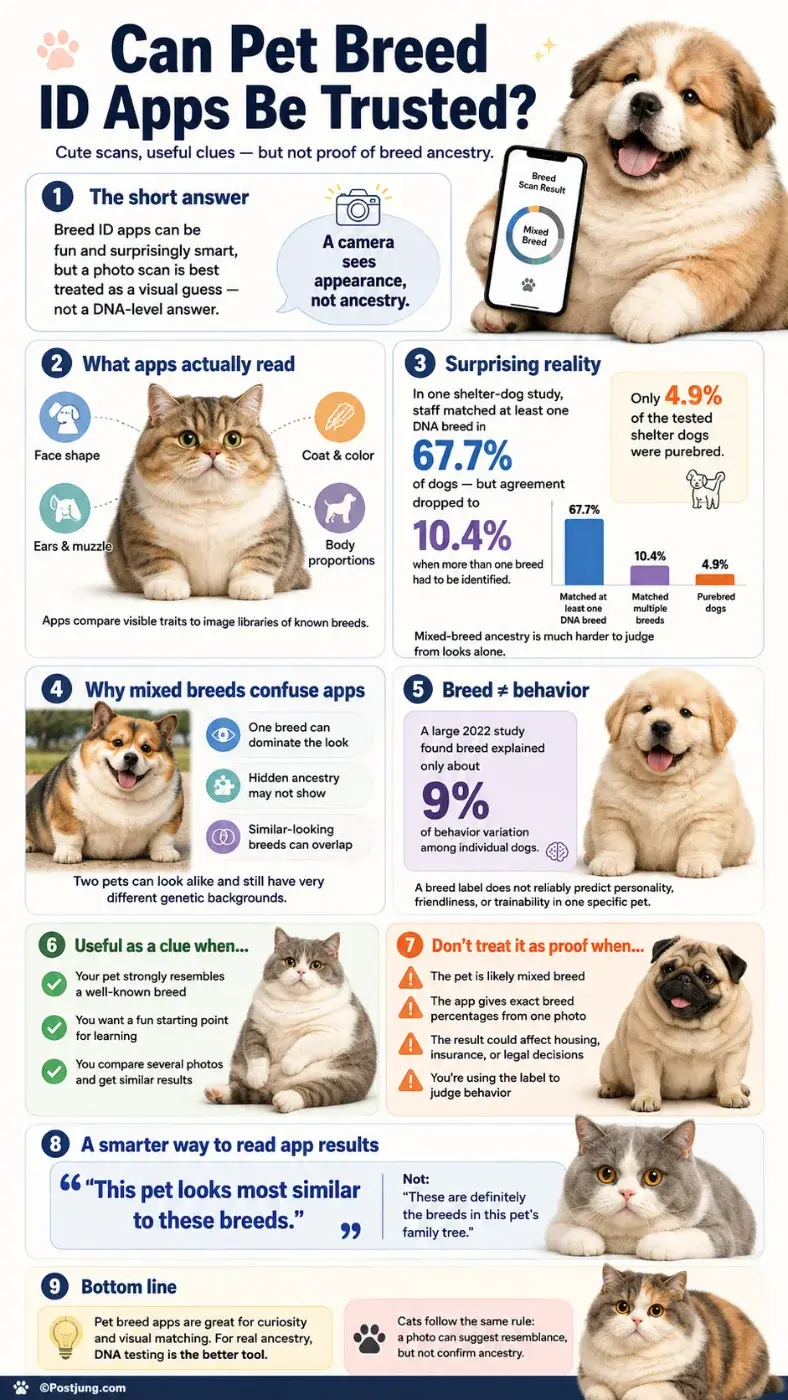
Most photo-based breed scanners are image-classification systems. They analyze visible characteristics such as facial shape, coat, ears, proportions, coloring and other patterns, then compare those features with examples the software has learned.
Some current apps explicitly describe their results as estimates. Others make stronger claims, including the ability to identify mixed breeds or display apparent percentage breakdowns. Google Play listings for breed-recognition apps show both approaches, with some developers emphasizing that lighting, image quality, visual similarity between breeds and mixed ancestry can affect predictions.
The crucial limitation is simple: two dogs can look similar without having the same ancestry, while genetically related dogs—or dogs containing some of the same breeds—can look surprisingly different.
A phone camera records phenotype, the animal's observable appearance. It does not read genotype, the underlying genetic information.
Mixed-breed dogs expose the weakness of visual guessing
One of the clearest demonstrations comes from research on shelter dogs.
A 2018 study genetically tested 919 dogs at shelters in Arizona and California and compared those findings with visual breed assignments. At the San Diego shelter, staff correctly matched at least one genetically detected breed in 67.7% of dogs. When more than one breed had to be identified, agreement dropped to just 10.4%. Only 4.9% of the genetically tested dogs in the overall sample were identified as purebred.
That does not mean humans and apps perform identically. A trained computer-vision model may recognize subtle visual patterns more consistently than a person.
But it illustrates the deeper problem any photo-only system faces: mixed ancestry is not reliably reconstructed from appearance.
Another study involving 120 shelter dogs found substantial disagreement when staff visually classified dogs as "pit bull-type." DNA testing identified 25 dogs in that category, while shelter staff collectively applied the label to 62. Individual visual assessments varied considerably in sensitivity and specificity. The researchers concluded that visual identification was unreliable for that classification.
Why "90% accurate" may not mean what it sounds like
Computer-vision research has sometimes reported dog-breed classification performance above 90%. That sounds reassuring until you examine what the model is being tested on.
A 2025 review in the American Journal of Veterinary Research examined whether artificial-intelligence breed recognition research could meaningfully support breed assignment in veterinary records. The authors noted that computer-science studies have reported accuracy exceeding 90%, but concluded that common research datasets use breed definitions and structures that limit their relevance to veterinary breed identification in the real world.
This is a familiar machine-learning problem.
A model can perform extremely well when choosing among known categories represented in its training data. The real world is messier: mixed ancestry, uncommon breeds, similar-looking breeds, puppies, unusual coat variations, poor camera angles and animals that simply do not resemble the textbook examples.
So an accuracy number from a controlled dataset should not automatically be interpreted as "this app has a 90% chance of correctly reconstructing my rescue dog's ancestry."
Those are different tests.
What about cats?
The same fundamental distinction applies to cats: recognizing that an animal visually resembles a Maine Coon, Siamese or British Shorthair is not the same as establishing documented or genetic ancestry.
Some cat-scanning services advertise high accuracy or mixed-breed identification from photos, but those figures are generally developer claims rather than independent genetic validation of every consumer result. For example, one current Cat Scanner listing says the app can recognize mixed breeds, while other services advertise confidence scores or proprietary accuracy figures.
That does not make the apps useless. It means the output should be interpreted for what it is: a visual prediction.
Breed labels also should not become personality predictions
There is another reason to avoid putting too much weight on a breed-scanner result.
Even a correct breed label does not determine how an individual dog will behave.
A major 2022 Science study analyzed behavioral information from 18,385 dogs and genetic data from 2,155. The researchers found that many behavioral traits have a genetic component, but breed explained only about 9% of behavioral variation among individual dogs.
Other genomic research has identified meaningful behavioral differences among canine genetic lineages, so ancestry is not irrelevant. But predicting an individual dog's temperament from a breed label remains much less certain than predicting obvious physical characteristics associated with some breeds.
That matters when an app accompanies its breed guess with generalized statements about friendliness, aggression, trainability or personality.
Those descriptions may characterize population tendencies. They are not a behavioral diagnosis of the animal standing in front of you.
So when should you trust a breed-scanning app?
Trust it as a clue, not a certificate.
If the app repeatedly identifies an unfamiliar dog as a particular breed and the animal strongly resembles that breed, the result can give you a useful starting point for learning about its appearance and possible heritage.
It can also be fun. Testing several photographs from different angles may reveal how the system interprets different physical features.
But a photo result should not be treated as definitive genetic ancestry, particularly when:
- the dog or cat is likely mixed breed;
- the app gives precise-looking ancestry percentages from a photograph;
- several visually similar breeds are possible;
- the result will influence a veterinary decision;
- the breed label has legal, housing or insurance consequences; or
- someone is using the breed prediction to judge an individual animal's behavior.
For ancestry questions, genetic testing evaluates biological information that a photograph simply cannot capture. Even genetic breed tests have limitations because results depend on reference populations and proprietary methods, but they address ancestry directly rather than inferring it from appearance.
The best way to read a pet breed scanner, then, may be exactly as its underlying technology works: "This animal looks most similar to these breeds"—not "these are definitely the breeds in this animal's family tree."
SOURCES USED:
- U.S. National Library of Medicine / PubMed — Standardizing canine breed data in veterinary records is challenging, but computer vision offers an alternative perspective on breed assignment
https://pubmed.ncbi.nlm.nih.gov/39983300/ - PLOS ONE / PubMed Central — A canine identity crisis: Genetic breed heritage testing of shelter dogs
https://pmc.ncbi.nlm.nih.gov/articles/PMC6107223/ - The Veterinary Journal / PubMed — Inconsistent identification of pit bull-type dogs by shelter staff
https://pubmed.ncbi.nlm.nih.gov/26403955/ - Science / PubMed — Ancestry-inclusive dog genomics challenges popular breed stereotypes
https://pubmed.ncbi.nlm.nih.gov/35482869/ - Cell / PubMed — Domestic dog lineages reveal genetic drivers of behavioral diversification
https://pubmed.ncbi.nlm.nih.gov/36493753/ - Google Play — Dog Scanner: Breed Recognition
https://play.google.com/store/apps/details?id=com.siwalusoftware.dogscanner

เขียนโดย Postjung Insights
 5 ไอเทมป้องกันความร้อนให้บ้านแบบโบราณ! ภูมิปัญญาเก่าที่ช่วยบ้านเย็นลงได้ 3-5 องศา
 7 บทเพลงไวรัลยุคโบราณ! เพลงงานวัดที่เปิดเมื่อไหร่ คนก็ลุกขึ้นรำวงเมื่อนั้น
 โรงเรียนที่มีนักเรียนมากที่สุดในไทย
 รู้หรือไม่? เปิดรายได้พนักงานส่งพัสดุของแต่ละแอป วันหนึ่งได้เท่าไร
 7 คันเบ็ดตกปลาโบราณ สายเรโทรยอมทุ่มเงินซื้อ! ยิ่งเก่า ยิ่งหายาก ยิ่งมีเรื่องราว
 รู้หรือไม่? ความทรงจำวัยเด็กอาจไม่ได้เหมือนที่เราเคยจำ! สมองสามารถ “เติมเรื่อง” ให้เราได้
 ทำไมหนังสือบางเล่มถึงมีหน้าว่างทั้งหน้า? มันอาจไม่ได้พิมพ์พลาด
 อำเภอที่มีชื่ออำเภอสั้นที่สุด 3 อำเภอเท่านั้นในประเทศไทย
 โรงเรียนเพียงแห่งเดียวของประเทศไทย ที่อยู่มาตั้งแต่ยุครัชกาลที่ 4
 ตาราง “เด่นเหนือเด่นใต้” งวด 1 ต.ค. 69 เปิดข้อมูลตามโพย เลขไหนอยู่ตรงไหน
 เปิด 5 โรงเรียนหญิงล้วนเก่าแก่ของไทย ที่มีประวัติยาวนานกว่าศตวรรษ
 เช็กด่วน ! ข่าวบัตรสวัสดิการแจก 10,000 บาท ก.ย. 69 จริงหรือ ? ก่อนเชื่อควรรู้อะไรอำเภอที่มีชื่ออำเภอสั้นที่สุด 3 อำเภอเท่านั้นในประเทศไทย
 English Edition