How toddlers can learn to respect pet body language

Toddlers cannot be expected to interpret every flick of an ear or movement of a tail. But adults can teach a few simple rules that help young children recognize when a dog or cat needs space—and make daily interactions safer for everyone.
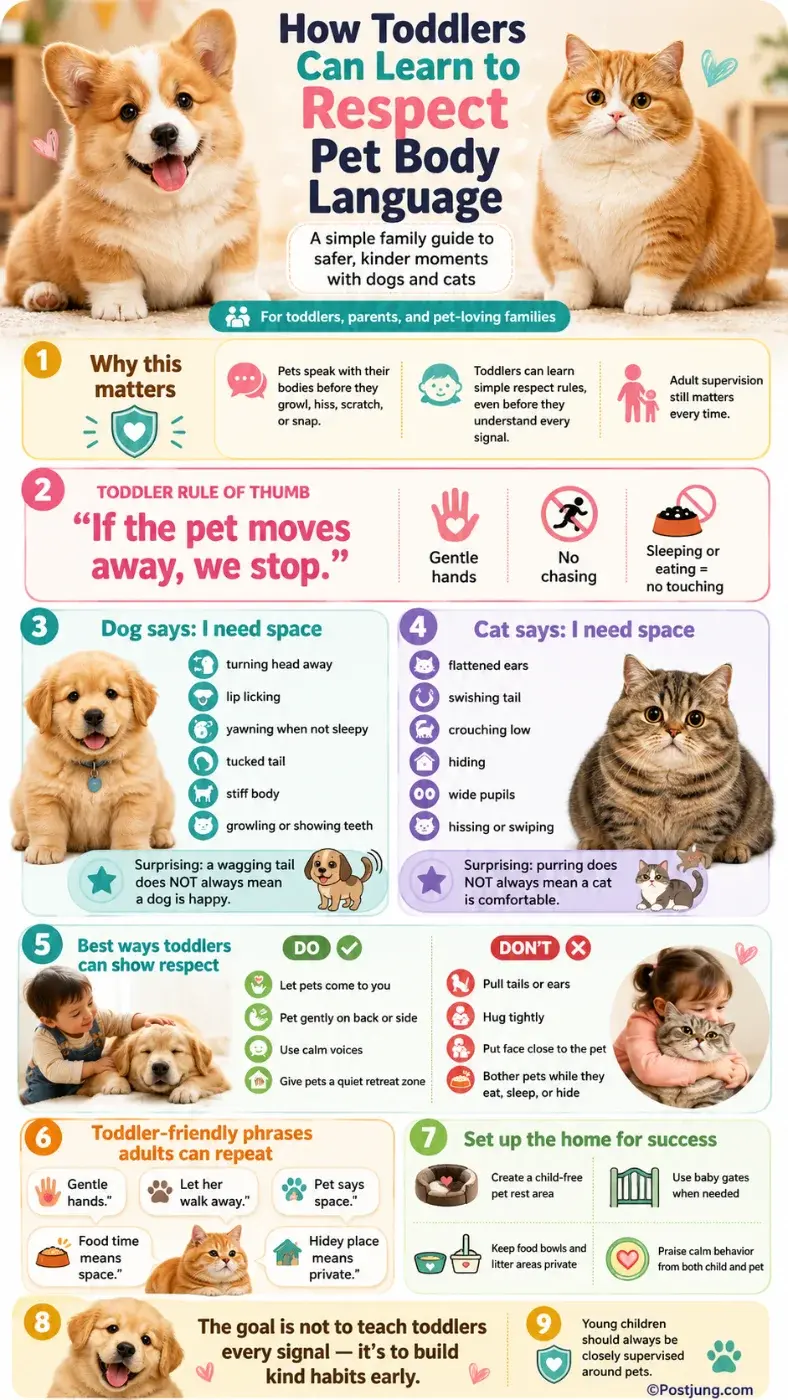
A toddler does not need to become an expert in animal behavior to start respecting a pet’s boundaries. At this age, the most useful lesson is much simpler: pets communicate with their bodies, and when they move away, become tense, hide, growl, hiss, or otherwise look uncomfortable, the child should stop and give them space.
The responsibility for safety, however, still belongs to adults. Animal-welfare organizations recommend supervising interactions between young children and pets rather than relying on a toddler to recognize every warning sign correctly.
Start with one rule: “If the pet moves away, we stop”
Young children learn well through short, repeatable rules. Instead of trying to explain every possible ear, eye, tail, and posture signal, parents can begin with an easy principle: if the animal tries to leave, let it leave.
That teaches something deeper than obedience. It introduces the idea that affection is not something a child is automatically entitled to receive from an animal.
A dog that turns its head away, lowers its body, tucks its tail, pulls its ears back, licks its lips, or yawns may be uncomfortable. The RSPCA also describes stiff posture, staring, snarling, and exposed teeth as stronger signals that a dog wants distance.
Cats have their own signals. A worried cat may crouch, flatten its ears, widen its pupils, hide, tense its body, or keep its tail close. Hissing, swiping, raised fur, or an arched, tense posture are clearer signs that the cat wants to be left alone.
For a toddler, these can all be translated into one useful phrase: “Pet says space.”
Teach what gentle contact actually looks like
Toddlers are naturally physical. They may hug tightly, grab fur, pull a tail, climb onto an animal, or place their face very close to a pet without understanding why the animal might object.
Dogs may find some typically affectionate human behavior uncomfortable, particularly hugging and close face-to-face contact. Guidance for families also recommends leaving dogs alone while they are eating, sleeping, chewing something valuable, resting, injured, or unwell.
With cats, adults can guide a toddler’s hand through a slow, gentle stroke rather than allowing poking, squeezing, grabbing, or rough patting. Cats Protection also recommends teaching children to leave cats alone when they retreat to hiding places.
Parents can turn these lessons into simple household phrases:
“Gentle hands.”
“Let her walk away.”
“Sleeping means no touching.”
“Food time means space.”
“Hidey place means private.”
The repetition matters more than a long explanation.
Watch the whole animal, not just the tail
One especially useful lesson for adults is that a single body part can be misleading.
A dog’s wagging tail, for example, should not automatically be treated as permission for a toddler to approach. Body posture, facial tension, ears, eyes, movement, and the situation around the dog all matter. The broader principle is to look at the entire animal rather than teach a child that one signal always means “friendly.”
The same applies to cats. Purring is commonly associated with contentment, but Cats Protection notes that context and the rest of the cat’s body language matter because cats can also purr in stressful situations.
For toddlers, adults can simplify this further: approach only when the pet appears relaxed and is choosing to stay nearby.
Give the pet a place the toddler cannot follow
Teaching children is only half of the arrangement. The environment should also make it easy for the animal to disengage.
A dog may need a bed, crate, gated room, or another quiet area where children do not disturb it. A cat benefits from hiding places or elevated spaces where it can retreat without being pursued. Animal-welfare guidance repeatedly emphasizes giving pets a safe area and teaching children that the area is off-limits.
This is especially valuable with toddlers because impulse control is still developing. A physical boundary such as a baby gate can succeed at moments when a verbal reminder does not.
Let the pet choose more of the interaction
Another useful habit is to teach children that an animal does not always have to be approached.
A calm child can sit nearby while the pet decides whether to come closer. This gives the animal more control and gives the adult time to watch its behavior.
The lesson can eventually become a form of early empathy: We notice what another living being is telling us, even when it cannot use words.
That does not mean a toddler can be made responsible for preventing scratches or bites. Young children can forget rules, move suddenly, misread signals, or become excited. Constant adult supervision around dogs is recommended for young children, and cat-safety guidance similarly advises supervising interactions and allowing the animal to escape or hide.
The goal is not to teach a toddler a perfect dictionary of animal communication. It is to build a few habits early: touch gently, do not chase, leave eating and sleeping pets alone, notice when the animal looks uncomfortable, and always let a pet walk away.
Those small lessons teach something useful long before a child can explain body language in words: affection should include respect for boundaries.
SOURCES USED:
- RSPCA — Understanding a dog's body language
https://www.rspca.org.uk/adviceandwelfare/pets/dogs/behaviour/understanding - RSPCA — Children & Dogs: How They Can Live Together
https://www.rspca.org.uk/adviceandwelfare/pets/dogs/company/children - American Kennel Club — How to Help Your Dog Love Children
https://www.akc.org/expert-advice/training/helping-your-dog-love-children/ - American Kennel Club — Safety Around Dogs
https://www.akc.org/public-education/resources/safety-around-dogs/ - Cats Protection — Teach Your Child to Care for Your Cat
https://www.cats.org.uk/cats-blog/teach-your-child-to-care-for-your-cat - Cats Protection — Cats and Children
https://www.cats.org.uk/help-and-advice/cats-and-your-family/cats-and-children

เขียนโดย Postjung Insights
 อำเภอที่มีชื่ออำเภอสั้นที่สุด 3 อำเภอเท่านั้นในประเทศไทย
 7 บทเพลงไวรัลยุคโบราณ! เพลงงานวัดที่เปิดเมื่อไหร่ คนก็ลุกขึ้นรำวงเมื่อนั้น
 รู้หรือไม่? ความทรงจำวัยเด็กอาจไม่ได้เหมือนที่เราเคยจำ! สมองสามารถ “เติมเรื่อง” ให้เราได้
 เช็กด่วน ! ข่าวบัตรสวัสดิการแจก 10,000 บาท ก.ย. 69 จริงหรือ ? ก่อนเชื่อควรรู้อะไร
 รู้หรือไม่? เปิดรายได้พนักงานส่งพัสดุของแต่ละแอป วันหนึ่งได้เท่าไร
 โรงเรียนที่มีนักเรียนมากที่สุดในไทย
 7 คันเบ็ดตกปลาโบราณ สายเรโทรยอมทุ่มเงินซื้อ! ยิ่งเก่า ยิ่งหายาก ยิ่งมีเรื่องราว
 5 ไอเทมป้องกันความร้อนให้บ้านแบบโบราณ! ภูมิปัญญาเก่าที่ช่วยบ้านเย็นลงได้ 3-5 องศา
 ตาราง “เด่นเหนือเด่นใต้” งวด 1 ต.ค. 69 เปิดข้อมูลตามโพย เลขไหนอยู่ตรงไหน
 ส่องเลข 3 สำนักพิมพ์ งวด 1 ต.ค. 69 ตัวไหนมีข้อมูลตรงกัน
 เปิด 5 โรงเรียนหญิงล้วนเก่าแก่ของไทย ที่มีประวัติยาวนานกว่าศตวรรษ
 5 เมนูอาหารไทยโบราณที่หาทานยาก ชื่อคุ้นหู แต่คนรุ่นใหม่อาจไม่เคยชิมอำเภอที่มีชื่ออำเภอสั้นที่สุด 3 อำเภอเท่านั้นในประเทศไทย
 English Edition