Why hand targeting is one of the most useful skills to teach your dog

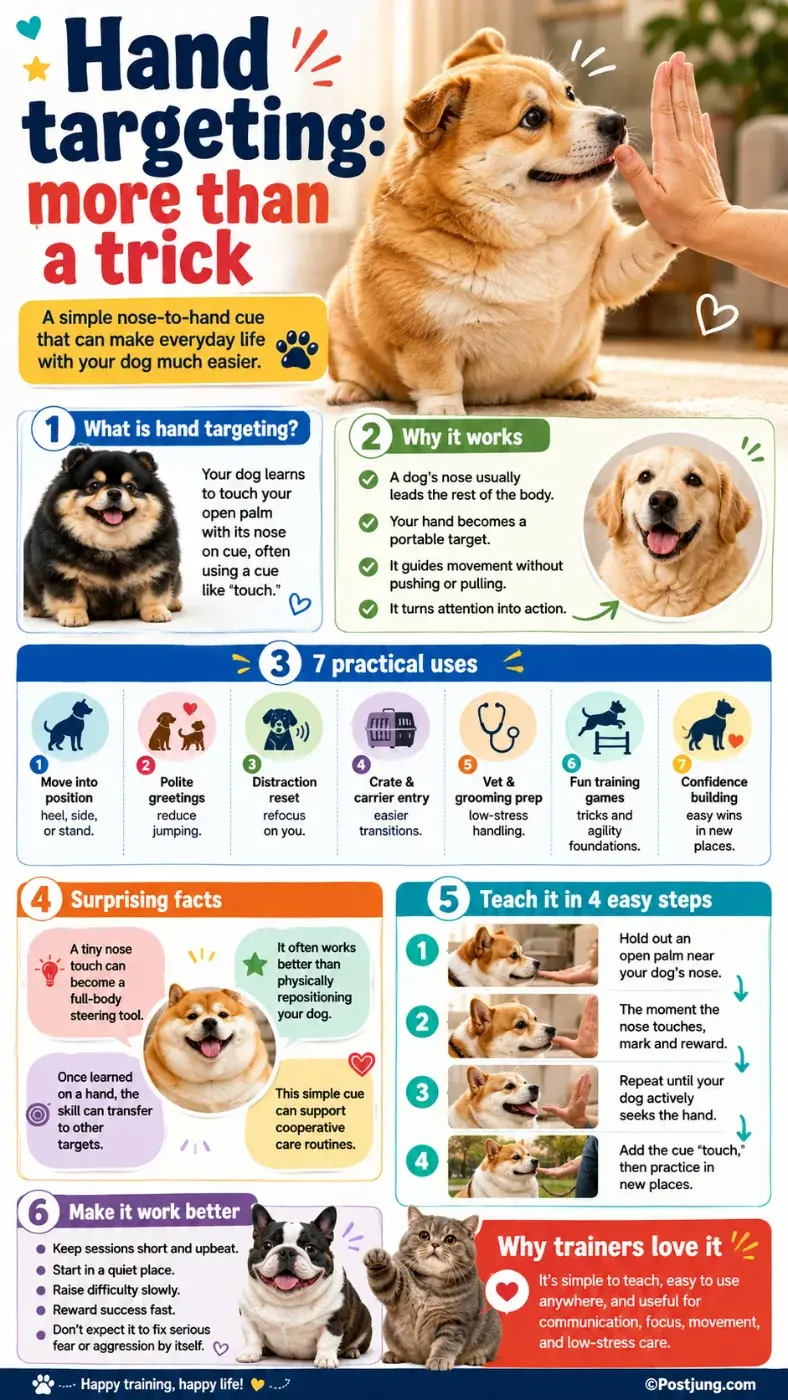
Teaching a dog to touch your palm with their nose may look like a tiny trick, but it creates a portable target you can use to guide movement, redirect attention, practice polite greetings, and support cooperative handling.
Teaching a dog to bump their nose against your palm is one of the simplest training exercises around. Yet once a dog understands the behavior, usually called “touch” or hand targeting, it can become a remarkably flexible tool for everyday communication.
The basic idea is straightforward: present an open hand, mark and reward the moment the dog’s nose makes contact, and gradually teach the dog to seek out that hand on cue. Because a dog’s head and body tend to follow the nose, changing the position of the target can also change where the dog moves.
That is where hand targeting becomes much more useful than its trick-like appearance suggests.
Your hand becomes a portable steering point
A food lure can guide a dog into position, but it requires food to be visibly involved during the early stage of the movement. A trained hand target works differently: the empty hand itself becomes the thing the dog moves toward.
VCA Animal Hospitals describes target training as teaching an animal to touch an object—such as a hand, finger, lid, or target stick—with part of the body. Once learned, targets can be used to guide an animal into positions, away from distractions, toward objects, or into places such as crates and carriers.
That means an owner can present a hand slightly to the left to reposition a dog, farther ahead to encourage movement, or near a particular location where the dog needs to stand.
The American Kennel Club similarly notes that nose targeting can be used to teach body positions and guide movements such as getting into heel position.
Instead of repeatedly pushing, pulling, or physically arranging a dog, the handler can give the dog a familiar destination.
It can redirect attention without turning everything into a confrontation
Hand targeting can also give dogs something specific to do when the environment becomes distracting.
The AKC recommends first practicing the behavior in easy environments, then progressively adding distance, different hand positions, and distractions. It also describes targeting as a potential way to redirect an anxious or reactive dog's attention toward the handler and away from something upsetting.
That distinction matters. “Touch” is not a cure for fear, anxiety, or aggression, and owners should not expect a trained cue to override a dog that is already overwhelmed.
But for a dog that can still respond and take reinforcement, a familiar hand target may provide a simple alternative behavior: instead of staring at a distraction, move toward this hand.
For significant fear, reactivity, or aggression, owners should work with a veterinarian or appropriately qualified behavior professional rather than relying on a single training exercise.
A nose touch can become the first step toward other behaviors
Once a dog understands targeting, the concept does not have to stay attached to a human hand.
The behavior can be transferred to another object. The AKC describes placing an object over the palm, rewarding the dog for touching it, and gradually moving that target away from the hand.
Suddenly, the same foundation skill can be used for completely different purposes.
A dog might learn to touch a bell, approach a designated object, move to a specific location, interact with training equipment, or perform more advanced tricks and dog-sport exercises. The AKC also notes applications ranging from polite greetings to agility and distance work.
The useful part is not the nose bump itself. It is the dog learning the broader concept: when a target appears, move toward it and interact with it.
It can make greetings more structured
Dogs that become excited around visitors often need a clear alternative to jumping, rushing forward, or bouncing around without direction.
A hand target offers one.
The AKC suggests using nose targeting as part of polite greetings by having a guest present a hand for the dog to touch rather than allowing jumping.
This should never mean forcing a nervous dog to approach a stranger. A dog that wants distance should be allowed distance.
For sociable dogs that simply need structure, however, a familiar target can transform “go say hello” into a specific behavior they already understand.
Targeting also fits naturally into cooperative care
One of the more interesting uses of targeting appears in cooperative animal care.
Fear Free Pets includes target training in its professional cooperative-care education, alongside voluntary interaction with veterinary equipment, positioning, and behaviors that allow animals to participate more predictably in handling.
A hand target can help move a dog into a useful location without grabbing or dragging them. Related targeting behaviors can also become foundations for more stationary cooperative-care skills.
This does not mean that a simple “touch” cue will make every veterinary procedure stress-free. Pain, illness, fear, previous experiences, and the procedure itself can all affect how a dog responds.
But teaching voluntary, reward-based positioning before it is urgently needed gives owners and veterinary teams another communication tool.
How to teach the basic hand target
Start somewhere quiet.
Hold an open palm close to the dog’s nose. Many dogs will naturally lean forward to investigate it.
The moment the nose touches the palm, mark the behavior with a clicker or a consistent marker such as “yes,” then immediately provide a reward. Once the dog is reliably choosing to touch the hand, a cue such as “touch” can be introduced before the hand appears. From there, gradually vary the hand position, distance, location, and level of distraction.
Avoid rushing to difficult environments. A dog that succeeds easily in the living room may not immediately understand the same exercise on a busy sidewalk. Training across different environments helps build a more dependable behavior.
Reward-based methods are also consistent with current guidance from the American Veterinary Society of Animal Behavior. AVSAB's current position recommends reward-based methods for dog training and behavior modification and advises against aversive techniques.
The value is in what comes next
Hand targeting rarely looks impressive when a dog first learns it. A palm appears, a nose touches it, and a treat follows.
But that tiny interaction creates a shared piece of vocabulary.
Your hand can mean “come this way,” “stand here,” “turn toward me,” or simply “here is an easy behavior you already know.”
That versatility is what makes targeting worth teaching. The nose bump may be the first lesson, but the real skill is giving a dog a clear, familiar destination—and giving the human an easy way to communicate where to go next.
SOURCES USED:

เขียนโดย Postjung Insights
 รู้หรือไม่? เปิดรายได้พนักงานส่งพัสดุของแต่ละแอป วันหนึ่งได้เท่าไร
 อำเภอที่มีชื่ออำเภอสั้นที่สุด 3 อำเภอเท่านั้นในประเทศไทย
 รู้หรือไม่? ความทรงจำวัยเด็กอาจไม่ได้เหมือนที่เราเคยจำ! สมองสามารถ “เติมเรื่อง” ให้เราได้
 เช็กด่วน ! ข่าวบัตรสวัสดิการแจก 10,000 บาท ก.ย. 69 จริงหรือ ? ก่อนเชื่อควรรู้อะไร
 5 ไอเทมป้องกันความร้อนให้บ้านแบบโบราณ! ภูมิปัญญาเก่าที่ช่วยบ้านเย็นลงได้ 3-5 องศา
 7 บทเพลงไวรัลยุคโบราณ! เพลงงานวัดที่เปิดเมื่อไหร่ คนก็ลุกขึ้นรำวงเมื่อนั้น
 โรงเรียนที่มีนักเรียนมากที่สุดในไทย
 7 คันเบ็ดตกปลาโบราณ สายเรโทรยอมทุ่มเงินซื้อ! ยิ่งเก่า ยิ่งหายาก ยิ่งมีเรื่องราว
 ตาราง “เด่นเหนือเด่นใต้” งวด 1 ต.ค. 69 เปิดข้อมูลตามโพย เลขไหนอยู่ตรงไหน
 เปิด 5 โรงเรียนหญิงล้วนเก่าแก่ของไทย ที่มีประวัติยาวนานกว่าศตวรรษ
 ทำไมบ้านเลขที่ 23–24 Leinster Gardens จึงไม่มีห้องอยู่ด้านหลัง
 โรงเรียนชายล้วนแห่งแรกของไทยคือที่ไหน? ย้อนดูจุดเริ่มต้นโรงเรียนสวนกุหลาบวิทยาลัยอำเภอที่มีชื่ออำเภอสั้นที่สุด 3 อำเภอเท่านั้นในประเทศไทย
 English Edition