Why humidity changes heat risk for dogs and cats
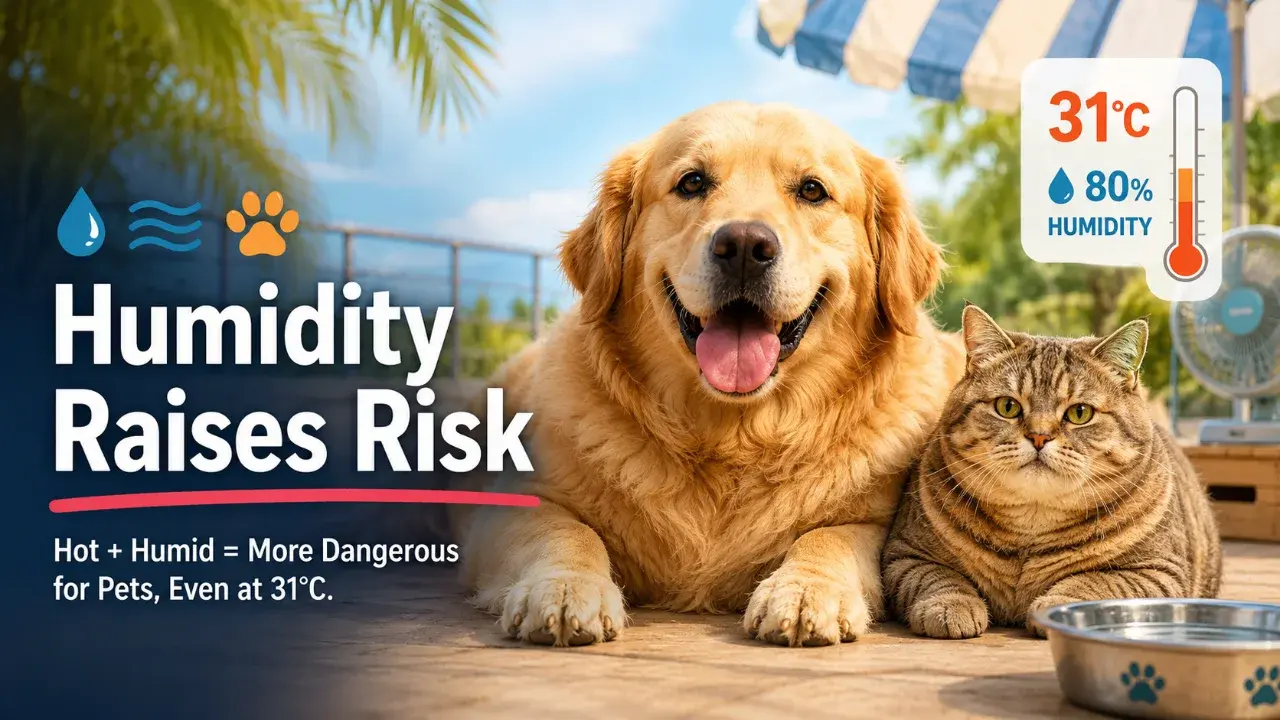
Dogs and cats do not cool themselves the way humans do. When the air is humid, evaporation becomes less effective, making hot weather potentially more dangerous even when the temperature does not seem extreme.
A hot day can become much harder on a pet when the air is also humid. The reason is not simply that humid weather feels uncomfortable: moisture in the air can interfere with evaporation, one of the key ways animals—especially dogs—release excess body heat.
That means two days with the same air temperature may not create the same level of heat stress.
For dogs, the difference can be especially important because panting is their primary mechanism for evaporative cooling. Cornell University College of Veterinary Medicine notes that dogs have sweat glands mainly on their paws and rely heavily on panting to control body temperature. Heatstroke can develop after exposure to hot or humid environments, strenuous activity, or a combination of the two.
Why humidity changes the cooling equation
When a dog pants, air passes across moist surfaces in the mouth, tongue and respiratory tract. Water evaporates from those surfaces, carrying heat away.
Research on canine thermoregulation describes panting as the major route of evaporative cooling in dogs exposed to heat or exercise. Studies of working dogs also note that humid conditions can impair effective evaporation.
The basic problem is straightforward: evaporation works best when surrounding air can accept more water vapor. As humidity rises, that process becomes less efficient.
At the same time, very warm air reduces other avenues of heat loss. A veterinary review of canine heatstroke explains that dogs normally lose considerable heat through radiation and convection, but those mechanisms become less effective as environmental temperature approaches body temperature. Evaporation through panting then becomes increasingly important.
Put those conditions together—high temperature plus high humidity—and a dog can face a particularly difficult cooling challenge.
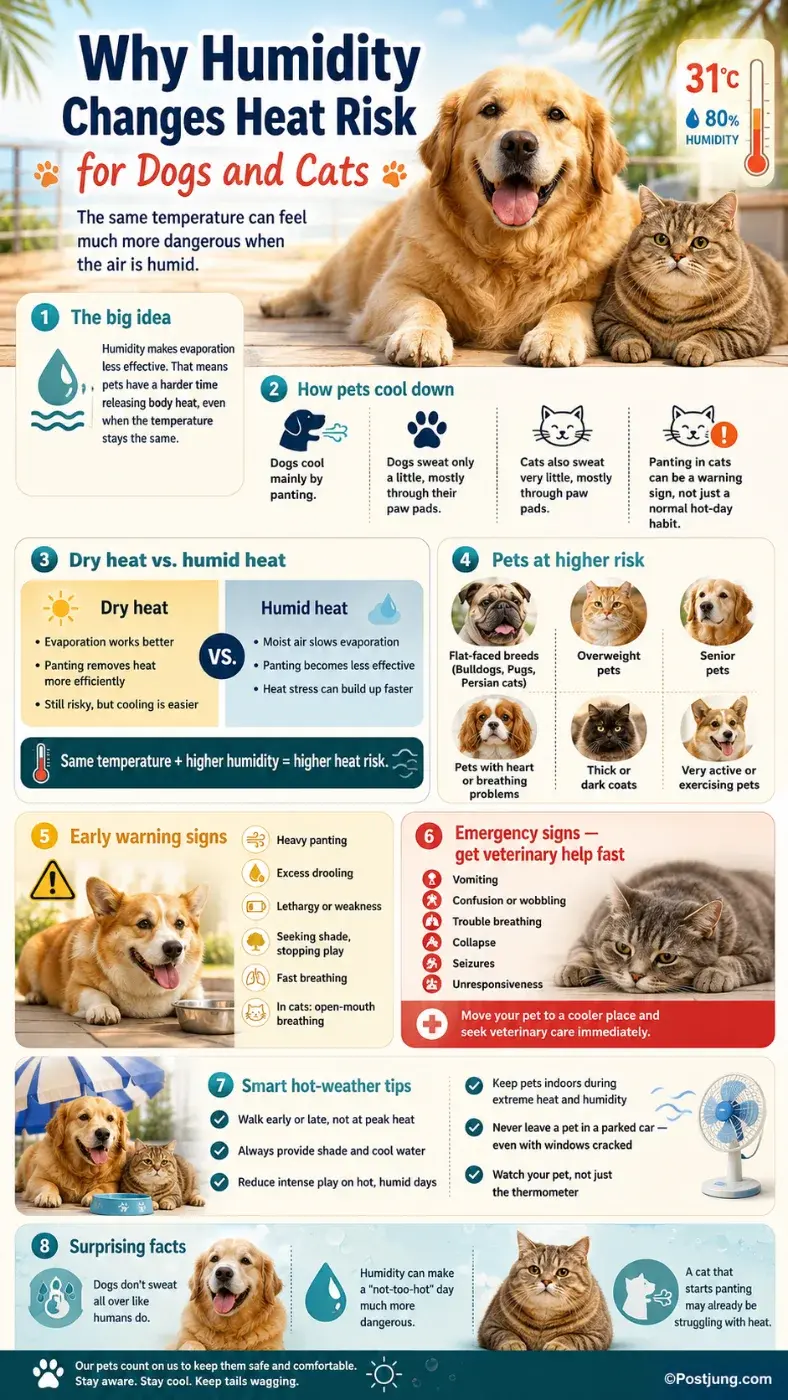
Cats can overheat too
Cats generally do not pant routinely in warm weather the way dogs do, but they also have limited ability to sweat across the body. Their sweat glands are concentrated largely in their paw pads.
Heatstroke in cats is less commonly discussed, but it is still a veterinary emergency. Merck Veterinary Manual lists heatstroke as an emergency in both dogs and cats, with possible signs including rapid panting, drooling, vomiting, loss of coordination, collapse and unconsciousness.
VCA Animal Hospitals similarly warns that cats can progress from overheating to life-threatening heatstroke and recommends keeping fresh water available and avoiding exposure to hot environments such as parked cars.
Open-mouth breathing or panting in a cat should therefore not simply be dismissed as a normal response to a warm day, particularly when accompanied by lethargy or distress.
Some pets have less room for error
Every dog can overheat, but certain animals are more vulnerable.
Cornell identifies short-muzzled, or brachycephalic, breeds such as Bulldogs and Pugs as particularly susceptible because their anatomy can make panting less efficient. Older dogs, overweight dogs, animals with thick or dark coats, and dogs with heart or respiratory disorders also have higher heatstroke risk.
Exercise adds another layer of risk because working muscles generate additional heat. A 2026 Cornell report on sporting dogs noted that exertional hyperthermia can develop rapidly during strenuous activity, particularly under hot, humid conditions or in environments to which a dog has not acclimatized.
This is why a routine walk, run or play session may need to be shortened—or skipped—when conditions become oppressive.
Watch the animal, not just the thermometer
There is no single temperature at which every dog or cat suddenly becomes unsafe. Risk varies with humidity, sunlight, airflow, exercise intensity, body condition, breed, age, hydration and medical history.
Instead of relying only on an air-temperature reading, watch how the animal is responding.
In dogs, early warning signs can include unusually heavy panting, seeking shade, excessive drooling, reluctance to continue exercising, whining or weakness. More serious signs include vomiting, diarrhea, confusion, breathing difficulty, seizures or collapse.
Cornell advises avoiding strenuous activity during hot and humid weather, providing shade and water, scheduling walks during cooler periods, and keeping pets indoors during extreme heat or humidity.
Cars are particularly dangerous. A parked vehicle can heat rapidly, and cracking a window does not make it reliably safe for a pet.
What to do when overheating is suspected
Heatstroke is not something to monitor casually at home.
Cornell recommends moving an overheated dog into a cooler environment, beginning cooling with cool water, and seeking veterinary treatment promptly. Severe signs such as persistent excessive panting, breathing difficulty, weakness, confusion, seizures or collapse require immediate veterinary care.
Merck likewise treats heatstroke as an emergency requiring rapid cooling and veterinary attention.
The practical takeaway is simple: humidity belongs in the heat-risk calculation.
A temperature that seems tolerable in dry conditions may place more strain on an animal when the air becomes humid, particularly during exercise or when airflow and access to cooler surroundings are limited.
For pet owners, the safest approach is not to search for one universal temperature cutoff. Pay attention to the combination of heat, humidity, activity and the individual animal—and respond early when a pet begins showing signs that its cooling system is struggling.
SOURCES USED:
- Cornell University College of Veterinary Medicine — Heatstroke: A medical emergency
- Cornell University College of Veterinary Medicine — Summer heat safety tips for dogs
- Merck Veterinary Manual — What to Do in a Dog or Cat Emergency
- PubMed — Panting in dogs: paths of air flow in response to heat and exercise
- PMC — Evaluation of Three Hydration Strategies in Detection Dogs Working in a Hot Environment
- VCA Animal Hospitals — Beat the heat! Tips to keep your cat cool

เขียนโดย Postjung Insights
 โรงเรียนที่มีนักเรียนมากที่สุดในไทย
 7 บทเพลงไวรัลยุคโบราณ! เพลงงานวัดที่เปิดเมื่อไหร่ คนก็ลุกขึ้นรำวงเมื่อนั้น
 รู้หรือไม่? เปิดรายได้พนักงานส่งพัสดุของแต่ละแอป วันหนึ่งได้เท่าไร
 5 ไอเทมป้องกันความร้อนให้บ้านแบบโบราณ! ภูมิปัญญาเก่าที่ช่วยบ้านเย็นลงได้ 3-5 องศา
 อำเภอที่มีชื่ออำเภอสั้นที่สุด 3 อำเภอเท่านั้นในประเทศไทย
 ส่องเลข 3 สำนักพิมพ์ งวด 1 ต.ค. 69 ตัวไหนมีข้อมูลตรงกัน
 เช็กด่วน ! ข่าวบัตรสวัสดิการแจก 10,000 บาท ก.ย. 69 จริงหรือ ? ก่อนเชื่อควรรู้อะไร
 รู้หรือไม่? ความทรงจำวัยเด็กอาจไม่ได้เหมือนที่เราเคยจำ! สมองสามารถ “เติมเรื่อง” ให้เราได้
 7 คันเบ็ดตกปลาโบราณ สายเรโทรยอมทุ่มเงินซื้อ! ยิ่งเก่า ยิ่งหายาก ยิ่งมีเรื่องราว
 ตาราง “เด่นเหนือเด่นใต้” งวด 1 ต.ค. 69 เปิดข้อมูลตามโพย เลขไหนอยู่ตรงไหน
 โรงเรียนชายล้วนแห่งแรกของไทยคือที่ไหน? ย้อนดูจุดเริ่มต้นโรงเรียนสวนกุหลาบวิทยาลัย
 AI วิเคราะห์สถิติ 20 ปีหวยงวด 1 ตุลาคม 69 ให้เลขท้าย 2 ตัวเน้นๆ!อำเภอที่มีชื่ออำเภอสั้นที่สุด 3 อำเภอเท่านั้นในประเทศไทย
 English Edition