What a Body Condition Score Can Tell You About Your Pet’s Weight

A dog or cat’s weight tells you how heavy they are, but not how much of that body is fat or muscle. Body condition scoring adds visual and hands-on clues that can make changes in a pet’s health easier to recognize.
Your pet can weigh exactly the same as another dog or cat and still have a very different body condition. That is why veterinarians do not rely on the scale alone when assessing whether an animal is too thin, at an appropriate weight, or carrying excess body fat.
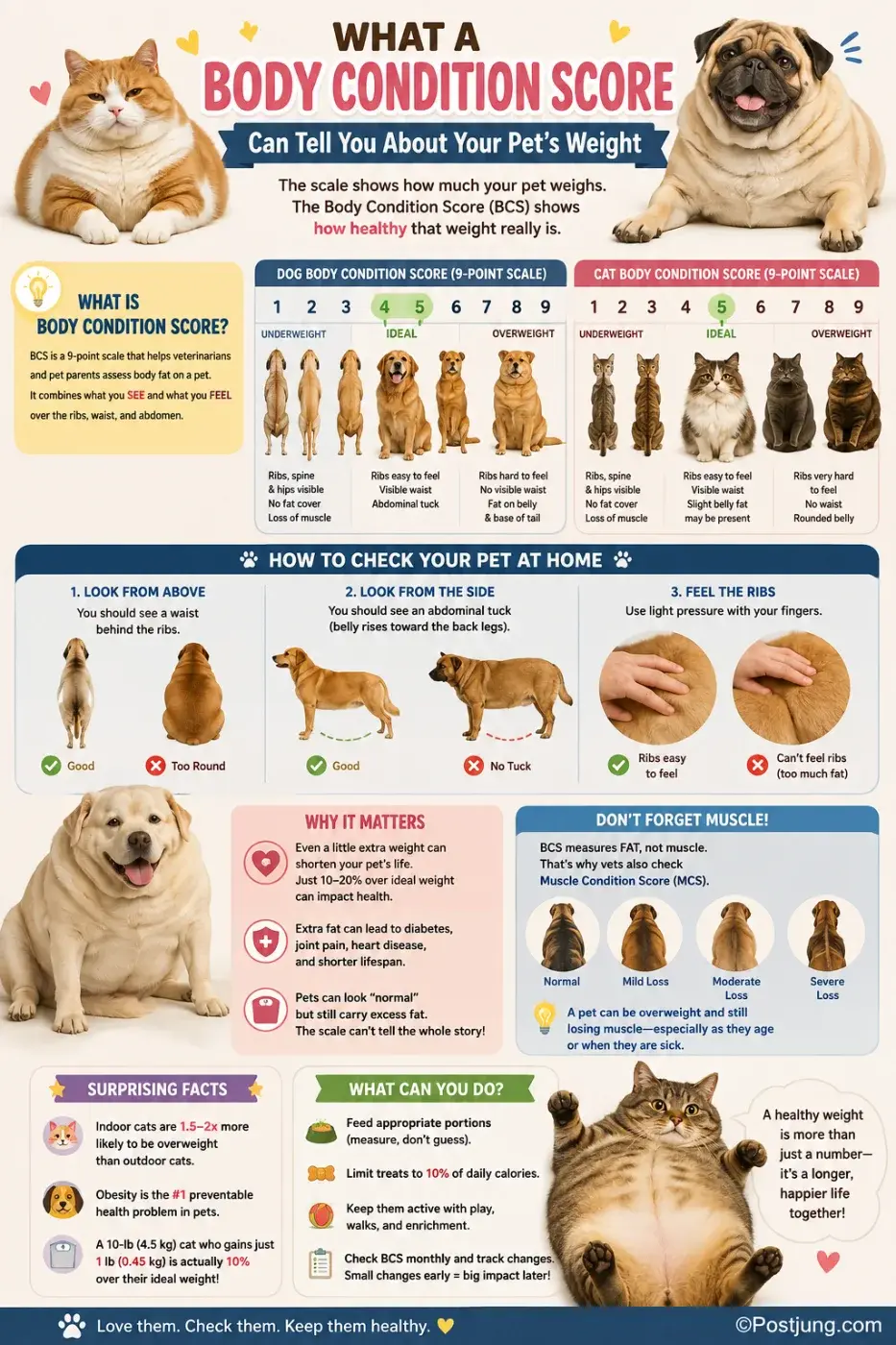
One of the simplest tools used for this purpose is the Body Condition Score, or BCS. It combines what a pet looks like with what can be felt beneath the coat, particularly around the ribs, waist, abdomen, spine, and other bony landmarks.
What does a Body Condition Score measure?
Body condition scoring is designed primarily to assess body fat, rather than simply total body weight.
The World Small Animal Veterinary Association, or WSAVA, provides 9-point scoring charts for both dogs and cats. At the lower end of the scale, ribs and other bones become increasingly visible or easy to feel because little fat covers them. At the upper end, the ribs become harder to feel and the waist and abdominal tuck gradually disappear beneath increasing fat deposits.
For dogs, WSAVA places scores of 4 and 5 out of 9 in the ideal range. At these scores, the ribs can be felt easily without excess fat, a waist is visible behind the ribs when viewed from above, and the abdomen has a noticeable tuck when viewed from the side.
For cats, 5 out of 9 is shown as ideal on the current WSAVA chart. A cat at this score is well proportioned, with ribs that can be felt beneath a slight fat layer, a visible but not exaggerated waist, and only a minimal abdominal fat pad. WSAVA also notes that a score of 6 may be acceptable in some cats, particularly older cats.
That difference is one reason BCS should not be interpreted as a rigid appearance standard for every individual animal.
Why the number on the scale is not enough
Body weight remains useful. Tracking it over time can reveal whether a pet is gaining or losing weight.
But weight alone cannot tell you what that weight consists of.
Two animals can weigh the same while carrying different proportions of fat and muscle. Size, skeletal build, breed characteristics, age, and changes in muscle mass can all influence what an appropriate weight looks like for an individual animal.
The American Animal Hospital Association recommends that nutritional assessments include body weight, body condition score, and muscle condition score, rather than treating any one measurement as the whole picture. AAHA says this assessment should ideally be performed at every veterinary examination.
This becomes especially useful when tracking changes over months or years. A pet may remain at roughly the same weight while losing muscle and gaining fat, meaning the scale barely moves even though body composition has changed.
What should you look and feel for at home?
A home check does not replace a veterinary examination, but the same basic landmarks used in veterinary BCS charts can help owners notice changes earlier.
For a dog near ideal condition, the ribs should generally be easy to feel without a thick layer of fat covering them. Looking down from above, there should be a waist behind the rib cage. From the side, the abdomen should rise toward the hind legs rather than hanging straight down.
For a cat near ideal condition, the ribs should also be easy to feel beneath a modest fat covering, while a waist should be visible from above. Some abdominal fat is normal in cats, so the presence of a belly flap alone does not determine whether a cat is overweight. WSAVA’s scoring system evaluates the whole body pattern rather than one feature in isolation.
Coat length can make visual judgment difficult, especially in long-haired pets. That is why gently feeling the ribs and body contours is an important part of the assessment.
Body fat and muscle are not the same thing
One particularly important distinction is that Body Condition Score and Muscle Condition Score measure different things.
BCS focuses mainly on fat stores. Muscle Condition Score, or MCS, evaluates muscle mass by looking at and feeling areas including the spine, shoulder blades, skull, and pelvis. WSAVA classifies muscle condition as normal, mild loss, moderate loss, or severe loss.
This matters because an overweight animal can still lose a significant amount of muscle. Conversely, an animal with a low body condition score may have relatively little muscle loss. WSAVA therefore recommends considering both scores rather than assuming that body fat reveals muscle condition.
The distinction can be particularly important as pets age or when illness affects appetite, activity, or metabolism.
Use the score as a trend, not just a label
The most useful Body Condition Score may not be a single measurement taken once. Its real value comes from tracking changes.
If a dog moves from 5/9 to 6/9, or a cat that previously maintained an ideal condition gradually develops less visible waist definition, that trend can prompt a closer look at portion sizes, treats, activity levels, or health changes.
Likewise, unexplained weight loss or a falling body condition score deserves attention even if the pet still appears active.
AAHA emphasizes individualized nutritional assessment rather than applying one feeding plan or target weight to every dog or cat.
For pet owners, the practical lesson is simple: weigh your pet, but also look and feel.
The scale tells you how much your pet weighs. Body Condition Score helps explain what that number means.
If your pet’s BCS appears to be changing, or you are unsure what an appropriate score should be for their age, breed, and health status, a veterinarian can assess body fat and muscle condition together and determine whether dietary or medical changes are appropriate.
SOURCES USED:
- World Small Animal Veterinary Association — Body Condition Score: Dogs
https://wsava.org/wp-content/uploads/2025/06/WSAVA_BCSCat_BCSDog_Nutrition_250612.pdf - World Small Animal Veterinary Association — Body Condition Score: Cats
https://wsava.org/wp-content/uploads/2025/06/WSAVA_BCSCat_BCSCat_Nutrition_250612.pdf - American Animal Hospital Association — 2021 AAHA Nutrition and Weight Management Guidelines for Dogs and Cats
https://www.aaha.org/resources/2021-aaha-nutrition-and-weight-management-guidelines/home/ - World Small Animal Veterinary Association — Muscle Condition Score: Dogs
https://wsava.org/wp-content/uploads/2020/01/Muscle-Condition-Score-Chart-for-Dogs.pdf

เขียนโดย Postjung Insights
 รู้หรือไม่? เปิดรายได้พนักงานส่งพัสดุของแต่ละแอป วันหนึ่งได้เท่าไร
 อำเภอที่มีชื่ออำเภอสั้นที่สุด 3 อำเภอเท่านั้นในประเทศไทย
 5 ไอเทมป้องกันความร้อนให้บ้านแบบโบราณ! ภูมิปัญญาเก่าที่ช่วยบ้านเย็นลงได้ 3-5 องศา
 เช็กด่วน ! ข่าวบัตรสวัสดิการแจก 10,000 บาท ก.ย. 69 จริงหรือ ? ก่อนเชื่อควรรู้อะไร
 โรงเรียนที่มีนักเรียนมากที่สุดในไทย
 ส่องเลข 3 สำนักพิมพ์ งวด 1 ต.ค. 69 ตัวไหนมีข้อมูลตรงกัน
 7 บทเพลงไวรัลยุคโบราณ! เพลงงานวัดที่เปิดเมื่อไหร่ คนก็ลุกขึ้นรำวงเมื่อนั้น
 7 คันเบ็ดตกปลาโบราณ สายเรโทรยอมทุ่มเงินซื้อ! ยิ่งเก่า ยิ่งหายาก ยิ่งมีเรื่องราว
 ตาราง “เด่นเหนือเด่นใต้” งวด 1 ต.ค. 69 เปิดข้อมูลตามโพย เลขไหนอยู่ตรงไหน
 รู้หรือไม่? ความทรงจำวัยเด็กอาจไม่ได้เหมือนที่เราเคยจำ! สมองสามารถ “เติมเรื่อง” ให้เราได้
 ทำไมหนังสือบางเล่มถึงมีหน้าว่างทั้งหน้า? มันอาจไม่ได้พิมพ์พลาด
 แปลปกสลาก งวด 1 ต.ค. 69 ส่องตัวเลขจากภาพปกสลากกินแบ่งรัฐบาลอำเภอที่มีชื่ออำเภอสั้นที่สุด 3 อำเภอเท่านั้นในประเทศไทย
 English Edition