Why decompression matters after a pet leaves a shelter

Moving from a shelter into a home can replace one stressful environment with a completely unfamiliar one. A calm space, predictable routine and gradual introductions can give newly adopted dogs and cats time to adjust without being overwhelmed.
Leaving an animal shelter is a positive change, but a newly adopted pet may not understand that yet.
A dog or cat arriving home suddenly faces unfamiliar rooms, smells, sounds, people, routines and possibly other animals. Some begin exploring almost immediately. Others hide, pace, bark, have toileting accidents or avoid interaction while they work out whether this unfamiliar place is safe. The ASPCA recommends giving adopted pets a quiet dedicated space, consistent routines and time to observe their surroundings without forcing interaction.
That adjustment period is often described as decompression.
A new home can still be overwhelming
Adopters naturally want to welcome a new pet with affection, toys, visitors and access to the entire house. From the animal's perspective, however, that can mean processing a large amount of new information at once.
The ASPCA advises that during an adopted pet's first days, owners keep things calm, establish a routine and allow the animal space to observe its new environment and companions. Interactions with people or other pets should not be forced.
For cats, the transition can be particularly tied to territory and familiarity. Cats Protection advises starting a newly arrived cat in a quiet room equipped with food, water, a litter tray, somewhere to hide, a sleeping area, scratching facilities and toys. The cat can then explore more of the home at its own pace.
Hiding alone does not necessarily mean that an adoption is going badly. Cats Protection notes that newly arrived cats may initially hide, avoid people or eat only when the house is quiet. What matters is whether the animal gradually begins to show signs of settling, such as eating normally, exploring, playing and seeking interaction. Persistent stress without improvement is a reason to contact a veterinarian.
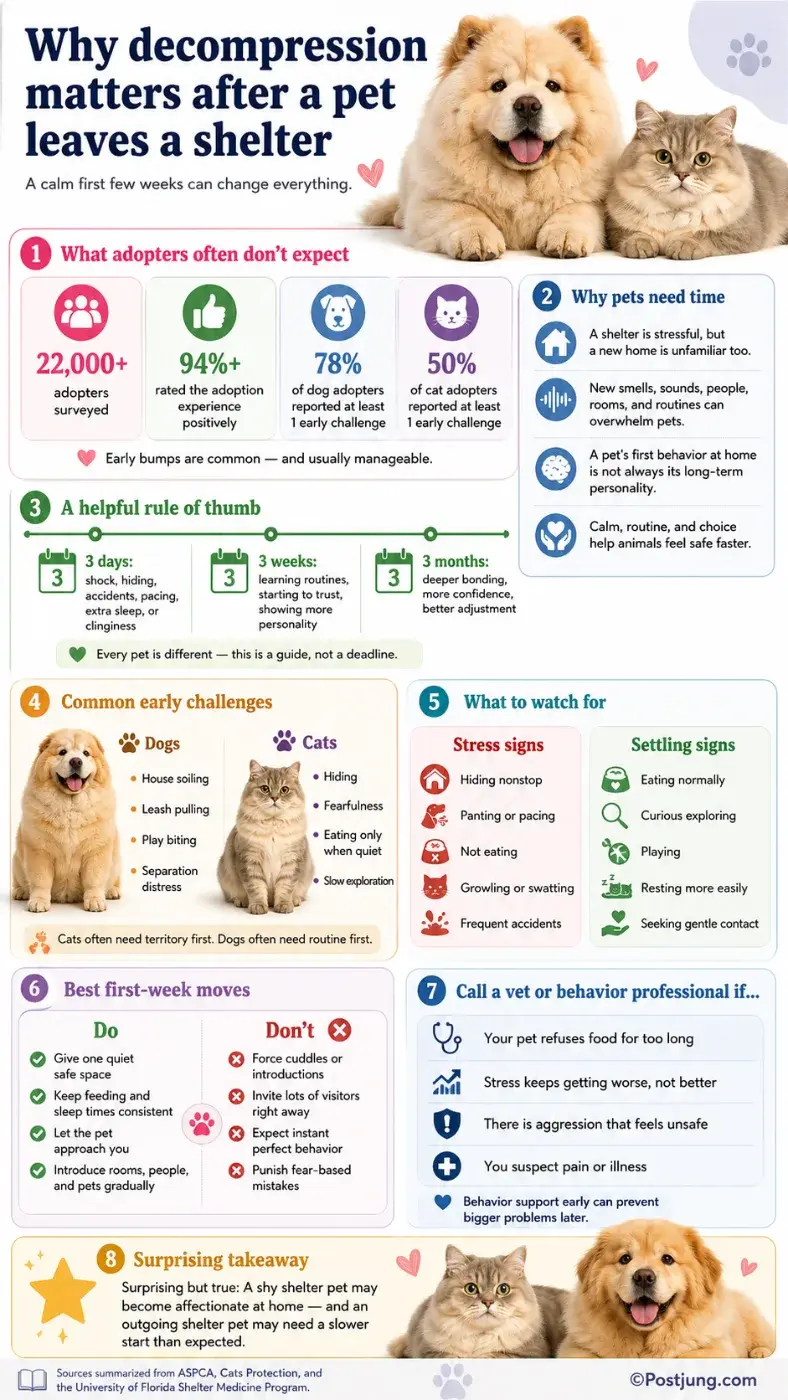
Early problems are more common than they may seem
The transition period is not just an anecdotal concern.
Research published by the University of Florida Shelter Medicine Program in 2026 analyzed surveys from more than 22,000 dog and cat adopters connected with 112 shelters and rescue organizations across 40 U.S. states. More than 94% of respondents rated their adoption experience positively at each survey point. Yet more than 78% of dog adopters and 50% of cat adopters reported at least one behavioral or care-related challenge.
Among dogs, reported issues included play biting, house soiling, leash pulling and separation distress or anxiety. Among cats, fear or hiding was the most frequently reported challenge in the study.
The numbers offer an important perspective: an early problem does not automatically mean that the match has failed.
Some behaviors are occurring while the pet is adapting to an unfamiliar household and while the adopter is still learning the animal's routines, preferences and stress signals.
Shelter behavior is not always home behavior
Decompression also matters because the animal seen inside a shelter may not behave exactly the same way once settled into a home.
The ASPCA notes that a dog's behavior at any particular moment is influenced by emotional state, stress level and environment. Its position statement on shelter behavior assessments says some assessment results do not reliably predict how a dog will behave after adoption and recommends considering behavior information in context rather than relying on a single observation.
That works in both directions.
A quiet shelter dog may become more energetic once comfortable. A highly excitable dog may become calmer. A cat that spends much of its time hiding may eventually become social and affectionate.
This is one reason adopters benefit from observing change over time instead of deciding during the first day that the animal's initial behavior is its permanent personality.
The “3-3-3” guideline is a framework, not a deadline
Some shelters and animal-welfare organizations describe adjustment using a “3-3-3” guideline: roughly three days for the initial transition, three weeks for settling into routines and three months for deeper adjustment and bonding.
The ASPCA uses this guideline in its adoption advice while also emphasizing that some pets adjust quickly and others need more time.
The numbers are most useful as expectations rather than promises.
There is no moment on day three, week three or month three when every animal suddenly reaches the next stage. Temperament, previous experiences, health, household activity and the presence of other animals can all affect the pace.
What decompression looks like in practice
For many newly adopted pets, the most useful first days are deliberately uneventful.
Give the animal a secure place where it can rest without being followed. Keep feeding, walks and bedtime reasonably predictable. Avoid introducing a long stream of visitors immediately. Let the pet initiate some interactions rather than repeatedly calling, carrying or touching it.
For cats, provide hiding places and allow gradual exploration instead of immediately opening the entire home. Cats Protection recommends introducing family members and other pets slowly once the cat appears more confident.
For dogs, calm routines and positive reinforcement can begin immediately, but there is little benefit in trying to fit every adventure, social introduction and training goal into the first few days. The ASPCA recommends using the early weeks to reinforce desired behavior, maintain consistent routines and build the relationship gradually.
Veterinary care also belongs in the transition plan. The ASPCA recommends establishing care with a veterinarian shortly after adoption, while the University of Florida researchers highlighted veterinary engagement and post-adoption support as areas that can strengthen outcomes.
Decompression is ultimately less about doing something special than about reducing unnecessary pressure.
The goal is not to make a newly adopted pet love its new life immediately. It is to create a predictable environment in which the animal has enough safety, time and choice to discover that it can.
SOURCES USED:
- ASPCA — Navigating Adoption: Finding and Welcoming Home Your Pet
- University of Florida Shelter Medicine Program — Shelter to Home: Surveys of Early Post-Adoption Experiences with More Than 22,000 Dog and Cat Adopters
- ASPCA — Position Statement on Shelter Dog Behavior Assessments
- Cats Protection — Bringing a Cat Home

เขียนโดย Postjung Insights
 7 บทเพลงไวรัลยุคโบราณ! เพลงงานวัดที่เปิดเมื่อไหร่ คนก็ลุกขึ้นรำวงเมื่อนั้น
 7 คันเบ็ดตกปลาโบราณ สายเรโทรยอมทุ่มเงินซื้อ! ยิ่งเก่า ยิ่งหายาก ยิ่งมีเรื่องราว
 5 ไอเทมป้องกันความร้อนให้บ้านแบบโบราณ! ภูมิปัญญาเก่าที่ช่วยบ้านเย็นลงได้ 3-5 องศา
 อำเภอที่มีชื่ออำเภอสั้นที่สุด 3 อำเภอเท่านั้นในประเทศไทย
 ส่องเลข 3 สำนักพิมพ์ งวด 1 ต.ค. 69 ตัวไหนมีข้อมูลตรงกัน
 รู้หรือไม่? เปิดรายได้พนักงานส่งพัสดุของแต่ละแอป วันหนึ่งได้เท่าไร
 โรงเรียนที่มีนักเรียนมากที่สุดในไทย
 ตาราง “เด่นเหนือเด่นใต้” งวด 1 ต.ค. 69 เปิดข้อมูลตามโพย เลขไหนอยู่ตรงไหน
 รู้หรือไม่? ความทรงจำวัยเด็กอาจไม่ได้เหมือนที่เราเคยจำ! สมองสามารถ “เติมเรื่อง” ให้เราได้
 เปิด 5 โรงเรียนหญิงล้วนเก่าแก่ของไทย ที่มีประวัติยาวนานกว่าศตวรรษ
 เช็กด่วน ! ข่าวบัตรสวัสดิการแจก 10,000 บาท ก.ย. 69 จริงหรือ ? ก่อนเชื่อควรรู้อะไร
 โรงเรียนชายล้วนแห่งแรกของไทยคือที่ไหน? ย้อนดูจุดเริ่มต้นโรงเรียนสวนกุหลาบวิทยาลัยอำเภอที่มีชื่ออำเภอสั้นที่สุด 3 อำเภอเท่านั้นในประเทศไทย
 English Edition