How Mat Training Gives Dogs a Portable Place to Settle
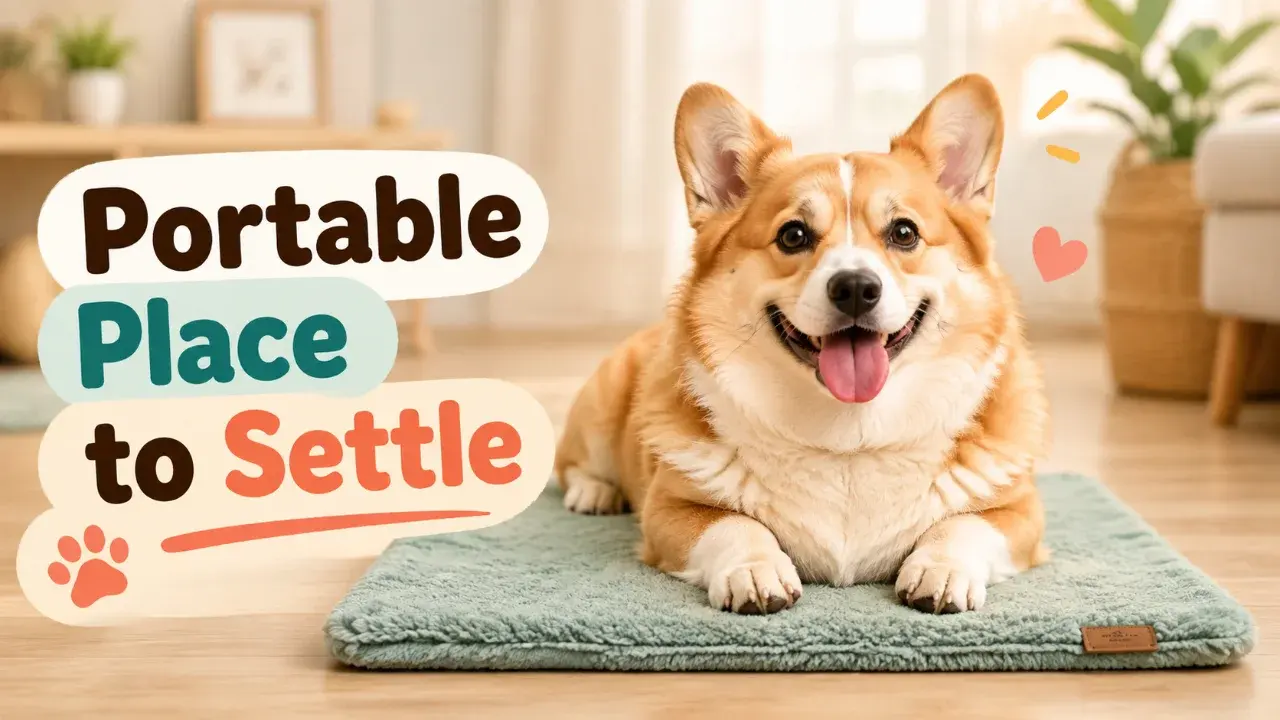
A blanket, towel, or small dog mat can become much more than a place to lie down. With reward-based training, it can give a dog a familiar cue for quiet behavior that travels from room to room—and, for dogs comfortable with new environments, beyond the home.
A small mat can become one of the most useful pieces of dog-training equipment in the house. Once a dog learns that stepping onto it, lying down, and remaining there leads to good things, the mat starts functioning as a clear physical cue: this is a place to settle.
Its biggest advantage is portability. Unlike a fixed dog bed or crate, a lightweight mat, towel, or blanket can move around the house and, when appropriate for the individual dog, travel to other environments. The American Kennel Club notes that a portable mat can be moved between rooms or taken on trips, while a familiar trained place may also be useful in locations such as a friend’s home or veterinary appointment.
The mat gives the dog something specific to do
Dogs do not automatically know what humans mean by “calm down.” Mat training makes that request more concrete.
Instead of repeatedly stopping behaviors such as hovering around the kitchen, jumping on visitors, or seeking attention, an owner can reinforce a different behavior: go to the mat, lie down, and remain there until released.
That distinction matters. Veterinary behavior guidance published by VCA Animal Hospitals emphasizes teaching desirable alternative behaviors rather than relying on punishment or confrontation. Consistently rewarding a dog for lying quietly on a mat can make that calm behavior increasingly likely to occur again.
The American Kennel Club similarly describes a “place” cue as a practical alternative behavior for situations such as visitors arriving or a dog getting underfoot.
Start by making the mat worth choosing
The goal is not to physically put a dog on the mat and make them stay there. The dog should learn that choosing the mat pays off.
A basic training progression begins with rewarding interest in the mat. That might mean looking at it, sniffing it, touching it with a paw, or stepping onto it. Rewards are delivered while the dog is on the mat so the location itself begins to predict something positive.
From there, the trainer can gradually reinforce all four paws on the mat and eventually a lying-down position. A separate release cue, such as “free,” tells the dog when the exercise is finished.
Keeping the association positive is important. Special treats, toys, or enjoyable chews can help make the mat somewhere the dog voluntarily wants to spend time rather than a place associated with punishment.
Calmness is built gradually
A dog that can lie quietly on a mat for 20 seconds in the living room is not automatically ready to do the same thing beside a busy café patio.
Training usually becomes more reliable by increasing difficulty in small pieces.
Once the dog understands the basic behavior, the owner can gradually increase how long the dog remains there. Distance can come next: perhaps the person moves a step away, then several steps. Distractions are added progressively after the easier version is reliable.
AKC training guidance recommends working progressively with duration, distance, and distraction rather than making all three difficult at once.
VCA gives a similarly gradual approach for independent rest periods. It suggests beginning with the mat near the owner, rewarding quiet resting during short sessions, then slowly increasing the time between rewards and moving the mat farther away.
That gradual progression is one reason mat training can become useful beyond basic obedience. The dog is learning not just where to lie but how to remain there despite increasingly realistic everyday distractions.
Why portability changes the skill
A bed can become associated with one particular corner of one particular room. A portable mat allows the same visual and tactile cue to appear somewhere else.
AKC guidance on canine anxiety describes a dog bed or mat as a portable calm place that can be brought into the car, to a veterinary office, or to another person’s home. The organization recommends first creating positive associations with the location, then slowly increasing distance, duration, and distractions.
That does not mean a mat automatically makes an anxious dog comfortable everywhere. A dog’s ability to perform a trained settle can decrease as nervousness rises, so the skill is most useful before stress becomes overwhelming.
For dogs that genuinely enjoy public outings, the same principle can be applied in suitable dog-friendly settings. AKC recommends practicing a “place” cue on a towel or small blanket before using it under a table at a restaurant, along with rewarding calm behavior. It also cautions that reactive, wary, or stressed dogs may be better off staying home rather than being pushed into a crowded environment.
A settle mat is not a substitute for a dog’s needs
Mat training works best as one skill within a larger routine.
Dogs still need appropriate physical activity, opportunities to sniff and explore, social interaction suited to their temperament, mental stimulation, rest, and outlets for normal canine behavior.
Before asking a dog to settle independently, VCA recommends making sure basic needs such as exercise, food, and a chance to eliminate have been met. If a dog becomes distressed during settle practice—such as persistent barking, whining, or scratching—the guidance recommends stopping rather than simply insisting that the dog remain there and seeking behavior help when needed.
That makes the purpose of the mat clearer. It is not meant to suppress every sign of energy or emotion.
It is a learned communication tool.
With repeated positive practice, an ordinary square of fabric can tell a dog exactly what behavior is being asked for and give the owner an equally clear behavior to reward. Because that square of fabric can travel, the lesson can travel with it.
SOURCES USED:

เขียนโดย Postjung Insights
 5 ไอเทมป้องกันความร้อนให้บ้านแบบโบราณ! ภูมิปัญญาเก่าที่ช่วยบ้านเย็นลงได้ 3-5 องศา
 รู้หรือไม่? เปิดรายได้พนักงานส่งพัสดุของแต่ละแอป วันหนึ่งได้เท่าไร
 อำเภอที่มีชื่ออำเภอสั้นที่สุด 3 อำเภอเท่านั้นในประเทศไทย
 7 บทเพลงไวรัลยุคโบราณ! เพลงงานวัดที่เปิดเมื่อไหร่ คนก็ลุกขึ้นรำวงเมื่อนั้น
 โรงเรียนที่มีนักเรียนมากที่สุดในไทย
 เช็กด่วน ! ข่าวบัตรสวัสดิการแจก 10,000 บาท ก.ย. 69 จริงหรือ ? ก่อนเชื่อควรรู้อะไร
 แปลปกสลาก งวด 1 ต.ค. 69 ส่องตัวเลขจากภาพปกสลากกินแบ่งรัฐบาล
 เปิด 5 โรงเรียนหญิงล้วนเก่าแก่ของไทย ที่มีประวัติยาวนานกว่าศตวรรษ
 ส่องเลข 3 สำนักพิมพ์ งวด 1 ต.ค. 69 ตัวไหนมีข้อมูลตรงกัน
 โรงเรียนชายล้วนแห่งแรกของไทยคือที่ไหน? ย้อนดูจุดเริ่มต้นโรงเรียนสวนกุหลาบวิทยาลัย
 5 เมนูอาหารไทยโบราณที่หาทานยาก ชื่อคุ้นหู แต่คนรุ่นใหม่อาจไม่เคยชิม
 7 คันเบ็ดตกปลาโบราณ สายเรโทรยอมทุ่มเงินซื้อ! ยิ่งเก่า ยิ่งหายาก ยิ่งมีเรื่องราวอำเภอที่มีชื่ออำเภอสั้นที่สุด 3 อำเภอเท่านั้นในประเทศไทย
 English Edition