How to Learn Your Pet’s Normal So Changes Stand Out

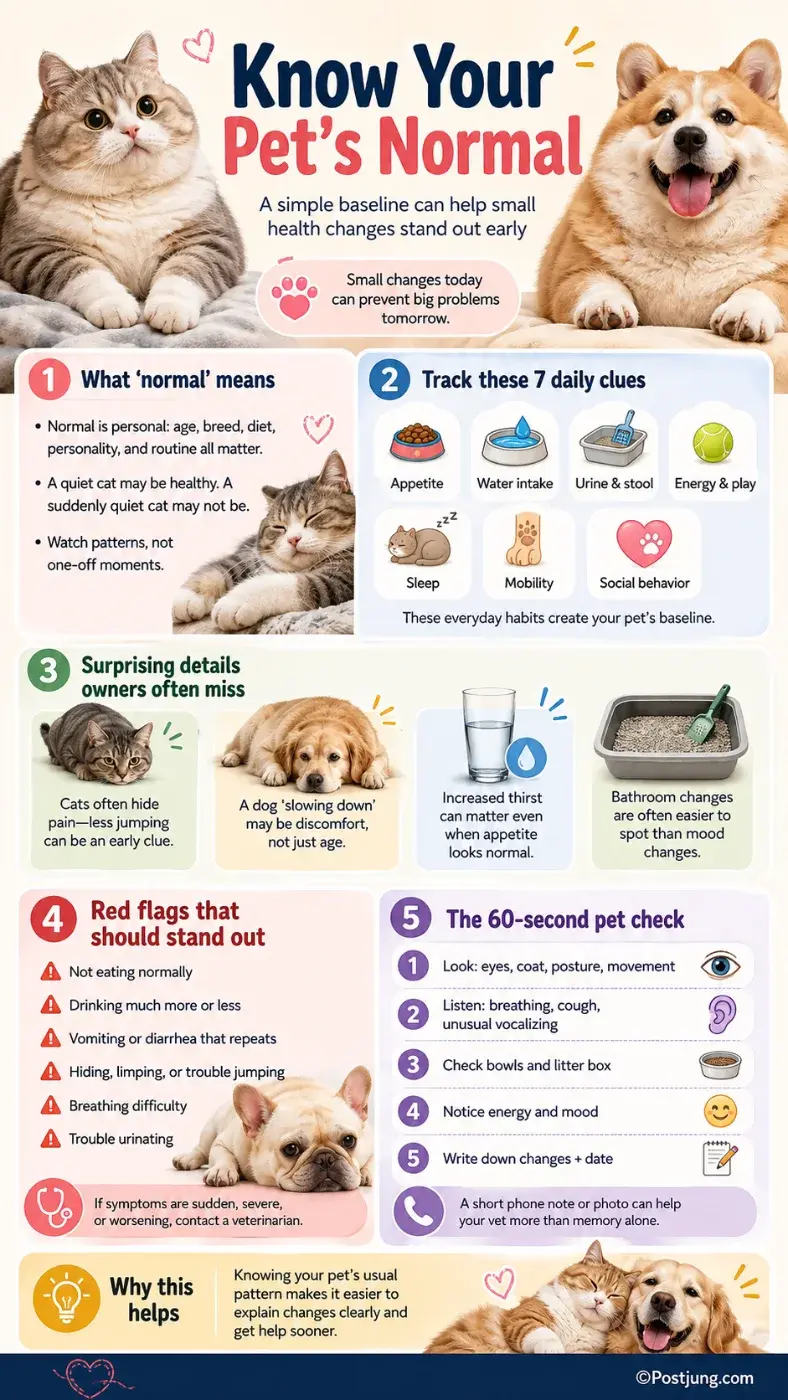
Your pet’s appetite, drinking, bathroom habits, activity, sleep, movement, and social behavior create a personal baseline. Paying attention to that pattern can make unusual changes easier to recognize and describe to a veterinarian.
A dog that suddenly leaves breakfast untouched or a cat that stops jumping onto a favorite chair may be telling you something important. The challenge is recognizing the change—and that becomes much easier when you already know what is normal for that particular animal.
There is no single daily routine that every healthy dog or cat should follow. Age, breed, body size, diet, environment, activity level, temperament, medications, and life stage all influence behavior. What matters is learning your own pet’s usual pattern and noticing when that pattern shifts.
Veterinary guidance supports paying attention to these changes. The Merck Veterinary Manual lists changes in appetite, activity, urination, thirst, movement, breathing, and other behaviors among signs that can warrant veterinary attention in dogs and cats.
Start with the things you already see every day
You do not need medical equipment to establish a useful baseline.
For a week or two, simply become more deliberate about observing a few parts of your pet’s routine:
Eating: How quickly does your pet approach meals? Do they normally finish everything, graze throughout the day, or occasionally skip food?
Drinking: Does the water bowl usually need refilling once a day or much less often? Does your cat mainly get moisture from wet food?
Bathroom habits: Notice the usual frequency and appearance of urine and stool, as well as where and how your pet eliminates.
Activity: Think about walks, play sessions, climbing, running, jumping, and general enthusiasm for movement.
Sleep and rest: Learn where your pet normally sleeps, roughly how much time they spend resting, and whether they usually settle comfortably.
Social behavior: Some animals follow their people everywhere; others prefer independence. Either pattern may be completely normal for the individual.
Grooming and appearance: Watch for the usual condition of the coat, skin, eyes, ears, and mouth, along with your pet’s normal grooming habits.
The goal is not constant surveillance. It is familiarity.
Look for changes from the pattern
A single unusual moment does not automatically mean a pet is ill. A dog may be tired after an unusually active day, while a cat may eat less after a stressful disruption at home.
What becomes more useful is a change that is persistent, pronounced, recurring, or accompanied by other signs.
For example, increased appetite can be completely normal in growing animals or pets with greater energy requirements. But increased eating combined with weight loss can have medical causes and deserves veterinary evaluation. VCA Animal Hospitals notes that veterinarians assessing appetite changes also consider drinking, urination, bowel habits, medications, and energy levels.
The same principle applies to behavior.
A normally independent cat suddenly hiding all day is different from a cat that has always preferred quiet spaces. A dog that has never hesitated at the stairs but begins stopping at the bottom presents a meaningful change from its own baseline.
Changes in movement, posture, appetite, mood, hiding, restlessness, and willingness to move can also be associated with pain or discomfort.
Bathroom habits deserve particular attention
Urination and bowel habits are easy to overlook, especially in multi-pet households.
For cats, litter-box behavior can provide particularly useful clues. Changes such as urinating outside the box can have behavioral explanations, but medical problems should also be considered rather than assuming the animal is simply misbehaving. Veterinary behavioral guidance recommends ruling out medical causes when a cat’s behavior changes.
The same idea applies to dogs. A previously house-trained dog suddenly having accidents may need a medical assessment before the problem is treated as a training failure.
Knowing what your pet normally produces—and how often—gives you something concrete to compare against.
A phone note can become surprisingly useful
You do not need a complicated health journal.
Keep a short note on your phone with a few baseline observations:
- Typical appetite
- Drinking pattern
- Usual bathroom frequency
- Normal activity and mobility
- Usual sleep and social behavior
- Current weight, when known
- Regular medications and supplements
If something changes, add the date and describe exactly what you saw.
Instead of remembering, “She has been acting strange lately,” you may be able to tell your veterinarian, “For the past four days, she has eaten about half her normal breakfast and stopped jumping onto the couch.”
That distinction can matter because veterinarians use the history supplied by owners when investigating changes. Behavioral histories may include when a problem began, how frequently it happens, how long episodes last, and whether its pattern or intensity has changed.
Photos and short videos can also help document intermittent limping, unusual breathing, abnormal movement, skin changes, or behaviors that may not happen during an appointment.
Normal changes as pets age
A baseline is not permanent.
Puppies and kittens grow rapidly. Adult animals may become more settled. Senior pets can experience changes in mobility, body condition, sleep patterns, and health risks.
That is why the baseline should evolve with the animal rather than becoming a rigid standard.
Preventive-care recommendations also change by life stage. The American Animal Hospital Association’s guidance emphasizes regular wellness examinations and monitoring areas including behavior, nutrition, body weight, mobility, elimination, and other health indicators. Its feline life-stage guidance specifically encourages owners to understand normal feline behavior and recognize the significance of behavioral changes.
Routine veterinary examinations provide another valuable baseline because weight, body condition, physical findings, and other measurements can be compared over time.
You do not need to diagnose the change yourself
Learning your pet’s normal is not about becoming your own veterinarian.
Its value is simpler: you are often the person who sees the animal every day. That puts you in a good position to recognize that something is different—even when you cannot explain why.
Loss of appetite, repeated vomiting or diarrhea, marked changes in drinking or urination, breathing difficulty, significant lethargy, pain, sudden weakness, difficulty urinating, rapidly worsening symptoms, or other concerning changes deserve veterinary attention. Cats can be particularly vulnerable when appetite loss persists; Cornell University’s Feline Health Center warns that sustained anorexia can seriously affect a mature cat’s health.
When in doubt, contact a veterinarian rather than trying to determine the cause from the symptom alone.
Your pet’s everyday routine may seem ordinary precisely because you see it so often. Learning that routine closely gives you a reference point—and when something genuinely changes, it is far more likely to stand out.
SOURCES USED:
- American Animal Hospital Association — 2021 AAHA/AAFP Feline Life Stage Guidelines: Life Stage Checklists
- American Animal Hospital Association — 8 Things You Need To Know About AAHA’s Canine Life Stage Guidelines
- Merck Veterinary Manual — Routine Health Care of Cats
- Merck Veterinary Manual — Routine Health Care of Dogs
- VCA Animal Hospitals — Testing for Increased Appetite
- Cornell University College of Veterinary Medicine — Anorexia

เขียนโดย Postjung Insights
 อำเภอที่มีชื่ออำเภอสั้นที่สุด 3 อำเภอเท่านั้นในประเทศไทย
 รู้หรือไม่? เปิดรายได้พนักงานส่งพัสดุของแต่ละแอป วันหนึ่งได้เท่าไร
 7 บทเพลงไวรัลยุคโบราณ! เพลงงานวัดที่เปิดเมื่อไหร่ คนก็ลุกขึ้นรำวงเมื่อนั้น
 5 ไอเทมป้องกันความร้อนให้บ้านแบบโบราณ! ภูมิปัญญาเก่าที่ช่วยบ้านเย็นลงได้ 3-5 องศา
 รู้หรือไม่? ความทรงจำวัยเด็กอาจไม่ได้เหมือนที่เราเคยจำ! สมองสามารถ “เติมเรื่อง” ให้เราได้
 เปิด 5 โรงเรียนหญิงล้วนเก่าแก่ของไทย ที่มีประวัติยาวนานกว่าศตวรรษ
 โรงเรียนที่มีนักเรียนมากที่สุดในไทย
 7 คันเบ็ดตกปลาโบราณ สายเรโทรยอมทุ่มเงินซื้อ! ยิ่งเก่า ยิ่งหายาก ยิ่งมีเรื่องราว
 ตาราง “เด่นเหนือเด่นใต้” งวด 1 ต.ค. 69 เปิดข้อมูลตามโพย เลขไหนอยู่ตรงไหน
 โรงเรียนชายล้วนแห่งแรกของไทยคือที่ไหน? ย้อนดูจุดเริ่มต้นโรงเรียนสวนกุหลาบวิทยาลัย
 แปลปกสลาก งวด 1 ต.ค. 69 ส่องตัวเลขจากภาพปกสลากกินแบ่งรัฐบาล
 โรงเรียนเพียงแห่งเดียวของประเทศไทย ที่อยู่มาตั้งแต่ยุครัชกาลที่ 4อำเภอที่มีชื่ออำเภอสั้นที่สุด 3 อำเภอเท่านั้นในประเทศไทย
 English Edition