What Your Cat’s Tail Position May Be Saying
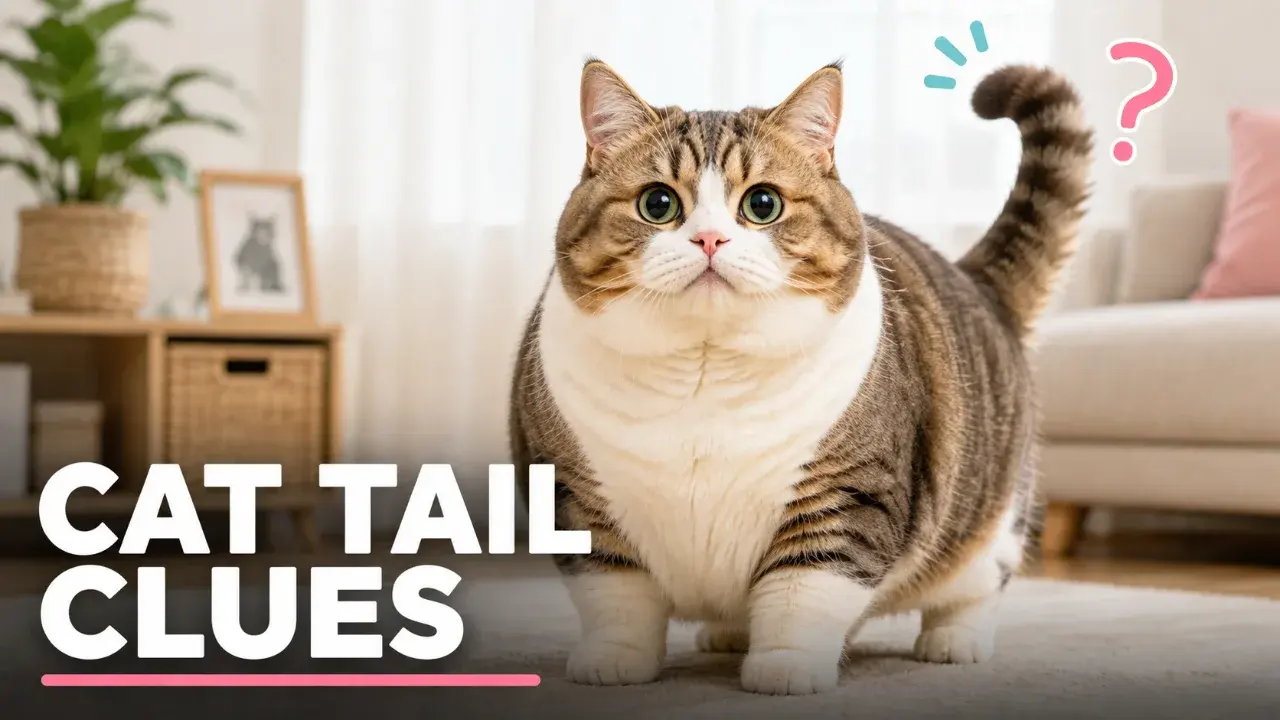
A raised tail can signal a friendly approach, while puffing, tucking, or forceful swishing may point to tension or discomfort. But a cat’s tail makes the most sense when you read it alongside the rest of the body.
A cat’s tail can offer useful clues about how the animal is feeling, but it is not a simple emotional code. A tail held high, tucked low, puffed out, or moving rapidly can mean very different things depending on what the cat’s ears, eyes, body posture, and surroundings are doing at the same time.
Research on feline visual communication supports that broader view. A 2021 study published in Animals found that cats approaching people very commonly used a tail-up posture, often followed by rubbing against the person. Yet in interactions between cats, ear position was a stronger predictor of whether an encounter would end positively or negatively.
That distinction matters: the tail is useful, but it should not be read alone.
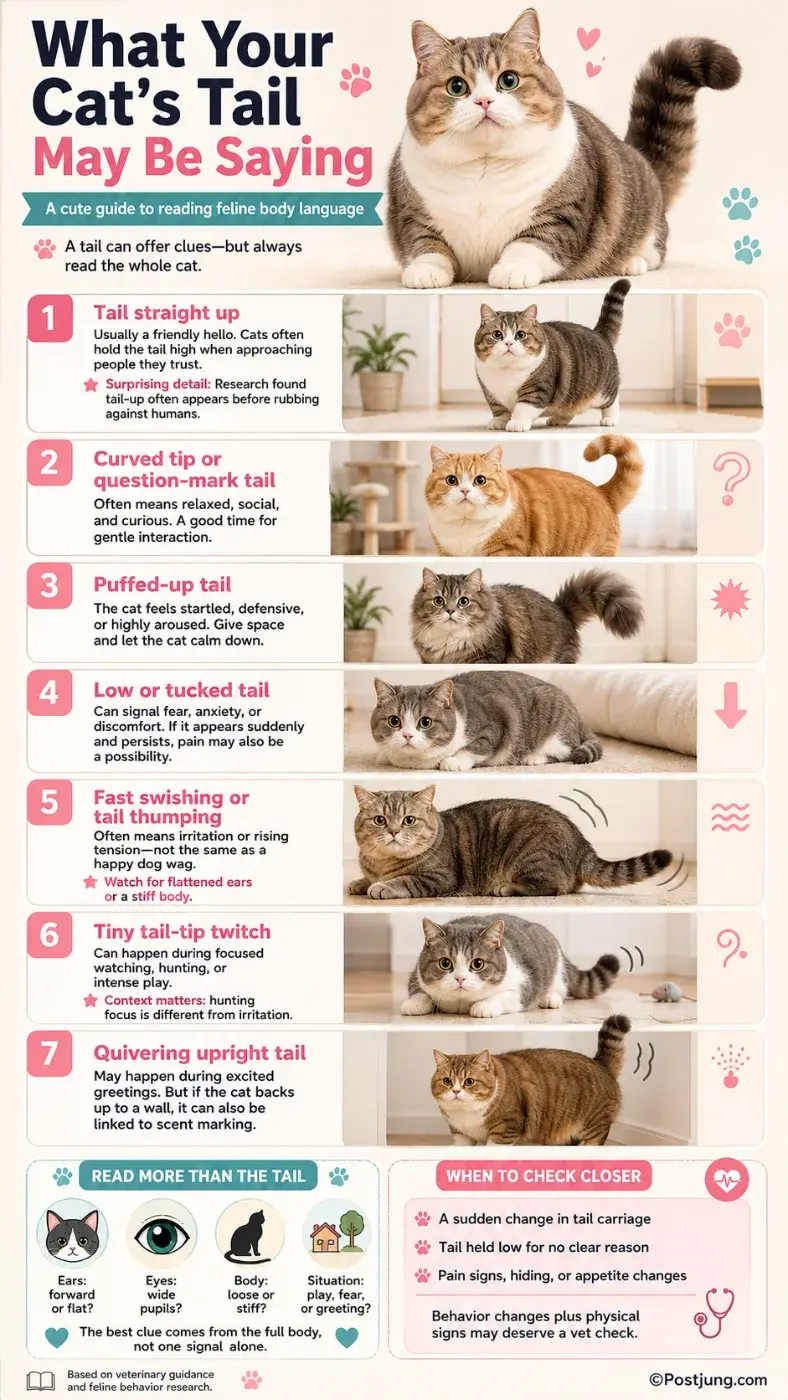
Tail straight up: usually a friendly signal
When a relaxed cat approaches with its tail upright, the message is generally positive.
Veterinary guidance from VCA describes a straight-up tail in a relaxed approaching cat as a sign of friendliness and confidence. A raised tail with a gently curved tip can similarly accompany a relaxed, social approach.
Scientific observations support this interpretation. Earlier research identified the tail-up display as part of friendly social behavior between cats, while the 2021 Animals study found that cats approaching humans frequently held their tails up before rubbing against them.
So when your cat walks toward you with its tail high and the rest of its body loose, that is usually a good moment to expect friendly interaction.
A puffed-up tail: something has raised the stakes
A suddenly enlarged, bottle-brush-looking tail is caused by the fur standing on end.
This commonly appears when a cat feels threatened or highly aroused. VCA advises giving a cat space when the tail is puffed because the animal may be reacting defensively to something in its environment.
Look beyond the tail before deciding what is happening. A puffed tail accompanied by an arched body, flattened ears, or an attempt to retreat is very different from the loose posture of a cat calmly approaching for attention.
Cats Protection likewise emphasizes that feline emotional signals are distributed across the whole body, including the ears, eyes, whiskers, posture, and coat.
Tail held low or tucked: fear is one possibility
A tail kept close to the ground or tucked beneath the body can indicate fear, anxiety, or discomfort.
Importantly, this posture does not automatically mean that a cat is simply “scared.” VCA notes that cats may also hold the tail low when they are in pain. A persistent change in tail carriage accompanied by hiding, reduced activity, appetite changes, unusual vocalization, or other signs of illness deserves more attention than an isolated posture during a stressful moment.
Context makes the difference.
A cat crouching under furniture during a noisy event with its tail tucked is giving you a very different set of clues from a cat that suddenly begins carrying its tail unusually low for no obvious reason.
Swishing and thrashing are not the same as a dog wag
One of the easiest mistakes is assuming that a wagging cat tail means the same thing as a wagging dog tail.
It often does not.
Fast swishing, thumping, or thrashing can accompany irritation or escalating arousal. A cat being petted may begin moving its tail more forcefully shortly before deciding it has had enough contact. During play or hunting, however, movement at the tip of the tail may reflect intense focus rather than anger.
That means the speed, size, and situation surrounding the movement all matter.
A gently twitching tail tip while a cat watches a bird through a window is not equivalent to a tail striking the floor while the cat’s ears turn back during unwanted handling.
A quivering upright tail needs context too
A raised tail that trembles or quivers can occur during excitement when a cat greets a familiar person.
But similar movement can have another meaning when the cat backs toward a wall or other vertical surface. In that position, tail quivering may accompany urine marking.
This is a useful example of why translating one tail movement into one emotion can be misleading. The surrounding behavior tells you which interpretation makes sense.
The best approach is to read the whole cat
Scientists are increasingly examining feline communication as a combination of signals rather than a collection of isolated gestures.
A 2026 Scientific Reports study examining how people recognized relaxed, tense, and fearful cats used whole-body visual information, including posture, facial expression, and tail position. The researchers noted that interpreting feline emotional states from visual cues can be challenging for people, reinforcing the value of looking at the complete behavioral picture.
Before deciding what your cat’s tail “means,” check several things at once:
Is the body loose or rigid? Are the ears forward or flattened? Are the pupils unusually wide? Is the cat approaching, hiding, stalking, playing, or trying to leave? Did something in the room just change?
The strongest interpretation usually comes from the pattern, not the tail by itself.
A raised tail on a relaxed cat approaching you can be a welcoming signal. A tucked or puffed tail paired with tense posture may mean the cat needs distance. And a sudden, unexplained change in how a cat carries or uses its tail can sometimes be a reason to look beyond behavior and consider physical discomfort.
The tail is an important part of feline communication, but the rest of the cat finishes the sentence.
SOURCES USED:
- Deputte et al., Animals — “Heads and Tails: An Analysis of Visual Signals in Cats, Felis catus”
https://www.mdpi.com/2076-2615/11/9/2752 - VCA Animal Hospitals — “How Does A Kitten Communicate With Their Tail?”
https://vcahospitals.com/pediatric/kitten/behavior-training/kitten-tail-meanings - Cats Protection — “Cat Body Language”
https://www.cats.org.uk/help-and-advice/cat-behaviour/cat-body-language - Cafazzo and Natoli, Behavioural Processes — “The social function of tail up in the domestic cat”
https://doi.org/10.1016/j.beproc.2008.09.008 - d’Ingeo et al., Scientific Reports — “Human recognition of feline stress-related behavioral states from visual cues depends on observer characteristics”
https://www.nature.com/articles/s41598-026-44812-x

เขียนโดย Postjung Insights
 5 ไอเทมป้องกันความร้อนให้บ้านแบบโบราณ! ภูมิปัญญาเก่าที่ช่วยบ้านเย็นลงได้ 3-5 องศา
 7 บทเพลงไวรัลยุคโบราณ! เพลงงานวัดที่เปิดเมื่อไหร่ คนก็ลุกขึ้นรำวงเมื่อนั้น
 โรงเรียนที่มีนักเรียนมากที่สุดในไทย
 รู้หรือไม่? เปิดรายได้พนักงานส่งพัสดุของแต่ละแอป วันหนึ่งได้เท่าไร
 7 คันเบ็ดตกปลาโบราณ สายเรโทรยอมทุ่มเงินซื้อ! ยิ่งเก่า ยิ่งหายาก ยิ่งมีเรื่องราว
 ตาราง “เด่นเหนือเด่นใต้” งวด 1 ต.ค. 69 เปิดข้อมูลตามโพย เลขไหนอยู่ตรงไหน
 เช็กด่วน ! ข่าวบัตรสวัสดิการแจก 10,000 บาท ก.ย. 69 จริงหรือ ? ก่อนเชื่อควรรู้อะไร
 เปิด 5 โรงเรียนหญิงล้วนเก่าแก่ของไทย ที่มีประวัติยาวนานกว่าศตวรรษ
 อำเภอที่มีชื่ออำเภอสั้นที่สุด 3 อำเภอเท่านั้นในประเทศไทย
 รู้หรือไม่? ความทรงจำวัยเด็กอาจไม่ได้เหมือนที่เราเคยจำ! สมองสามารถ “เติมเรื่อง” ให้เราได้
 ทำไมหนังสือบางเล่มถึงมีหน้าว่างทั้งหน้า? มันอาจไม่ได้พิมพ์พลาด
 ส่องเลข 3 สำนักพิมพ์ งวด 1 ต.ค. 69 ตัวไหนมีข้อมูลตรงกันอำเภอที่มีชื่ออำเภอสั้นที่สุด 3 อำเภอเท่านั้นในประเทศไทย
 English Edition