What pet DNA tests can—and cannot—tell owners
Pet DNA testing can provide useful information about ancestry, parentage, inherited variants, and physical traits. But breed percentages and health reports come with important limitations—and they should not replace veterinary evaluation.
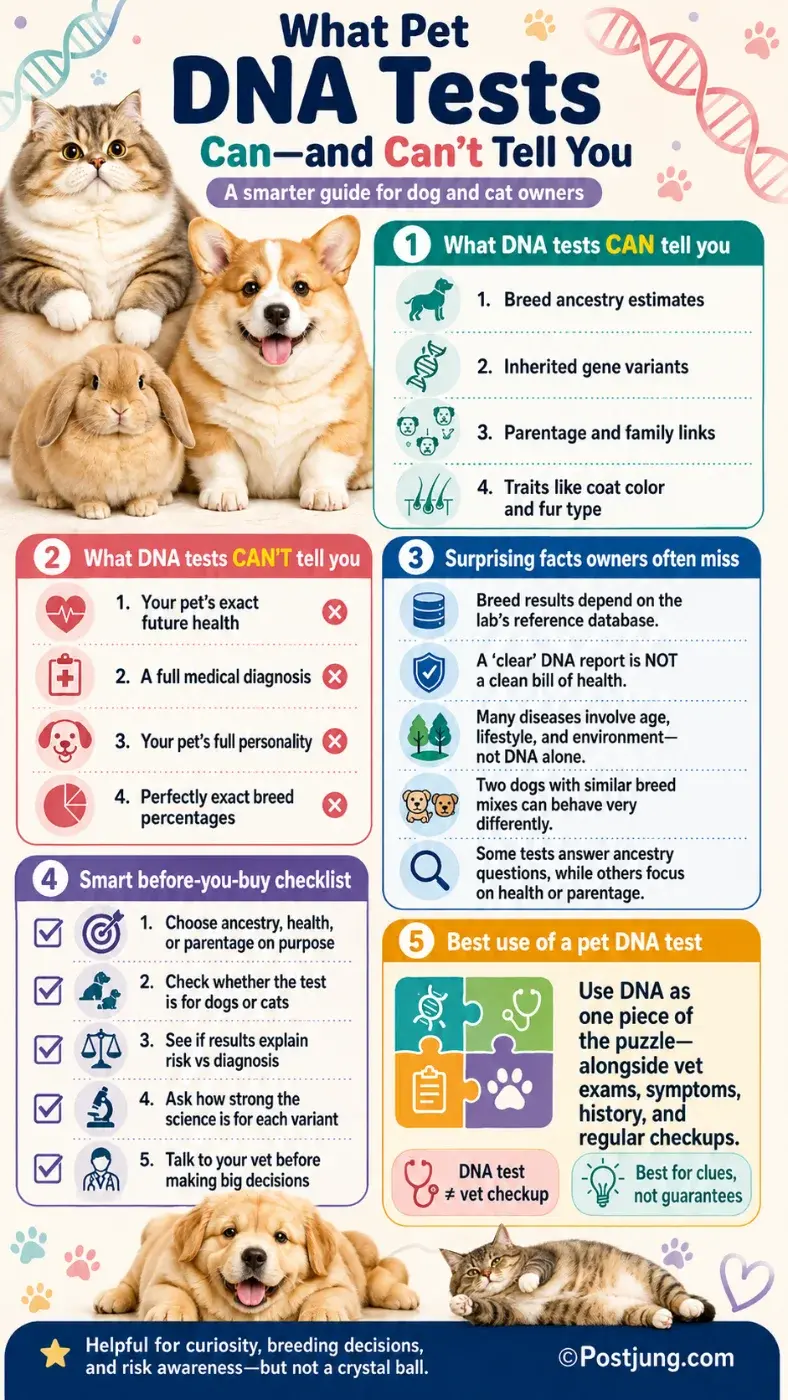
A cheek swab can reveal an impressive amount about a pet. Depending on the test, DNA analysis may help identify ancestry, confirm parentage, detect particular inherited variants, or explain traits such as coat color.
What it cannot do is read a pet’s entire future.
That distinction matters as at-home DNA testing becomes increasingly familiar to dog and cat owners. Genetic information can be genuinely useful, but different tests answer different questions, and the meaning of a result depends heavily on what was tested, how well the relevant genetic variant is understood, and what reference data the laboratory used.
Breed ancestry is an estimate built from comparisons
For mixed-breed dogs, one of the biggest attractions is discovering which breeds may be in the family tree.
Breed identification systems generally compare a dog’s DNA with reference data from dogs assigned to known breeds. The resulting ancestry report reflects how closely parts of the tested dog’s genome resemble those reference populations. UC Davis notes that breed-identification tests use company-specific DNA databases, an important reason results should be interpreted as ancestry estimates rather than an infallible pedigree.
Reference coverage matters. A 2025 Scientific Reports study involving 5,673 dogs in the Dog Aging Project found that most owners felt the project’s genetic breed calls agreed with what they knew or suspected about their dogs. But among reported disagreements, a major issue was that an expected breed was not represented in the genetic reference panel.
This means an unusual result does not automatically prove that family knowledge, shelter records, or a previous test were wrong. The databases and analytical methods behind ancestry reports matter too.
It is also important not to confuse ancestry testing with other DNA services. UC Davis, for example, offers parentage testing that compares genetic markers between an offspring and possible parents, while its separate canine genetic-diversity test measures genetic variation and explicitly does not identify breed.
Some health results are much more specific
DNA testing can be particularly valuable when scientists have identified a well-established genetic variant linked to an inherited disorder.
The Orthopedic Foundation for Animals, or OFA, maintains information on DNA-based disease tests and breed-specific health screening. UC Davis also offers genetic diagnostics for inherited conditions, and its veterinary genetics specialists note that hundreds of DNA tests are now available for dogs.
These results can sometimes answer a tightly defined question very well: Does this animal carry a particular tested variant?
For some inherited conditions, that information can help breeders avoid pairings that could produce affected offspring. It can also help owners and veterinarians decide whether a known genetic risk deserves closer attention. UC Davis specifically notes that genetic testing can support breeding and management decisions when the relevant disease variant is understood.
But a genetic result and a medical diagnosis are not always the same thing.
Some variants directly cause particular inherited disorders. Others merely alter risk. Disease can also depend on multiple genes, environmental exposures, age, nutrition, infections, body condition, or other factors that a DNA panel cannot fully capture.
A result showing increased genetic susceptibility therefore does not necessarily mean a pet will develop the condition. Likewise, not finding the variants included in a panel does not prove that the animal will remain free of inherited or acquired disease.
A “clear” DNA panel is not a complete health screening
This may be the easiest result for owners to overinterpret.
Dogs can suffer from important health conditions for which a consumer DNA panel provides little or no useful information. Breed health programs therefore commonly combine DNA testing with other forms of screening.
OFA’s health programs include assessments for conditions involving hips, elbows, eyes, the heart, thyroid, patellas, respiratory function, and other systems in addition to DNA-based tests. Its breed-specific recommendations also warn that listed screenings are not necessarily exhaustive and that some genetic diseases lack easily accessible screening protocols.
In practical terms, a pet can receive reassuring DNA results and still develop arthritis, heart disease, cancer, dental disease, obesity-related illness, infections, injuries, or many other health problems.
A DNA report should therefore complement routine veterinary care, not replace physical examinations, appropriate laboratory testing, imaging, or breed-specific screening.
Traits can be easier to predict than personality
Genetic laboratories can test for certain inherited physical characteristics, including some coat colors and other visible traits. UC Davis says many of the tests it performs across animal species involve known variants affecting disease risk or physical characteristics such as coat color.
Behavior is far more complicated.
Knowing that a dog has ancestry from a breed historically selected for herding, retrieving, guarding, or companionship may provide context, but ancestry percentages cannot reliably write a behavioral biography for an individual animal. Learning, early socialization, environment, health, training, life experience, and individual variation all matter.
Owners should be especially cautious about using a DNA breed result alone to decide whether a particular dog is friendly, dangerous, trainable, suitable for children, or destined for a specific personality.
The laboratory matters as much as the swab
Pet genetic testing does not operate under one universal global standard.
UC Davis warns that animal genetic testing is not regulated in the same way as human testing and says direct-to-consumer results can be difficult to interpret when companies do not make their methodologies or quality-control procedures fully transparent. Its Veterinary Genetics Laboratory emphasizes validated assays and laboratory quality controls.
The World Small Animal Veterinary Association also maintains resources designed to help veterinarians and breeders identify hereditary-disease tests and testing laboratories for dogs and cats. Its guidance emphasizes appropriate use of genetic testing and counseling rather than treating DNA results as standalone answers.
Before acting on a result, owners can ask a few useful questions: What exact variant was tested? Is the association with disease well established in this breed or population? Is the finding a diagnosis, carrier result, or risk estimate? And would a veterinarian recommend confirmation or additional screening?
Those questions become especially important before changing medication, breeding decisions, surgery plans, diet, or long-term medical care.
The best use of pet DNA is as another piece of evidence
A well-chosen DNA test can answer some remarkably specific questions. It may establish parentage, reveal useful ancestry clues, identify a known genetic variant, or help explain an inherited trait.
Its limits are just as important.
DNA cannot provide a complete forecast of a pet’s health, guarantee that a disease will or will not develop, replace broader health screening, or reduce a living animal to a set of breed percentages.
The most useful report is not necessarily the one with the longest list of findings. It is the one whose results answer a clearly defined question—and whose limitations are understood before decisions are made.
SOURCES USED:
- UC Davis School of Veterinary Medicine — “What Genetic Testing Can and Can't Tell You About Your Pet”
- UC Davis Veterinary Genetics Laboratory — “Parentage/Genetic Marker Report”
- Orthopedic Foundation for Animals — “Diseases” and breed-specific health screening guidance
- Orthopedic Foundation for Animals — “DNA Based Disease Tests”
- Scientific Reports — “Comparing owner reported and genetic breed identification reveals high concordance in a large cohort from the Dog Aging Project”
- World Small Animal Veterinary Association — Hereditary Disease resources and DNA testing guidance

เขียนโดย Postjung Insights
 รู้หรือไม่? เปิดรายได้พนักงานส่งพัสดุของแต่ละแอป วันหนึ่งได้เท่าไร
 อำเภอที่มีชื่ออำเภอสั้นที่สุด 3 อำเภอเท่านั้นในประเทศไทย
 5 ไอเทมป้องกันความร้อนให้บ้านแบบโบราณ! ภูมิปัญญาเก่าที่ช่วยบ้านเย็นลงได้ 3-5 องศา
 รู้หรือไม่? ความทรงจำวัยเด็กอาจไม่ได้เหมือนที่เราเคยจำ! สมองสามารถ “เติมเรื่อง” ให้เราได้
 โรงเรียนที่มีนักเรียนมากที่สุดในไทย
 เช็กด่วน ! ข่าวบัตรสวัสดิการแจก 10,000 บาท ก.ย. 69 จริงหรือ ? ก่อนเชื่อควรรู้อะไร
 7 บทเพลงไวรัลยุคโบราณ! เพลงงานวัดที่เปิดเมื่อไหร่ คนก็ลุกขึ้นรำวงเมื่อนั้น
 ทำไมหนังสือบางเล่มถึงมีหน้าว่างทั้งหน้า? มันอาจไม่ได้พิมพ์พลาด
 ตาราง “เด่นเหนือเด่นใต้” งวด 1 ต.ค. 69 เปิดข้อมูลตามโพย เลขไหนอยู่ตรงไหน
 7 คันเบ็ดตกปลาโบราณ สายเรโทรยอมทุ่มเงินซื้อ! ยิ่งเก่า ยิ่งหายาก ยิ่งมีเรื่องราว
 โรงเรียนเพียงแห่งเดียวของประเทศไทย ที่อยู่มาตั้งแต่ยุครัชกาลที่ 4
 ส่องเลข 3 สำนักพิมพ์ งวด 1 ต.ค. 69 ตัวไหนมีข้อมูลตรงกันอำเภอที่มีชื่ออำเภอสั้นที่สุด 3 อำเภอเท่านั้นในประเทศไทย
 English Edition