Why Pet-Safe Cleaning Products Are Worth Checking
A “pet-safe” label can be a useful starting point, but it does not replace reading directions, checking ingredients, and keeping animals away from wet surfaces. The safest choice depends on the product, how it is used, and the pet in the home.
A clean home and a pet-friendly home should not be competing goals. But choosing a cleaner simply because its label says “natural,” “green,” or even “pet-safe” can leave important questions unanswered.
The better approach is to check what the product is designed to do, follow its directions exactly, and think about how a dog, cat, bird, or other animal might come into contact with it. A cleaner may be appropriate for routine use around pets when used correctly, yet still cause trouble if it is swallowed, licked from paws, sprayed in a poorly ventilated room, or left within reach.
“Pet-safe” is not a single universal standard
The phrase “pet-safe” is widely used in marketing, but it does not automatically mean a product is harmless in every circumstance. Formulas vary, as do the animals living with them.
A dog may walk through a wet floor and lick its paws. A cat may groom residue from its fur. Birds can be particularly sensitive to airborne chemicals and fumes. That means the same cleaning routine can carry different risks depending on the animal, the product concentration, ventilation, and whether the surface has dried.
The American Society for the Prevention of Cruelty to Animals notes that many household cleaning products can be used around dogs and cats when used according to label directions. Its guidance also emphasizes keeping pets away from freshly cleaned areas until surfaces are dry and products are put away.
That is why “safe when used as directed” is a more useful mindset than “safe under all conditions.”
What to look for before buying
Start with the product’s intended use. A mild everyday surface cleaner is not the same as a concentrated drain opener, oven cleaner, toilet-bowl product, disinfectant, or limescale remover. Strongly acidic or alkaline cleaners can cause chemical burns if they contact the mouth, skin, or eyes.
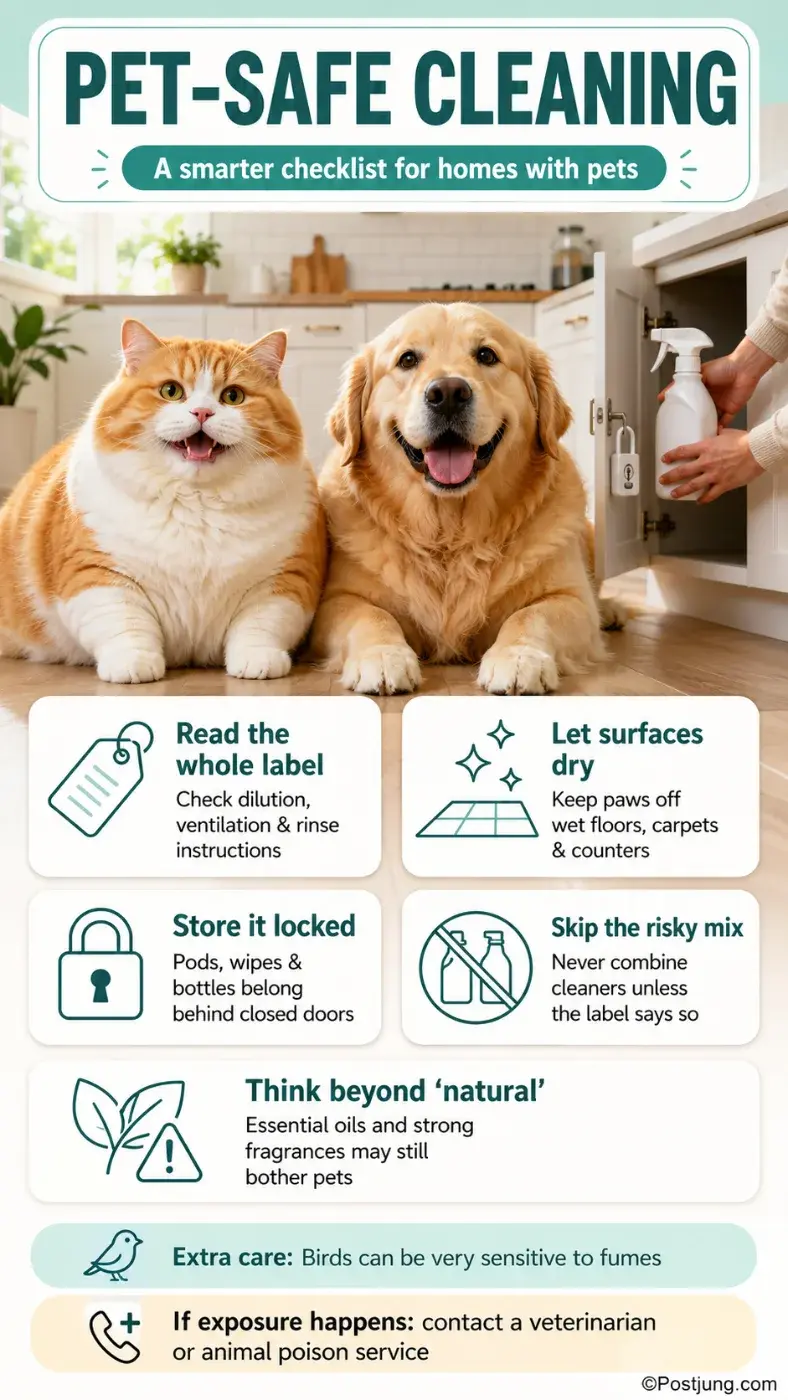
Next, read the entire label rather than relying on front-of-bottle claims. Check dilution instructions, ventilation requirements, warning language, and whether the product must be rinsed from food-contact surfaces or pet items. If a cleaner is not meant for a pet’s bedding, crate, toys, food bowls, or litter area, do not assume it can be used there.
For U.S. shoppers, the Environmental Protection Agency’s Safer Choice label can be one additional signal. The voluntary program evaluates ingredients against human-health and environmental criteria. It is not, however, a blanket veterinary guarantee for every animal or every use. A product with a recognized certification still needs to be used according to its label.
Fragrance is another detail worth considering. “Natural” fragrances and essential oils are not automatically gentle for pets. The ASPCA warns that cats can be especially sensitive to essential oils, particularly through significant ingestion or exposure in areas they can access. If a pet has respiratory sensitivities, a fragrance-free option may be easier to assess, but it still needs to be used properly.
The cleaning habits that matter most
A safer product choice works best alongside a safer routine:
- Keep pets out of the room while spraying, mopping, or using strong-smelling products.
- Let treated floors, counters, carpets, and fabric surfaces dry fully before animals return.
- Store bottles, pods, wipes, and used cleaning tools in closed cabinets or containers.
- Dispose of dirty cleaning solution promptly rather than leaving buckets or wipes accessible.
- Never mix products unless their labels specifically say it is safe to do so.
- Keep packaging available in case a veterinarian needs to identify the product quickly.
These habits matter even with products marketed for pet households. The risk is often tied to exposure: a curious animal chewing a detergent pod, drinking from a bucket, or licking a freshly treated surface is facing a different situation from one resting in a dry, ventilated room.
When to be extra cautious
Concentrated cleaners deserve more care than routine sprays. Drain cleaners, oven cleaners, rust removers, concentrated toilet cleaners, and products containing strong acids or alkalis can be especially hazardous.
Laundry products should also be stored carefully. The ASPCA warns that detergent pods, fabric softeners, and dryer sheets can irritate the mouth and throat, and some may cause more serious injuries if chewed or swallowed.
If a pet has been exposed to a cleaner, contact a veterinarian or a local animal poison service promptly. Bring the product container or a clear photo of its label if possible. General online advice cannot determine the risk for a particular product, dose, or animal.
The point of checking pet-safe cleaning products is not to find a magic bottle. It is to make a more informed choice—then pair it with careful storage, ventilation, and a little patience while surfaces dry.
SOURCES USED:

เขียนโดย Postjung Insights
 อำเภอที่มีชื่ออำเภอสั้นที่สุด 3 อำเภอเท่านั้นในประเทศไทย
 รู้หรือไม่? เปิดรายได้พนักงานส่งพัสดุของแต่ละแอป วันหนึ่งได้เท่าไร
 7 บทเพลงไวรัลยุคโบราณ! เพลงงานวัดที่เปิดเมื่อไหร่ คนก็ลุกขึ้นรำวงเมื่อนั้น
 7 คันเบ็ดตกปลาโบราณ สายเรโทรยอมทุ่มเงินซื้อ! ยิ่งเก่า ยิ่งหายาก ยิ่งมีเรื่องราว
 โรงเรียนที่มีนักเรียนมากที่สุดในไทย
 ตาราง “เด่นเหนือเด่นใต้” งวด 1 ต.ค. 69 เปิดข้อมูลตามโพย เลขไหนอยู่ตรงไหน
 ส่องเลข 3 สำนักพิมพ์ งวด 1 ต.ค. 69 ตัวไหนมีข้อมูลตรงกัน
 5 ไอเทมป้องกันความร้อนให้บ้านแบบโบราณ! ภูมิปัญญาเก่าที่ช่วยบ้านเย็นลงได้ 3-5 องศา
 เช็กด่วน ! ข่าวบัตรสวัสดิการแจก 10,000 บาท ก.ย. 69 จริงหรือ ? ก่อนเชื่อควรรู้อะไร
 เปิด 5 โรงเรียนหญิงล้วนเก่าแก่ของไทย ที่มีประวัติยาวนานกว่าศตวรรษ
 แปลปกสลาก งวด 1 ต.ค. 69 ส่องตัวเลขจากภาพปกสลากกินแบ่งรัฐบาล
 รู้หรือไม่? ความทรงจำวัยเด็กอาจไม่ได้เหมือนที่เราเคยจำ! สมองสามารถ “เติมเรื่อง” ให้เราได้อำเภอที่มีชื่ออำเภอสั้นที่สุด 3 อำเภอเท่านั้นในประเทศไทย
 English Edition