Why Kittens Turn Ordinary Rooms Into Playgrounds
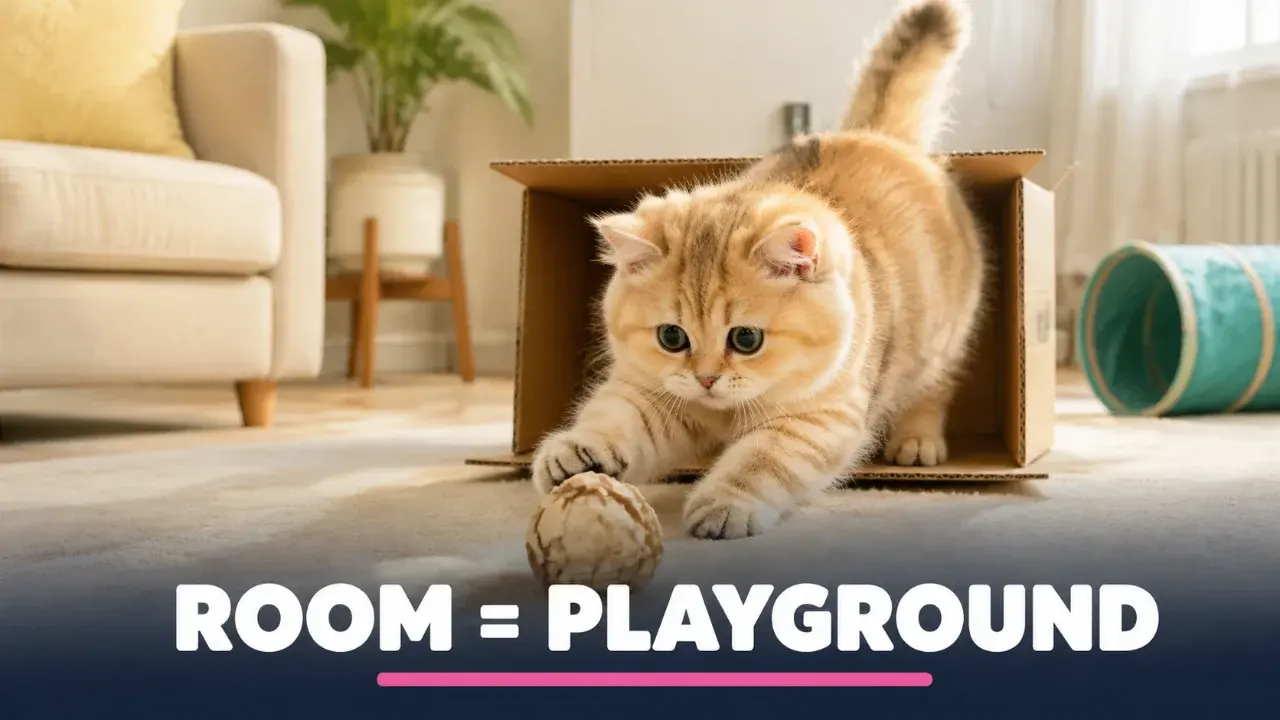
A cardboard box can become a hiding place, a curtain can resemble moving prey, and a hallway can turn into a racetrack. This playful chaos reflects how kittens explore their surroundings and practice natural feline behaviors.
To a kitten, an ordinary room is rarely ordinary. Chair legs create an obstacle course, boxes become ambush shelters, and anything that rolls or flutters may invite a chase.
The reason is not simply excess energy. Kittens are developing movement, hunting-related, object-play, and social skills at the same time. A familiar room supplies countless opportunities to test them.
Household objects create miniature hunting scenarios
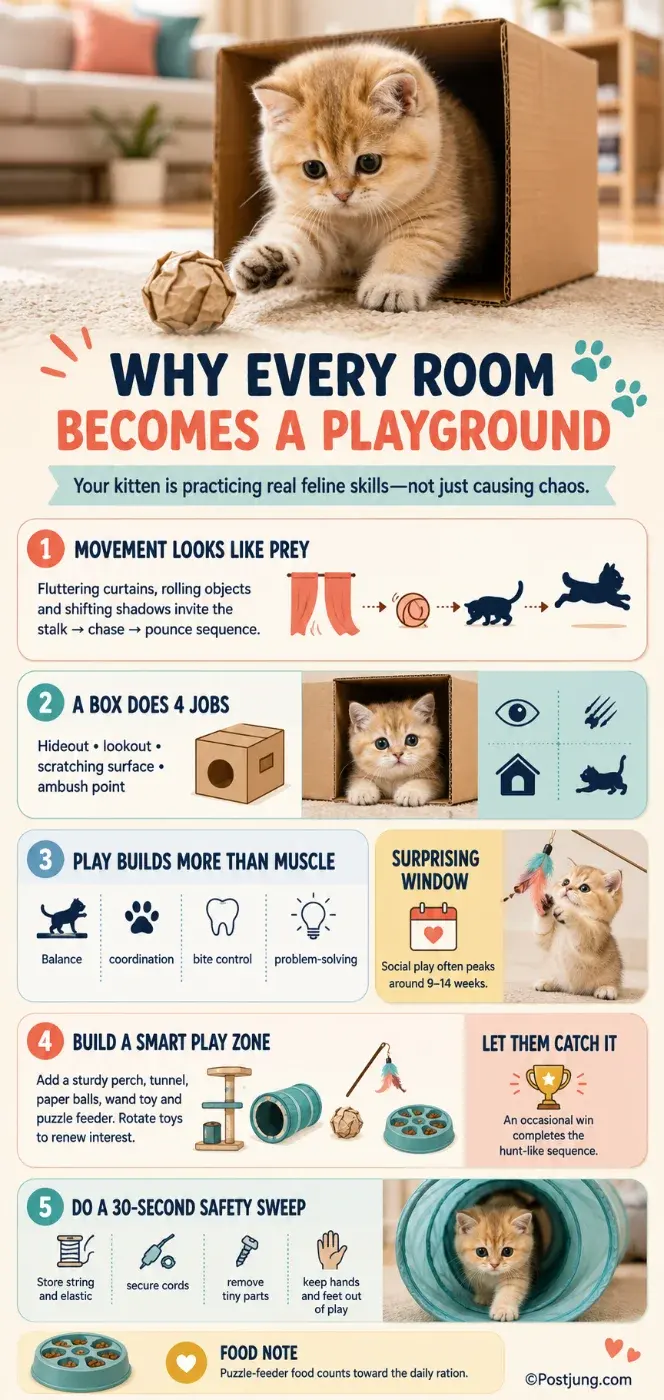
Domestic cats retain behavioral patterns associated with stalking and catching prey. During play, a kitten may search, crouch, chase, pounce, grab, and kick—even when the “prey” is a paper ball or the corner of a blanket.
Small movements are particularly compelling. A curtain shifting in the air, a shoelace sliding across the floor, or a shadow moving along a wall can trigger attention because it behaves somewhat like a small animal attempting to escape.
Furniture makes the game more interesting. A kitten can disappear behind a couch, watch from beneath a chair, or leap from one surface to another. These structures provide concealment, changes in height, and unpredictable sightlines—the ingredients for an engaging pursuit.
This helps explain why an expensive cat toy may temporarily lose to the box it arrived in. The box offers several experiences at once: shelter, a lookout point, a surface to scratch, and a place from which to launch a surprise attack.
Play changes as kittens develop
Research describes feline play in several overlapping categories, including social, locomotor, object, and predatory play. Their prominence changes as kittens mature.
Young kittens initially interact heavily with their mother and littermates. Wrestling, pawing, chasing, and biting allow them to practice coordination while receiving immediate feedback. If one kitten bites too hard, its playmate may stop the game or respond in kind.
Cornell University’s Feline Health Center notes that kittens raised without littermates—or without enough appropriate play—may be more likely to direct rough play toward people. Ankles and hands can become substitute moving targets.
As coordination improves, kittens become increasingly capable of sprinting, climbing, balancing, and jumping. The result can look like random chaos, but the kitten is repeatedly testing what its growing body can do.
A good playground needs safe limits
A kitten-friendly room does not need to be filled with specialized equipment. Cardboard boxes, sturdy scratching surfaces, accessible perches, lightweight balls, and size-appropriate toys can create variety at relatively little cost.
Interactive wand toys can direct stalking and pouncing away from human hands. Moving the toy like prey—sometimes hiding it, sometimes letting it escape—makes the game more engaging. Allowing the kitten to catch it occasionally completes the sequence instead of making every pursuit unwinnable.
Hands and feet should not be used as toys. A bite that seems harmless from a tiny kitten can become painful as the animal grows, and repeated hand play teaches the kitten that human skin is an acceptable target.
Toy rotation can also keep a familiar room interesting. Leaving every toy out continuously may reduce its novelty, while bringing back a stored toy can renew attention without requiring a new purchase.
Some objects require supervision. International Cat Care advises putting away wand toys with string or elastic after play because these materials can become wrapped around a kitten’s neck or limbs. Loose ribbons, yarn, small detachable pieces, electrical cords, unstable shelves, and accessible household chemicals should also be secured.
Rest is part of the environment too
An exciting room should still offer places where the kitten can withdraw. Feline environmental guidelines recommend secure hiding areas and elevated resting spots that give cats a sense of control over their surroundings.
That means the ideal kitten room is not a nonstop amusement park. It contains active areas for chasing and climbing, quieter areas for eating and toileting, and safe places where the kitten will not be disturbed.
Play should remain voluntary. If a kitten walks away, hides, or settles down, it does not need to be repeatedly drawn back into the game.
A kitten’s ability to find entertainment almost anywhere is one of its most charming qualities. It is also a reminder that play is meaningful behavior: through every chase, leap, and carefully planned cardboard-box ambush, the kitten is learning how to move through its world.
SOURCES USED:
- Journal of Feline Medicine and Surgery — AAFP and ISFM Feline Environmental Needs Guidelines
- Frontiers in Veterinary Science — Are These Cats Playing? A Closer Look at Social Play in Cats
- Cornell Feline Health Center — Feline Behavior Problems: Aggression
- International Cat Care — Caring for Your New Kitten

เขียนโดย Postjung Insights
 7 บทเพลงไวรัลยุคโบราณ! เพลงงานวัดที่เปิดเมื่อไหร่ คนก็ลุกขึ้นรำวงเมื่อนั้น
 อำเภอที่มีชื่ออำเภอสั้นที่สุด 3 อำเภอเท่านั้นในประเทศไทย
 รู้หรือไม่? ความทรงจำวัยเด็กอาจไม่ได้เหมือนที่เราเคยจำ! สมองสามารถ “เติมเรื่อง” ให้เราได้
 รู้หรือไม่? เปิดรายได้พนักงานส่งพัสดุของแต่ละแอป วันหนึ่งได้เท่าไร
 โรงเรียนที่มีนักเรียนมากที่สุดในไทย
 5 ไอเทมป้องกันความร้อนให้บ้านแบบโบราณ! ภูมิปัญญาเก่าที่ช่วยบ้านเย็นลงได้ 3-5 องศา
 7 คันเบ็ดตกปลาโบราณ สายเรโทรยอมทุ่มเงินซื้อ! ยิ่งเก่า ยิ่งหายาก ยิ่งมีเรื่องราว
 ตาราง “เด่นเหนือเด่นใต้” งวด 1 ต.ค. 69 เปิดข้อมูลตามโพย เลขไหนอยู่ตรงไหน
 โรงเรียนชายล้วนแห่งแรกของไทยคือที่ไหน? ย้อนดูจุดเริ่มต้นโรงเรียนสวนกุหลาบวิทยาลัย
 เช็กด่วน ! ข่าวบัตรสวัสดิการแจก 10,000 บาท ก.ย. 69 จริงหรือ ? ก่อนเชื่อควรรู้อะไร
 แปลปกสลาก งวด 1 ต.ค. 69 ส่องตัวเลขจากภาพปกสลากกินแบ่งรัฐบาล
 เปิด 5 โรงเรียนหญิงล้วนเก่าแก่ของไทย ที่มีประวัติยาวนานกว่าศตวรรษอำเภอที่มีชื่ออำเภอสั้นที่สุด 3 อำเภอเท่านั้นในประเทศไทย
 English Edition