Why dogs stare into your eyes—and what they may be telling you

Dogs use their eyes to request attention, read human behavior, seek help, and reinforce social bonds. The surrounding context and body language reveal whether a stare is relaxed, expectant, anxious, or confrontational.
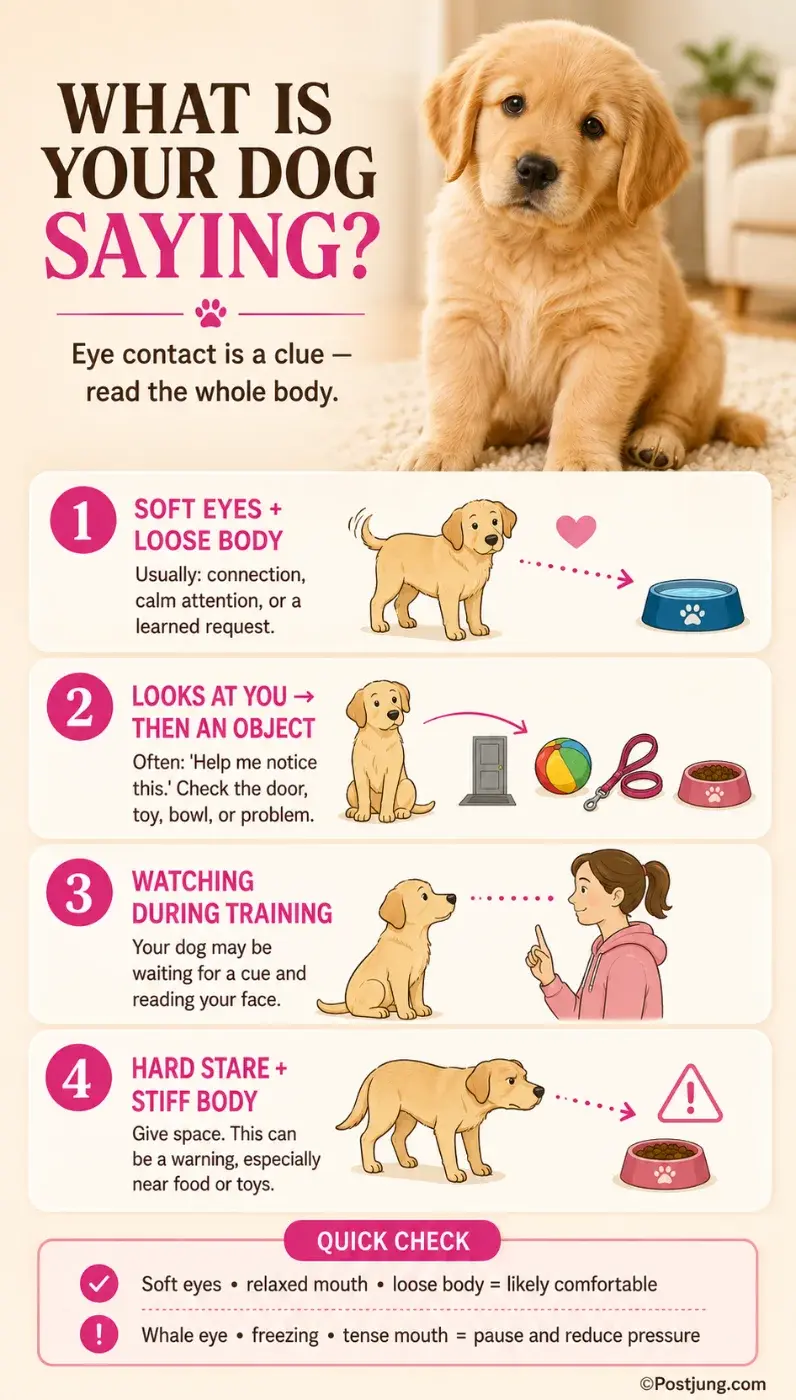
A dog looking steadily into your eyes may be asking for dinner, waiting for a cue, seeking reassurance, or simply enjoying your attention. Eye contact is one of the ways domestic dogs communicate with humans, but no single interpretation fits every stare.
The most reliable way to understand it is to look beyond the eyes. What happened immediately before the stare? Is the dog’s body loose or rigid? Where are the ears, tail, and mouth? Those clues can separate a warm social gaze from anxiety or a warning.
Your dog may be asking for something
Dogs quickly learn which behaviors make people respond. If staring at a person leads to food, a walk, play, or an opened door, the dog has a reason to repeat it.
Watch what happens alongside the gaze. A dog that looks at you and then at an empty water bowl may be directing your attention to it. Looking between you and a toy can be an invitation to play. Waiting near the door while maintaining eye contact may be a request to go outside.
Researchers call this type of looking “referential communication.” In experiments, dogs have used alternating looks between a person and an object to help direct the person’s attention.
A 2016 study of pet dogs found that establishing eye contact with their owners affected how the animals used visual signals to communicate about inaccessible food. The result supports the idea that dogs recognize eye contact as an indication that a person is ready to receive information.
Dogs also look to people for guidance
A stare is not always a demand. Dogs observe human faces to learn whether someone is attentive and what might happen next.
Research reviewed in Frontiers in Psychology shows that dogs adjust their behavior according to whether a person is watching them. They can follow human gaze and pointing, monitor facial expressions, and look toward their owners when confronted with unfamiliar situations or problems they cannot solve.
This helps explain why a dog may stare during training or when routines suddenly change. The animal may be waiting for a familiar word, gesture, or expression that makes the situation clearer.
Individual experience matters. Dogs that have received consistent attention or training may use eye contact differently from dogs with limited human socialization. Breed, temperament, age, and the relationship between the dog and the person can also influence how often a dog looks at human faces.
Relaxed mutual gaze can reinforce a bond
Gentle eye contact between a dog and a familiar person may be part of their social connection.
Research has linked longer mutual gaze between dogs and their owners with changes in oxytocin, a hormone involved in several forms of social behavior and bonding. A scientific review describes a possible positive feedback loop: a dog’s gaze encourages human interaction, and that interaction may reinforce further social contact.
That does not mean every stare is a declaration of love, nor does oxytocin reveal a dog’s precise thoughts. It does show that eye contact can have a physiological as well as a communicative role in established dog-human relationships.
A relaxed dog may have soft eyes, a loose posture, naturally positioned ears, and an easy or gently open mouth. In that setting, returning brief, gentle eye contact may be comfortable for both dog and person.
A hard stare can mean something very different
Prolonged eye contact should not automatically be treated as affection, especially with an unfamiliar dog.
VCA Animal Hospitals distinguishes relaxed eyes from a hard, unblinking stare, which can accompany a threat. Warning signs may include a stiff or frozen body, a tightly closed mouth, raised or forward-focused ears, growling, bared teeth, or guarding food, a toy, or another valued object.
Fear can look different. A worried dog may turn its head away while keeping its eyes on the perceived threat, exposing the whites of the eyes—often called “whale eye.” Lip licking, yawning, crouching, pinned-back ears, or attempts to retreat can add to the picture.
Do not force eye contact, lean over the dog, punish the warning, or move closer to test its reaction. Give the animal space and remove the source of pressure when it is safe to do so. Repeated fearful, guarding, or aggressive behavior warrants help from a veterinarian or a qualified, reward-based behavior professional.
Read the whole conversation
A dog’s stare is closer to a signal than a sentence. Its meaning comes from the setting, the dog’s posture, and what the animal does next.
Notice the pattern over time. A soft gaze before the evening walk probably has a different meaning from a rigid stare over a food bowl. Learning that difference makes everyday communication clearer—and helps people respond before discomfort escalates.
SOURCES USED:

เขียนโดย Postjung Insights
 รู้หรือไม่? เปิดรายได้พนักงานส่งพัสดุของแต่ละแอป วันหนึ่งได้เท่าไร
 ตาราง “เด่นเหนือเด่นใต้” งวด 1 ต.ค. 69 เปิดข้อมูลตามโพย เลขไหนอยู่ตรงไหน
 5 ไอเทมป้องกันความร้อนให้บ้านแบบโบราณ! ภูมิปัญญาเก่าที่ช่วยบ้านเย็นลงได้ 3-5 องศา
 7 บทเพลงไวรัลยุคโบราณ! เพลงงานวัดที่เปิดเมื่อไหร่ คนก็ลุกขึ้นรำวงเมื่อนั้น
 อำเภอที่มีชื่ออำเภอสั้นที่สุด 3 อำเภอเท่านั้นในประเทศไทย
 เช็กด่วน ! ข่าวบัตรสวัสดิการแจก 10,000 บาท ก.ย. 69 จริงหรือ ? ก่อนเชื่อควรรู้อะไร
 ส่องเลข 3 สำนักพิมพ์ งวด 1 ต.ค. 69 ตัวไหนมีข้อมูลตรงกัน
 โรงเรียนที่มีนักเรียนมากที่สุดในไทย
 7 คันเบ็ดตกปลาโบราณ สายเรโทรยอมทุ่มเงินซื้อ! ยิ่งเก่า ยิ่งหายาก ยิ่งมีเรื่องราว
 เปิด 5 โรงเรียนหญิงล้วนเก่าแก่ของไทย ที่มีประวัติยาวนานกว่าศตวรรษ
 แปลปกสลาก งวด 1 ต.ค. 69 ส่องตัวเลขจากภาพปกสลากกินแบ่งรัฐบาล
 ทำไมหนังสือบางเล่มถึงมีหน้าว่างทั้งหน้า? มันอาจไม่ได้พิมพ์พลาดอำเภอที่มีชื่ออำเภอสั้นที่สุด 3 อำเภอเท่านั้นในประเทศไทย
 English Edition