Why a pet’s purchase price says little about lifetime cost

Food, housing, routine veterinary care, emergencies, and years of responsibility usually matter far more than the amount paid to bring an animal home. A realistic budget begins with the pet’s needs and expected lifespan.
A free kitten, a low-priced hamster, or an inexpensive bird can look like the most affordable route into pet ownership. The amount paid on the first day, however, reveals very little about what that animal will cost over its life.
The meaningful calculation begins after the pet arrives. Food, safe housing, veterinary care, cleaning supplies, equipment, grooming, training, travel arrangements, and unexpected illness can continue for years. The pet with the lowest purchase or adoption price is therefore not automatically the least expensive one to care for responsibly.
The first price covers only the beginning
Acquisition costs are easy to see because they arrive as a single number. Long-term costs are scattered across dozens of smaller transactions.
A new owner may need an enclosure or crate, carrier, bedding, bowls, identification, vaccinations, parasite prevention, sterilization, licensing, and an initial veterinary examination. Some adoption fees already include services such as vaccinations, microchipping, or spaying and neutering, so a pet with a higher upfront fee may include care that would otherwise need to be purchased separately.
The American Society for the Prevention of Cruelty to Animals lists food, routine medical care, preventive medication, insurance, grooming supplies, toys, litter, and boarding among the recurring costs associated with dogs and cats. Its published figures are based on U.S. prices and were updated in 2021, so they should be treated as examples of cost categories—not as a current universal budget.
Local prices, the animal’s health, and the owner’s standard of care can change the total substantially.
Lifespan turns small expenses into large commitments
A modest monthly expense becomes significant when it repeats for many years. Lifespan is therefore one of the most important—and most frequently overlooked—parts of a pet budget.
The American Veterinary Medical Association advises prospective owners to plan for an animal’s full potential lifespan. That period varies widely by species. Some small rodents live only a few years, while certain birds can remain part of a household for decades.
A longer life is not a disadvantage, but it does multiply years of food, preventive care, replacement equipment, and possible age-related treatment. It may also require plans for major life changes such as moving, having children, traveling, losing income, or becoming unable to provide daily care.
Small animals do not always have small needs
Body size is another unreliable shortcut. A rabbit may eat less than a large dog, but responsible rabbit care can involve substantial housing, fresh hay, bedding, enrichment, sterilization, and veterinary treatment from a professional familiar with the species.
Social needs can also change the calculation. The Royal Society for the Prevention of Cruelty to Animals recommends keeping a rabbit with at least one compatible rabbit unless a veterinarian or qualified behaviorist advises otherwise. That means a realistic rabbit budget may need to cover two animals, sufficient space, and resources for both.
Birds, reptiles, fish, and small mammals may require specialized enclosures, lighting, heating, filtration, diets, or veterinary services. The animal itself may be inexpensive while the environment needed to keep it healthy is not.
Build four budgets before choosing a pet
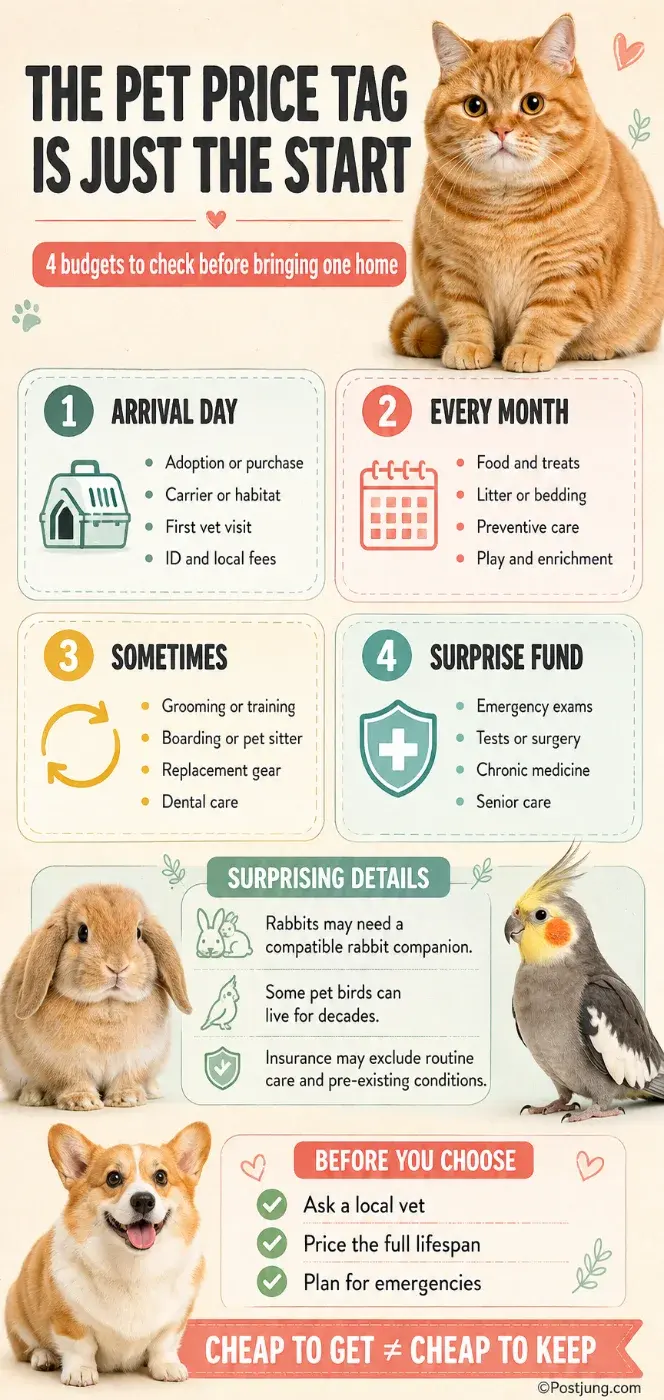
A practical estimate should include four separate categories:
- Arrival costs: The adoption or purchase fee, initial veterinary care, sterilization, identification, permits, enclosure, carrier, and essential equipment.
- Normal recurring costs: Food, litter or bedding, preventive veterinary care, medication, grooming, training, enrichment, and electricity for temperature control, lighting, or filtration where required.
- Irregular costs: Dental treatment, replacement equipment, property damage, boarding, pet sitting, transportation, and care during travel or emergencies at home.
- Medical risk: Urgent treatment, diagnostic tests, surgery, chronic medication, rehabilitation, and additional support as the animal ages.
Ask local veterinary clinics what routine and emergency care commonly costs for the species being considered. Check whether an appropriate veterinarian is available nearby, especially for birds, reptiles, rabbits, and other animals that may require specialized expertise.
A shelter, veterinarian, or reputable welfare organization can also help identify needs that a seller’s price tag does not show.
Insurance reduces some risks, not every expense
Pet insurance may help with eligible accident or illness costs, but it is not a replacement for a routine-care budget. Policies differ by country and provider, and they may exclude preventive care, pre-existing conditions, certain hereditary conditions, or particular species.
Blue Cross advises owners to examine limits, deductibles or excess payments, exclusions, reimbursement arrangements, and whether long-term conditions remain covered after renewal. Owners who do not use insurance still need another realistic plan for unexpected veterinary bills, such as a dedicated emergency fund.
The best financial match is personal
There is no single “cheapest pet” for every household. One owner may already have suitable housing and access to affordable veterinary care, while another may need to buy specialized equipment or pay for frequent pet sitting.
Housing rules, climate, working hours, transportation, allergies, and the availability of qualified care can all change the calculation.
Research remains uneven. In the United Kingdom, PDSA’s 2024 survey found that only 24% of dog, cat, and rabbit owners had investigated ownership costs before choosing their pet. The same report said 60% of owners surveyed in 2023 underestimated the minimum monthly cost.
The most responsible choice is not necessarily the animal with the lowest price. It is the pet whose needs, lifespan, and possible medical risks fit the household’s money, time, space, and long-term plans. If that fit is not yet possible, waiting can be the kindest decision for both the person and the animal.
SOURCES USED:

เขียนโดย Postjung Insights
 รู้หรือไม่? เปิดรายได้พนักงานส่งพัสดุของแต่ละแอป วันหนึ่งได้เท่าไร
 รู้หรือไม่? ความทรงจำวัยเด็กอาจไม่ได้เหมือนที่เราเคยจำ! สมองสามารถ “เติมเรื่อง” ให้เราได้
 อำเภอที่มีชื่ออำเภอสั้นที่สุด 3 อำเภอเท่านั้นในประเทศไทย
 5 ไอเทมป้องกันความร้อนให้บ้านแบบโบราณ! ภูมิปัญญาเก่าที่ช่วยบ้านเย็นลงได้ 3-5 องศา
 แปลปกสลาก งวด 1 ต.ค. 69 ส่องตัวเลขจากภาพปกสลากกินแบ่งรัฐบาล
 7 บทเพลงไวรัลยุคโบราณ! เพลงงานวัดที่เปิดเมื่อไหร่ คนก็ลุกขึ้นรำวงเมื่อนั้น
 7 คันเบ็ดตกปลาโบราณ สายเรโทรยอมทุ่มเงินซื้อ! ยิ่งเก่า ยิ่งหายาก ยิ่งมีเรื่องราว
 โรงเรียนที่มีนักเรียนมากที่สุดในไทย
 ตาราง “เด่นเหนือเด่นใต้” งวด 1 ต.ค. 69 เปิดข้อมูลตามโพย เลขไหนอยู่ตรงไหน
 เปิด 5 โรงเรียนหญิงล้วนเก่าแก่ของไทย ที่มีประวัติยาวนานกว่าศตวรรษ
 ส่องเลข 3 สำนักพิมพ์ งวด 1 ต.ค. 69 ตัวไหนมีข้อมูลตรงกัน
 5 เมนูอาหารไทยโบราณที่หาทานยาก ชื่อคุ้นหู แต่คนรุ่นใหม่อาจไม่เคยชิมอำเภอที่มีชื่ออำเภอสั้นที่สุด 3 อำเภอเท่านั้นในประเทศไทย
 English Edition