Why adopting a senior pet can be deeply rewarding

Older dogs and cats often come with established personalities and gentler routines. The right match can bring meaningful companionship, provided adopters are prepared for their changing health and comfort needs.
A senior dog or cat may not offer as many years as a puppy or kitten, but that does not make the relationship less meaningful. For the right household, an older animal can offer calm companionship, a more predictable personality, and the satisfaction of making their later years safe and comfortable.
The appeal is real, but so is the responsibility. Adopters should look beyond a pet’s age and consider the individual animal’s health, temperament, history, and daily needs.
You have a clearer idea of who you are bringing home
One advantage of adopting an older pet is that much of the animal’s adult personality has already developed. Shelter or foster caregivers may be able to describe whether the pet is social or independent, energetic or relaxed, comfortable around children, or able to live with other animals.
The British animal welfare charity Blue Cross notes that an adult pet’s established personality can help prospective adopters judge whether the animal fits their lifestyle. Its teams also assess animals and share information about the kind of household likely to suit them.
This does not eliminate surprises. Behavior may change as a pet leaves a shelter, becomes comfortable in a new environment, or recovers from stress. Still, an older animal often provides more information for matching than a very young puppy or kitten whose adult temperament has not fully emerged.
Daily life may be less demanding
Many adult and senior pets have moved beyond the most intensive stage of early development. Some are already housetrained, know basic cues, sleep through the night, or have experience living with people and other animals.
Humane World for Animals says shelters and rescue groups care for many pets that have already been housetrained or have lived successfully with children or other animals. Blue Cross similarly reports that many adult dogs arrive with some basic training.
These are possibilities, not guarantees. A senior pet may still need help adjusting to a new toilet routine, learning household boundaries, or becoming comfortable when left alone. Positive, patient training remains useful at any age.
Energy levels also vary. Some older dogs enjoy long walks, while others need shorter, slower outings. Some senior cats remain highly playful; others prefer a warm bed and a quiet window. Age alone should not be used as a shortcut for understanding an animal’s needs.
“Senior” does not mean the same age for every pet
There is no single birthday when every dog or cat becomes senior.
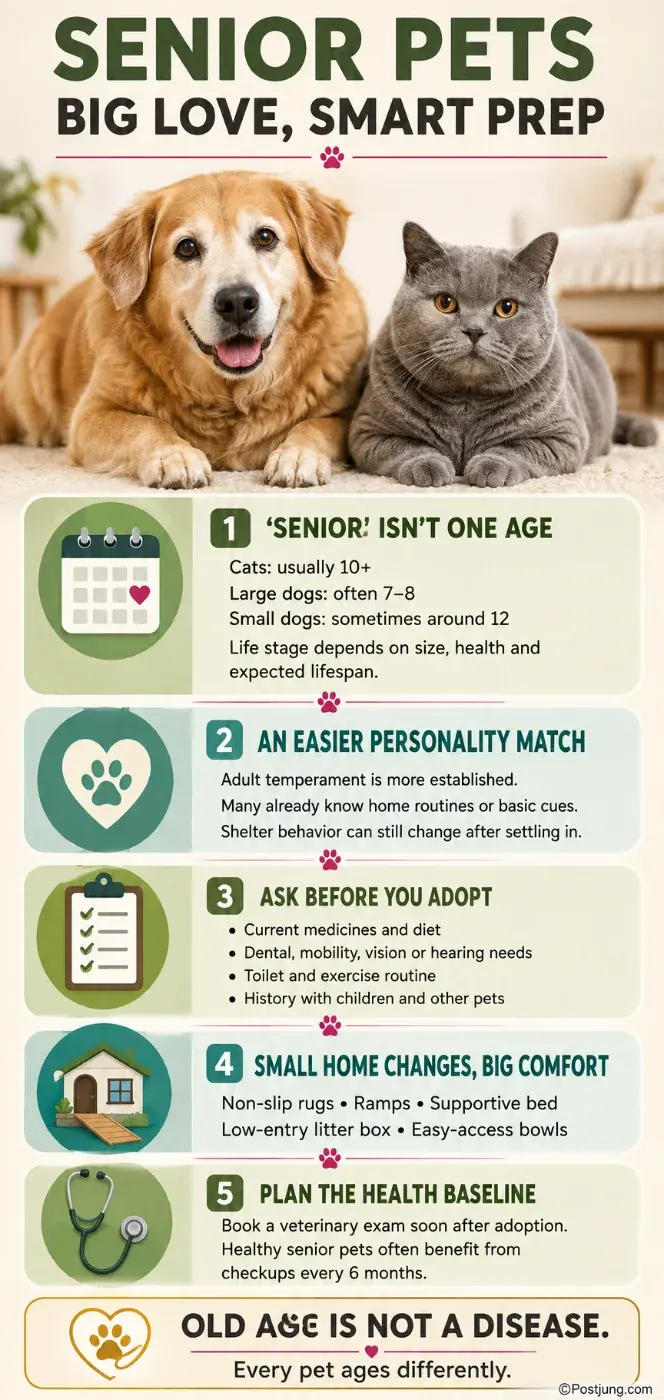
The American Animal Hospital Association, or AAHA, generally describes the senior stage as the final quarter of an animal’s estimated lifespan. Cats are commonly considered senior after age 10. A large dog might enter this stage at 7 or 8, while a smaller dog may not be considered senior until around age 12.
Senior status also does not mean an animal is necessarily sick. AAHA’s veterinary guidelines emphasize that old age itself is not a disease. Some older pets remain active and healthy, while others live comfortably with conditions that require medication, monitoring, or changes at home.
This individual variation makes the pet’s medical history more useful than the age printed on an adoption profile.
The care plan matters as much as the emotional connection
Before adopting, ask the shelter or rescue for all available veterinary and behavioral records. Useful questions include:
- Is the pet taking medication or eating a prescribed diet?
- Are there known dental, mobility, vision, hearing, or cognitive changes?
- What exercise and toilet routine does the pet currently follow?
- How does the animal respond to handling, visitors, children, and other pets?
- What medical follow-up has the shelter recommended?
- Is post-adoption behavior support available?
A veterinary examination soon after adoption can establish a health baseline and help create an appropriate care schedule. AAHA recommends that senior dogs and cats receive more frequent veterinary assessments, commonly every six months, although the right schedule depends on the individual animal.
Prospective adopters should budget for routine examinations, diagnostic tests, dental care, medication, and unexpected treatment. An adoption fee may be modest, but long-term care can be the larger financial commitment.
Simple changes can make home life more comfortable. Non-slip rugs can help pets with reduced traction, while ramps or steps may make beds and furniture easier to reach. A senior cat with limited mobility may benefit from a litter box with a lower entrance. Exercise and food should be adjusted with veterinary guidance rather than reduced solely because of age.
The reward is a relationship, not a rescue fantasy
Adopting a senior pet is sometimes described as “saving” an animal, but a lasting relationship depends on more than good intentions. The pet still needs patience, stability, medical care, enrichment, and respect for its individual boundaries.
The emotional reward may come from quieter moments: watching an anxious animal begin to relax, discovering a favorite walking route, or learning the small routines that make an older companion comfortable.
There may also be difficult decisions sooner than there would be with a younger pet. Adopters should be emotionally prepared for age-related illness and, eventually, end-of-life care. No shelter can predict exactly how long an animal will live.
That uncertainty does not diminish the value of the time shared. When the match is thoughtful and the commitment is realistic, adopting a senior pet can give an older animal a secure home—and give the adopter a companion whose personality is already waiting to be known.
SOURCES USED:
- American Animal Hospital Association — Senior Status? Understanding Your Senior Pet’s Life Stage
- American Animal Hospital Association — 2023 AAHA Senior Care Guidelines for Dogs and Cats
- Blue Cross — Pet rehoming myths debunked
- Blue Cross — Would an older dog suit you better?
- Humane World for Animals — Adopt pets from animal shelters or rescues

เขียนโดย Postjung Insights
 โรงเรียนที่มีนักเรียนมากที่สุดในไทย
 7 บทเพลงไวรัลยุคโบราณ! เพลงงานวัดที่เปิดเมื่อไหร่ คนก็ลุกขึ้นรำวงเมื่อนั้น
 7 คันเบ็ดตกปลาโบราณ สายเรโทรยอมทุ่มเงินซื้อ! ยิ่งเก่า ยิ่งหายาก ยิ่งมีเรื่องราว
 เช็กด่วน ! ข่าวบัตรสวัสดิการแจก 10,000 บาท ก.ย. 69 จริงหรือ ? ก่อนเชื่อควรรู้อะไร
 5 ไอเทมป้องกันความร้อนให้บ้านแบบโบราณ! ภูมิปัญญาเก่าที่ช่วยบ้านเย็นลงได้ 3-5 องศา
 ตาราง “เด่นเหนือเด่นใต้” งวด 1 ต.ค. 69 เปิดข้อมูลตามโพย เลขไหนอยู่ตรงไหน
 รู้หรือไม่? เปิดรายได้พนักงานส่งพัสดุของแต่ละแอป วันหนึ่งได้เท่าไร
 อำเภอที่มีชื่ออำเภอสั้นที่สุด 3 อำเภอเท่านั้นในประเทศไทย
 ทำไมหนังสือบางเล่มถึงมีหน้าว่างทั้งหน้า? มันอาจไม่ได้พิมพ์พลาด
 ส่องเลข 3 สำนักพิมพ์ งวด 1 ต.ค. 69 ตัวไหนมีข้อมูลตรงกัน
 โรงเรียนชายล้วนแห่งแรกของไทยคือที่ไหน? ย้อนดูจุดเริ่มต้นโรงเรียนสวนกุหลาบวิทยาลัย
 รู้หรือไม่? ความทรงจำวัยเด็กอาจไม่ได้เหมือนที่เราเคยจำ! สมองสามารถ “เติมเรื่อง” ให้เราได้อำเภอที่มีชื่ออำเภอสั้นที่สุด 3 อำเภอเท่านั้นในประเทศไทย
 English Edition