Why Dogs Press Against Your Legs—and What Their Body Language Says

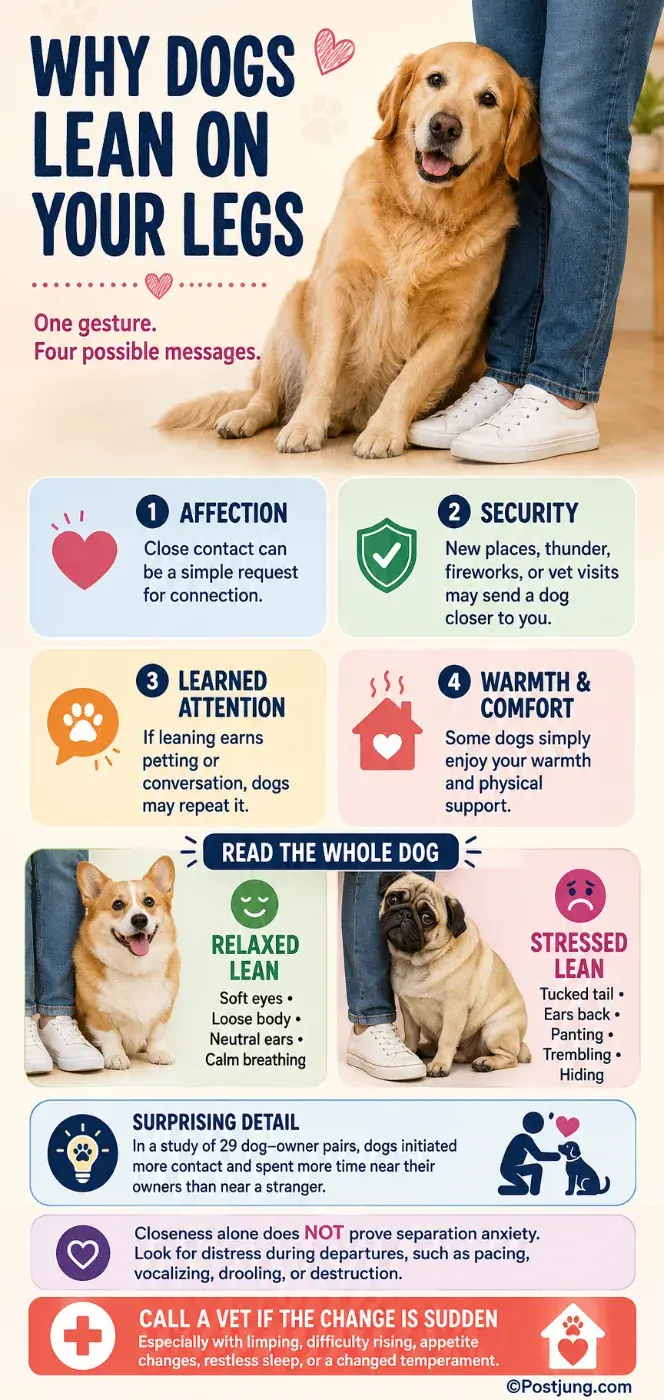
A dog leaning against your legs may be seeking affection, security, warmth, or attention. The surrounding situation and the rest of the dog’s body provide the clearest clues.
When a dog presses its side, shoulder, or entire body against your legs, the simplest explanation is often that it wants to be close to you. But leaning is not a single-purpose signal: the same behavior can appear during a relaxed cuddle, in an unfamiliar place, or when a dog feels uneasy.
To understand what the contact means, look beyond the lean itself. Notice when it happens, what occurred immediately beforehand, and whether the dog’s body appears loose or tense.
It may be a request for closeness
Dogs form attachment relationships with their caregivers, and physical proximity is one way that relationship appears in everyday behavior.
In a 2019 study involving 29 dog-owner pairs, dogs spent more time near their owners and initiated more contact with them than with an unfamiliar person during a controlled separation-and-reunion test. The study supports the broader idea that owners can function as attachment figures for their dogs.
That does not mean every lean carries a deep emotional message. Sometimes a dog simply enjoys physical contact or has learned that resting against a person leads to petting, conversation, or attention.
The behavior is more likely to reflect comfortable social contact when the dog has:
- Relaxed muscles
- Soft, normally shaped eyes
- A loose or gently wagging tail
- Ears held in their usual position
- A soft mouth rather than tightly closed lips
- Calm, unhurried breathing
A dog showing these signs may remain beside you even when nothing stressful is happening. If you move, the dog might follow and lean again because the contact itself is rewarding.
Your dog may be looking for reassurance
Leaning can take on a different meaning during thunderstorms, fireworks, veterinary visits, crowded gatherings, or encounters with unfamiliar people and animals.
In these situations, a dog may move behind a trusted person, press against their legs, or position itself between their feet. The contact can be an attempt to stay close to a familiar source of security while the dog assesses what is happening.
Signs that the lean may be related to fear or stress include:
- A tucked or lowered tail
- Ears pulled back
- Crouching or shifting weight backward
- Trembling
- Panting without recent exercise or heat
- Repeated lip licking or yawning
- Avoiding eye contact
- Trying to hide behind you or leave the area
- A rigid body rather than a loose one
Context matters. A dog that leans against you every evening on the couch is communicating something different from a dog that suddenly pushes into your legs when thunder begins.
If stress appears to be the reason, avoid forcing the dog to interact with whatever is frightening it. Give it space to retreat to a calm location and allow it to choose whether it wants contact.
Attention can turn leaning into a habit
Dogs repeat actions that produce useful results. If leaning makes you immediately scratch your dog’s ears, talk to it, or offer a treat, the dog may learn that body pressure is an effective way to ask for engagement.
There is nothing inherently wrong with this habit if both the dog and the people around it are comfortable. For a large dog, however, forceful leaning can unbalance a child, an older adult, or someone with limited mobility.
If the behavior becomes inconvenient, avoid pushing or punishing the dog. Instead, teach an alternative such as sitting beside you or settling on a mat, then reward that behavior with the attention the dog was seeking.
Leaning does not automatically mean separation anxiety
A dog that likes constant contact is sometimes described as overly attached, but affectionate or “clingy” behavior by itself is not enough to diagnose separation anxiety.
The Merck Veterinary Manual notes that dogs that follow family members around the home are not necessarily at greater risk of separation anxiety than dogs that do not. A clinical separation-related problem involves distress when a caregiver leaves or prepares to leave.
More meaningful warning signs include destructive behavior near exits, persistent vocalizing, pacing, drooling, refusing food, house soiling, or an inability to settle during an absence. A video recorded while the dog is alone can help a veterinarian or veterinary behaviorist evaluate what is happening.
When a new lean deserves closer attention
A long-standing leaning habit in an otherwise relaxed, healthy dog is usually not concerning. A sudden change in contact-seeking behavior, especially in an older dog, deserves more attention.
Pain and reduced mobility can alter how dogs sit, stand, rest, and interact. Watch for limping, difficulty rising, reluctance to use stairs, an unusual sitting position, nighttime restlessness, reduced interest in play, or sensitivity when touched.
Contact a veterinarian if the leaning begins suddenly, becomes unusually persistent, or appears alongside changes in movement, appetite, sleep, elimination, or temperament. The veterinarian can first rule out pain or illness and, when appropriate, recommend a qualified behavior professional.
Most of the time, a relaxed dog leaning against familiar legs is doing exactly what it appears to be doing: choosing closeness. The important part is not assigning one universal meaning, but learning how that particular dog behaves when comfortable, uncertain, or in need of help.
SOURCES USED:
- American Kennel Club — Why Does My Dog Sit on My Feet?
- Frontiers in Behavioral Neuroscience — Physiological Indicators of Attachment in Domestic Dogs and Their Owners
- VCA Animal Hospitals — Signs Your Dog Is Stressed and How to Relieve It
- Merck Veterinary Manual — Behavior Problems of Dogs
- VCA Animal Hospitals — How to Recognize Pain in Aging Dogs

เขียนโดย Postjung Insights
 อำเภอที่มีชื่ออำเภอสั้นที่สุด 3 อำเภอเท่านั้นในประเทศไทย
 7 บทเพลงไวรัลยุคโบราณ! เพลงงานวัดที่เปิดเมื่อไหร่ คนก็ลุกขึ้นรำวงเมื่อนั้น
 โรงเรียนที่มีนักเรียนมากที่สุดในไทย
 7 คันเบ็ดตกปลาโบราณ สายเรโทรยอมทุ่มเงินซื้อ! ยิ่งเก่า ยิ่งหายาก ยิ่งมีเรื่องราว
 ตาราง “เด่นเหนือเด่นใต้” งวด 1 ต.ค. 69 เปิดข้อมูลตามโพย เลขไหนอยู่ตรงไหน
 รู้หรือไม่? เปิดรายได้พนักงานส่งพัสดุของแต่ละแอป วันหนึ่งได้เท่าไร
 รู้หรือไม่? ความทรงจำวัยเด็กอาจไม่ได้เหมือนที่เราเคยจำ! สมองสามารถ “เติมเรื่อง” ให้เราได้
 5 ไอเทมป้องกันความร้อนให้บ้านแบบโบราณ! ภูมิปัญญาเก่าที่ช่วยบ้านเย็นลงได้ 3-5 องศา
 ส่องเลข 3 สำนักพิมพ์ งวด 1 ต.ค. 69 ตัวไหนมีข้อมูลตรงกัน
 แปลปกสลาก งวด 1 ต.ค. 69 ส่องตัวเลขจากภาพปกสลากกินแบ่งรัฐบาล
 โรงเรียนชายล้วนแห่งแรกของไทยคือที่ไหน? ย้อนดูจุดเริ่มต้นโรงเรียนสวนกุหลาบวิทยาลัย
 โรงเรียนเพียงแห่งเดียวของประเทศไทย ที่อยู่มาตั้งแต่ยุครัชกาลที่ 4อำเภอที่มีชื่ออำเภอสั้นที่สุด 3 อำเภอเท่านั้นในประเทศไทย
 English Edition