Why Dogs Love Smelly Socks—and Why the Habit Can Be Dangerous

A worn sock carries a strong, familiar scent and is conveniently soft enough to carry or chew. But a playful theft can become a veterinary emergency if the sock is swallowed.
A dirty sock may smell unpleasant to a human, but to a dog it can be a scent-rich object connected to someone familiar. Add a soft texture, an easy-to-carry shape, and the possibility of an exciting chase, and the appeal becomes easier to understand.
There is no single scientific study proving that all dogs have a special preference for socks. Research into canine smell and behavior, however, offers several convincing explanations for why worn clothing attracts so many of them.
Your sock smells unmistakably like you
Dogs experience much of their environment through smell. A worn sock collects a concentrated mixture of body odor and scents from the places its owner has walked, making it far more informative to a dog than a freshly washed piece of fabric.
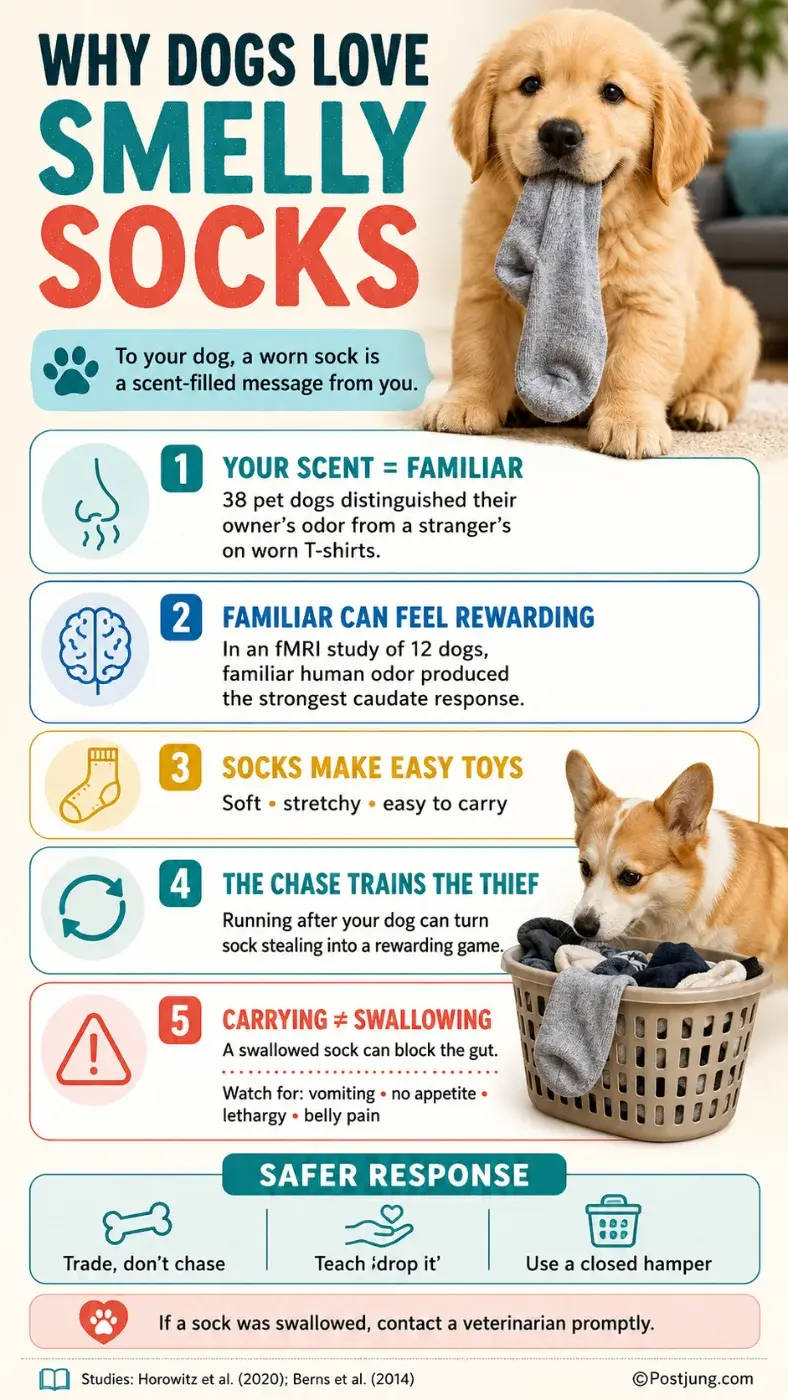
In a 2020 experiment involving 38 pet dogs, researchers presented the animals with body odors collected on T-shirts. The dogs could distinguish their owner’s odor from that of an unfamiliar person without either person being present.
The researchers cautioned that this result did not prove the dogs consciously connected the scent with a mental image of their owner. It did demonstrate that familiar and unfamiliar human odors were meaningfully different to them.
A smaller brain-imaging study provides another piece of the puzzle. Twelve trained dogs were exposed to five scents while undergoing functional MRI scans. These included odors from familiar and unfamiliar humans and dogs.
The strongest response in the caudate, a brain region associated with positive expectations, appeared when the dogs smelled a familiar human. The study was small, so it should not be treated as proof that every dog finds an owner’s clothing comforting. Still, it supports the idea that a familiar person’s scent can have positive significance even when that person is absent.
A sock also behaves like a toy
Smell is only part of the attraction. Socks are lightweight, stretchy, easy to grab, and satisfying for some dogs to shake, chew, or carry.
Puppies routinely investigate objects with their noses and mouths. Adult dogs may continue the behavior because chewing and carrying objects are enjoyable, particularly when they have excess energy or too few appropriate outlets.
The dog may not care that the object is classified as clothing. From its perspective, the sock is a portable, strongly scented item with an interesting texture.
The chase can reinforce the theft
A dog that grabs a sock often receives an immediate reaction. A person may shout, run after the dog, reach for the sock, or offer a treat in exchange.
That response can unintentionally transform laundry theft into a reliable game. VCA veterinary behavior guidance notes that some dogs learn to steal valued possessions specifically because doing so starts an exciting chase.
Even scolding can function as attention. If stealing a sock reliably makes an otherwise busy human engage, the behavior may become increasingly rewarding.
This does not mean every sock-stealing dog is bored or seeking attention. The motivation may be scent, play, teething, anxiety, exploration—or several of these at once. Observing when the behavior happens can help identify the most likely trigger.
Carrying a sock is not the same as eating one
A dog that briefly carries a sock is displaying a different behavior from a dog that repeatedly swallows fabric or other non-food objects. Repeated consumption of non-food material is known as pica and can be associated with behavioral or medical problems.
Swallowing a sock can obstruct the stomach or intestines. According to the Merck Veterinary Manual, gastrointestinal obstruction can lead to dehydration, tissue damage, perforation, shock, and other life-threatening complications.
Possible warning signs include:
- Repeated vomiting or regurgitation
- Loss of appetite
- Lethargy
- Abdominal pain
- Diarrhea or difficulty passing stool
- Sudden behavioral changes after a suspected ingestion
A dog that has swallowed—or may have swallowed—a sock should be assessed promptly by a veterinarian. Owners should not induce vomiting unless a veterinary professional specifically instructs them to do so.
How to stop the sock-stealing cycle
The safest strategy begins with preventing access. Use a closed laundry hamper, keep bedroom floors clear, and check that washing-machine loads are not accessible to the dog.
Provide legal alternatives with appealing textures, such as appropriately sized tug toys or soft dog toys designed for supervised chewing. Regular exercise, sniffing activities, food puzzles, and interactive play may help when boredom or unmet enrichment needs contribute to the behavior.
Teach “leave it” and “drop it” using positive reinforcement. If the dog already has a sock, avoid turning the moment into a chase or angrily forcing open its mouth. Instead, calmly offer a high-value treat or approved toy and reward the dog for releasing the sock.
Punishment can make some dogs run away, swallow the object quickly, or become defensive about possessions. Dogs that growl, freeze, guard stolen objects, or repeatedly consume fabric should be evaluated by a veterinarian or qualified veterinary behaviorist.
Your sock is not necessarily attractive because it is dirty. To a dog, it may be familiar, portable, fun—and unusually effective at making you pay attention. Understanding those rewards is the first step toward replacing the habit with something safer.
SOURCES USED:
- International Journal of Comparative Psychology — Discrimination of Person Odor by Owned Domestic Dogs
- Emory Health Sciences — Scent of the Familiar: An fMRI Study of Canine Brain Responses
- VCA Animal Hospitals — Dogs and Destructive Chewing
- VCA Animal Hospitals — Teaching Your Dog to Drop an Object
- Merck Veterinary Manual — Gastrointestinal Obstruction in Small Animals

เขียนโดย Postjung Insights
 รู้หรือไม่? เปิดรายได้พนักงานส่งพัสดุของแต่ละแอป วันหนึ่งได้เท่าไร
 5 ไอเทมป้องกันความร้อนให้บ้านแบบโบราณ! ภูมิปัญญาเก่าที่ช่วยบ้านเย็นลงได้ 3-5 องศา
 7 คันเบ็ดตกปลาโบราณ สายเรโทรยอมทุ่มเงินซื้อ! ยิ่งเก่า ยิ่งหายาก ยิ่งมีเรื่องราว
 7 บทเพลงไวรัลยุคโบราณ! เพลงงานวัดที่เปิดเมื่อไหร่ คนก็ลุกขึ้นรำวงเมื่อนั้น
 ตาราง “เด่นเหนือเด่นใต้” งวด 1 ต.ค. 69 เปิดข้อมูลตามโพย เลขไหนอยู่ตรงไหน
 อำเภอที่มีชื่ออำเภอสั้นที่สุด 3 อำเภอเท่านั้นในประเทศไทย
 โรงเรียนที่มีนักเรียนมากที่สุดในไทย
 เช็กด่วน ! ข่าวบัตรสวัสดิการแจก 10,000 บาท ก.ย. 69 จริงหรือ ? ก่อนเชื่อควรรู้อะไร
 โรงเรียนเพียงแห่งเดียวของประเทศไทย ที่อยู่มาตั้งแต่ยุครัชกาลที่ 4
 แปลปกสลาก งวด 1 ต.ค. 69 ส่องตัวเลขจากภาพปกสลากกินแบ่งรัฐบาล
 รู้หรือไม่? ความทรงจำวัยเด็กอาจไม่ได้เหมือนที่เราเคยจำ! สมองสามารถ “เติมเรื่อง” ให้เราได้
 เปิด 5 โรงเรียนหญิงล้วนเก่าแก่ของไทย ที่มีประวัติยาวนานกว่าศตวรรษอำเภอที่มีชื่ออำเภอสั้นที่สุด 3 อำเภอเท่านั้นในประเทศไทย
 English Edition