Why pet medication bills are often higher than owners expect
The price of a pet prescription may reflect far more than the tablets in the package. Dose, formulation, monitoring, dispensing fees, and where the medicine is purchased can all change the final cost.
A prescription that appears inexpensive by the tablet can become a substantial monthly expense once dosage, dispensing, veterinary examinations, and monitoring are included. Prices may also differ considerably between a veterinary clinic and an outside pharmacy, even when the active ingredient appears to be the same.
Understanding what is actually included in the bill can help pet owners ask better questions without compromising their animal’s treatment.
The prescription may be only one part of the cost
Owners sometimes describe the entire treatment bill as “the medication cost,” although the invoice may include several separate services.
A veterinarian may need to examine the animal, establish a diagnosis, calculate a dose, explain administration, maintain medication records, and monitor for side effects. Some treatments also require follow-up examinations or blood tests.
The U.S. Food and Drug Administration notes that veterinarians determine whether a dose needs to change and whether an animal needs blood tests or a checkup. Those steps can make treatment safer, but they can also make the total care plan cost much more than the medicine alone.
Ask for an itemized estimate that separates:
- The consultation or examination
- Diagnostic or monitoring tests
- The medication itself
- Dispensing, administration, or prescription fees
- Expected follow-up visits
This makes it easier to calculate the real monthly or annual cost of treatment.
Body size and dosage can change the calculation
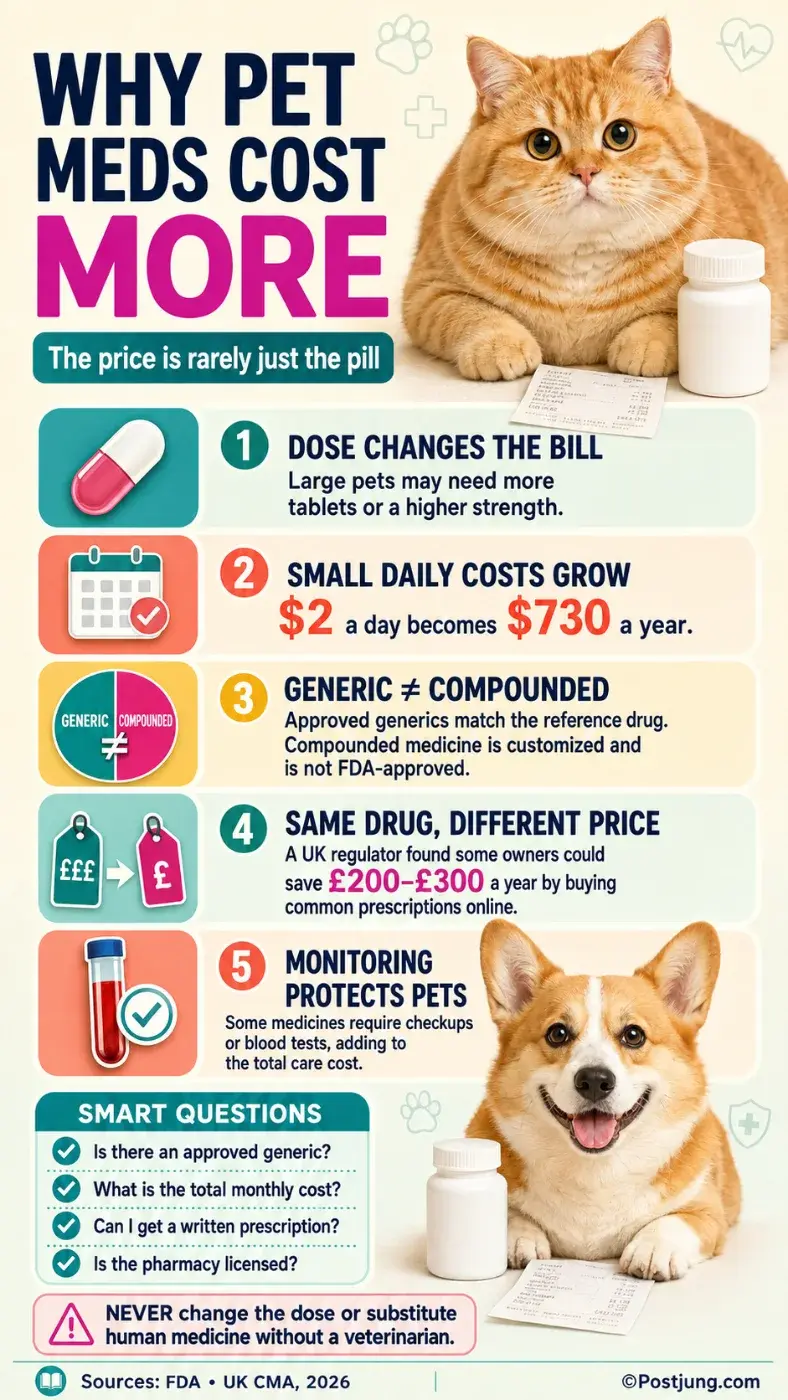
Pet medicines are frequently dosed according to body weight or divided into size bands. A large dog may need more tablets, a higher-strength product, or a greater volume of liquid than a small dog receiving the same active ingredient.
Duration matters just as much. A relatively affordable antibiotic used briefly is financially different from a heart, thyroid, seizure, allergy, or pain medication that must be given for months or years.
Owners should therefore compare the cost of the prescribed course—not merely the price of one tablet or package. The correct comparison uses the same active ingredient, strength, dosage form, quantity, and dosing schedule.
A generic and a compounded medicine are not the same thing
An approved generic can offer another treatment option when one is available. In the United States, the FDA requires an approved generic animal drug to have the same active ingredient, strength, dosage form, dosing regimen, and intended use as its reference product. It must also demonstrate bioequivalence, meaning it is absorbed and performs in the animal’s body in the same way.
Generic competition does not always begin immediately. According to the FDA’s explanation of generic animal drugs, relevant patents and marketing exclusivity generally must expire before a generic version can be approved.
Compounded medication is different. A pharmacy may prepare a special flavor, concentration, capsule, or liquid for an animal that cannot use an available finished product. This is especially helpful when an animal needs an unusual dose or refuses a standard formulation.
However, an individually compounded medicine is not simply a cheaper generic. The FDA explains that compounded animal drugs are not FDA-approved and are not reviewed in advance under the same safety, effectiveness, manufacturing, and quality framework as approved products.
Owners can ask whether the prescription is an approved brand-name drug, an approved generic, an approved human medicine being used under veterinary direction, or a compounded preparation. The answer may explain part of the price difference—and affects what can safely be substituted.
Where the prescription is filled can matter
Recent evidence from the United Kingdom illustrates how strongly the sales channel can influence cost.
In its final veterinary-market decision published in March 2026, the UK’s Competition and Markets Authority found that many owners could save an average of £200 to £300 a year by purchasing commonly prescribed medicines through an online pharmacy instead of a first-opinion veterinary practice.
The regulator also found that 69% of surveyed respondents had not tried to compare medicine prices or had been unable to do so. Its measures require clearer information about written prescriptions and the possibility that medicines may cost less online.
Those findings are specific to the UK and should not be treated as a universal price comparison. Prescription rules, professional fees, pharmacy systems, and consumer rights vary between countries—and sometimes between states or provinces.
Veterinary clinics also provide immediate access, professional guidance, storage, and continuity of care. The UK regulator acknowledged that revenue from medicine sales has historically helped some practices meet the wider costs of operating their clinics. A lower outside-pharmacy price therefore does not necessarily mean that every difference is an unexplained markup.
How to compare prices safely
Start by asking the veterinarian for the exact name, active ingredient, strength, formulation, quantity, and dosing schedule. Then ask whether an approved generic or another clinically appropriate formulation is available.
Where local rules permit, owners may also ask for a written prescription and compare the complete cost at licensed pharmacies. Include prescription fees, dispensing charges, delivery costs, and the number of refills in the calculation.
Extremely low prices deserve caution. In the United States, an online seller offering prescription veterinary medicine without requiring a valid veterinary prescription is breaking federal law. The FDA advises consumers to check for a physical address, contact information, secure payment practices, and access to a licensed pharmacist.
Never change the dose, split a tablet that was not intended to be divided, replace a veterinary product with a human product, or switch formulations based only on price. The least expensive option is useful only when the veterinarian confirms that it remains appropriate for the individual animal.
A good cost conversation is not a challenge to the veterinarian’s judgment. It is part of planning sustainable care—especially when a pet may need treatment for the rest of its life.
SOURCES USED:
- U.S. Food and Drug Administration — Medicines for Your Pet: What’s the Difference Between FDA-Approved and Pharmacy-Compounded Drugs?
- U.S. Food and Drug Administration — Generic Animal Drugs: Approved or Unapproved?
- U.S. Food and Drug Administration — Need Pet Meds? Protect Yourself and Your Pet
- U.S. Food and Drug Administration — Veterinarian-Client-Patient Relationships and Prescribing Animal Drugs
- UK Competition and Markets Authority — Summary of the Veterinary Services Final Report
- U.S. Federal Trade Commission — Competition in the Pet Medications Industry

เขียนโดย พชร ภูวดล
 รู้หรือไม่? เปิดรายได้พนักงานส่งพัสดุของแต่ละแอป วันหนึ่งได้เท่าไร
 รู้หรือไม่? ความทรงจำวัยเด็กอาจไม่ได้เหมือนที่เราเคยจำ! สมองสามารถ “เติมเรื่อง” ให้เราได้
 7 บทเพลงไวรัลยุคโบราณ! เพลงงานวัดที่เปิดเมื่อไหร่ คนก็ลุกขึ้นรำวงเมื่อนั้น
 7 คันเบ็ดตกปลาโบราณ สายเรโทรยอมทุ่มเงินซื้อ! ยิ่งเก่า ยิ่งหายาก ยิ่งมีเรื่องราว
 อำเภอที่มีชื่ออำเภอสั้นที่สุด 3 อำเภอเท่านั้นในประเทศไทย
 5 ไอเทมป้องกันความร้อนให้บ้านแบบโบราณ! ภูมิปัญญาเก่าที่ช่วยบ้านเย็นลงได้ 3-5 องศา
 โรงเรียนที่มีนักเรียนมากที่สุดในไทย
 เปิด 5 โรงเรียนหญิงล้วนเก่าแก่ของไทย ที่มีประวัติยาวนานกว่าศตวรรษ
 ส่องเลข 3 สำนักพิมพ์ งวด 1 ต.ค. 69 ตัวไหนมีข้อมูลตรงกัน
 โรงเรียนเพียงแห่งเดียวของประเทศไทย ที่อยู่มาตั้งแต่ยุครัชกาลที่ 4
 โรงเรียนชายล้วนแห่งแรกของไทยคือที่ไหน? ย้อนดูจุดเริ่มต้นโรงเรียนสวนกุหลาบวิทยาลัย
 5 เมนูอาหารไทยโบราณที่หาทานยาก ชื่อคุ้นหู แต่คนรุ่นใหม่อาจไม่เคยชิมอำเภอที่มีชื่ออำเภอสั้นที่สุด 3 อำเภอเท่านั้นในประเทศไทย
 English Edition