Why air purifiers help some pet homes more than others
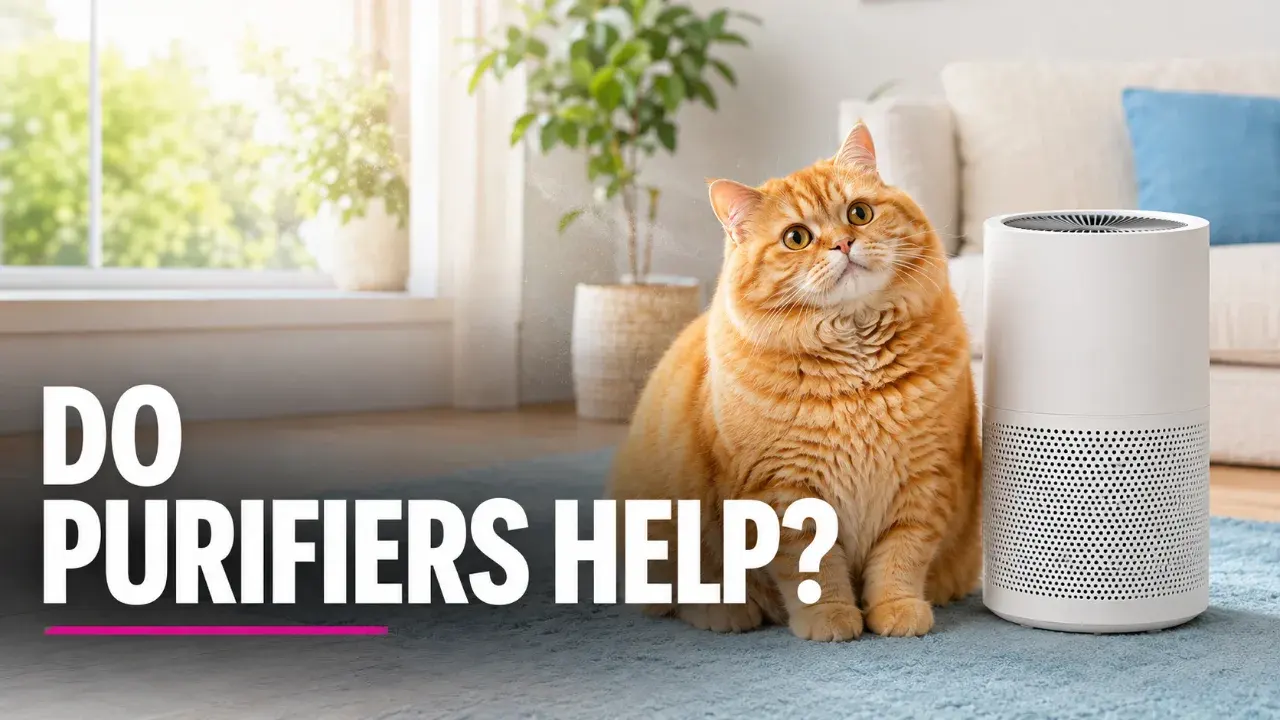
A well-sized HEPA air purifier can reduce airborne pet allergens and fine particles, but it cannot clean every surface or guarantee relief from allergy symptoms.
Pet homes contain more than the fur people can see. Tiny allergen-carrying particles, outdoor pollen brought in on coats, litter dust, and particles stirred up by movement can remain suspended in the air—and an appropriately sized air purifier may reduce part of that airborne load.
The important word is “part.” Air cleaners can filter air that passes through them, but they cannot capture material trapped in carpets, bedding, curtains, or upholstered furniture. That distinction helps explain why one household may notice a meaningful difference while another sees little change.
Pet allergy is not simply a reaction to fur
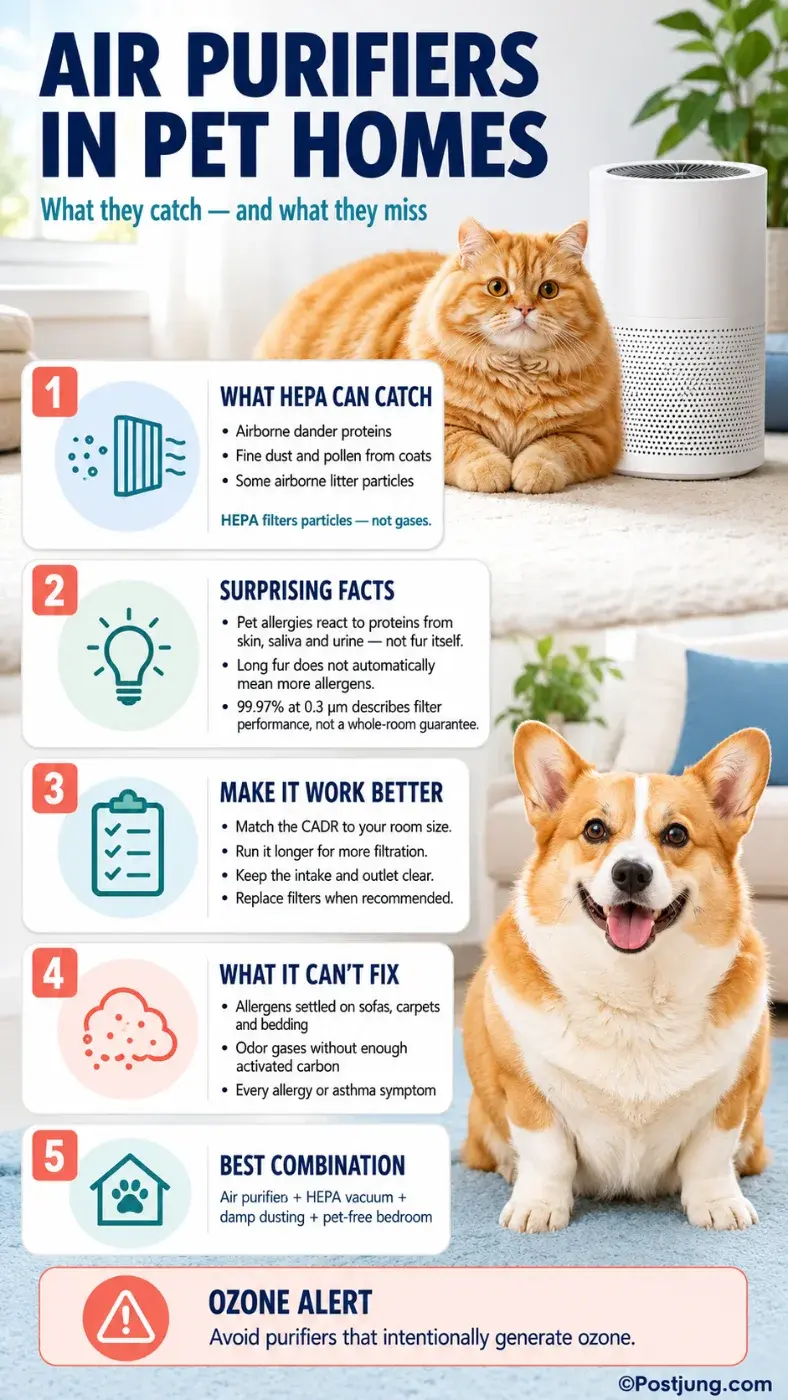
People commonly use “pet hair” and “pet dander” as if they were interchangeable. The actual allergy triggers are proteins produced by animals and found in substances such as skin flakes, saliva, and urine.
Cats and dogs both produce multiple allergens. According to the American College of Allergy, Asthma & Immunology, no cat or dog breed has been shown to be completely allergen-free. Hair length alone is not a reliable guide to the allergen level in a home.
These proteins can attach to particles that become airborne when a pet moves, someone sits on a sofa, bedding is shaken, or a room is vacuumed. A mechanical filter can capture some of those particles when the purifier draws them in.
What a HEPA filter actually does
A high-efficiency particulate air, or HEPA, filter is designed to trap particles rather than destroy allergens chemically. The U.S. Environmental Protection Agency says this type of filter can theoretically remove at least 99.97% of airborne particles measuring 0.3 micrometers under the filter’s test conditions.
That figure describes the filter material’s efficiency—not a promise that a portable appliance will remove 99.97% of everything in a room. Real-world performance also depends on how much air the machine moves, how long it operates, whether air can circulate freely, and whether new particles are continually being released.
A small study conducted in nine homes with dogs illustrates the potential. Researchers found that HEPA filtration substantially reduced airborne Can f 1, a major dog allergen. The reduction was greater when the dog was not in the room, showing that filtration worked best when the source was also controlled. The study measured airborne allergen rather than long-term symptom relief and was too small to predict what every household will experience.
Why results differ from one home to another
The purifier must be powerful enough for the space. The EPA recommends comparing a unit’s clean air delivery rate, or CADR, with the room’s floor area. High ceilings and open floor plans may require a larger unit or more than one purifier.
Placement matters too. A purifier hidden behind furniture or pressed against curtains cannot move air effectively. It generally works best in the room where people spend the most time, with its intake and outlet unobstructed.
Operating time is another major variable. Higher fan speeds and longer run times filter more air, although noise may lead people to use a quieter—and less effective—setting. A machine that is switched on only occasionally may struggle to keep up with an animal that continuously releases allergen-carrying particles.
Filters also lose performance when they become clogged. Replacement schedules vary with the machine, the number of animals, local pollution, and the amount of dust and hair in the home.
Cleaner air does not always mean fewer symptoms
Reducing airborne particles is easier to demonstrate than guaranteeing a health benefit. The EPA notes that studies of portable HEPA cleaners have found improvements in some allergy or asthma outcomes, but the effects are not consistently large and do not appear across every symptom.
A meta-analysis of 10 trials involving 482 people with allergic asthma found improvements in certain quality-of-life and airway-inflammation measurements. Other outcomes—including overall symptom scores, medication use, and a standard measure of lung function—did not improve significantly. The researchers also identified limitations in the available trials, including small numbers and possible bias.
An air purifier should therefore be viewed as one layer of exposure control, not a treatment or a substitute for prescribed asthma or allergy care.
What filtration cannot fix
A particle filter does not remove fur and allergens that have already settled throughout a room. Regular cleaning remains necessary. Damp dusting can help prevent particles from being thrown back into the air, while a well-sealed vacuum with suitable filtration can reduce material collected on floors and furniture.
Keeping a pet out of the bedroom may also reduce exposure during sleep. Closing the bedroom door is not a perfect barrier—pet allergens can travel on clothing and through the rest of the home—but it reduces the number of fresh particles released inside that room.
Odor requires a separate consideration. HEPA filters target particles, not gases. Activated carbon may adsorb some odor-causing gases, but performance depends heavily on the amount and type of carbon used. No purifier can replace cleaning a litter box, washing pet bedding, addressing urine contamination, or bringing in clean outdoor air when conditions allow.
The EPA also advises avoiding devices that intentionally generate ozone. Ozone is a lung irritant, and some ionizers, electrostatic devices, plasma cleaners, and inadequately designed ultraviolet systems may emit it.
For the right household, a properly sized HEPA purifier can make the air measurably cleaner. Its greatest value comes when it runs consistently and supports a broader routine of cleaning, source control, ventilation, and appropriate medical care—not when it is expected to solve the entire pet environment alone.
SOURCES USED:
- U.S. Environmental Protection Agency — Guide to Air Cleaners in the Home
- U.S. Environmental Protection Agency — What Is a HEPA Filter?
- American College of Allergy, Asthma & Immunology — Pets, Dog and Cat Allergies
- Allergy — The Effect of Air Filtration on Airborne Dog Allergen
- International Archives of Allergy and Immunology — Effectiveness of Air Purification Strategies for Allergic Asthma

เขียนโดย พชร ภูวดล
 5 ไอเทมป้องกันความร้อนให้บ้านแบบโบราณ! ภูมิปัญญาเก่าที่ช่วยบ้านเย็นลงได้ 3-5 องศา
 รู้หรือไม่? เปิดรายได้พนักงานส่งพัสดุของแต่ละแอป วันหนึ่งได้เท่าไร
 อำเภอที่มีชื่ออำเภอสั้นที่สุด 3 อำเภอเท่านั้นในประเทศไทย
 7 คันเบ็ดตกปลาโบราณ สายเรโทรยอมทุ่มเงินซื้อ! ยิ่งเก่า ยิ่งหายาก ยิ่งมีเรื่องราว
 โรงเรียนที่มีนักเรียนมากที่สุดในไทย
 รู้หรือไม่? ความทรงจำวัยเด็กอาจไม่ได้เหมือนที่เราเคยจำ! สมองสามารถ “เติมเรื่อง” ให้เราได้
 ตาราง “เด่นเหนือเด่นใต้” งวด 1 ต.ค. 69 เปิดข้อมูลตามโพย เลขไหนอยู่ตรงไหน
 เช็กด่วน ! ข่าวบัตรสวัสดิการแจก 10,000 บาท ก.ย. 69 จริงหรือ ? ก่อนเชื่อควรรู้อะไร
 ส่องเลข 3 สำนักพิมพ์ งวด 1 ต.ค. 69 ตัวไหนมีข้อมูลตรงกัน
 ทำไมหนังสือบางเล่มถึงมีหน้าว่างทั้งหน้า? มันอาจไม่ได้พิมพ์พลาด
 7 บทเพลงไวรัลยุคโบราณ! เพลงงานวัดที่เปิดเมื่อไหร่ คนก็ลุกขึ้นรำวงเมื่อนั้น
 เปิด 5 โรงเรียนหญิงล้วนเก่าแก่ของไทย ที่มีประวัติยาวนานกว่าศตวรรษอำเภอที่มีชื่ออำเภอสั้นที่สุด 3 อำเภอเท่านั้นในประเทศไทย
 English Edition