Why Dog Parks Are Not Right for Every Dog
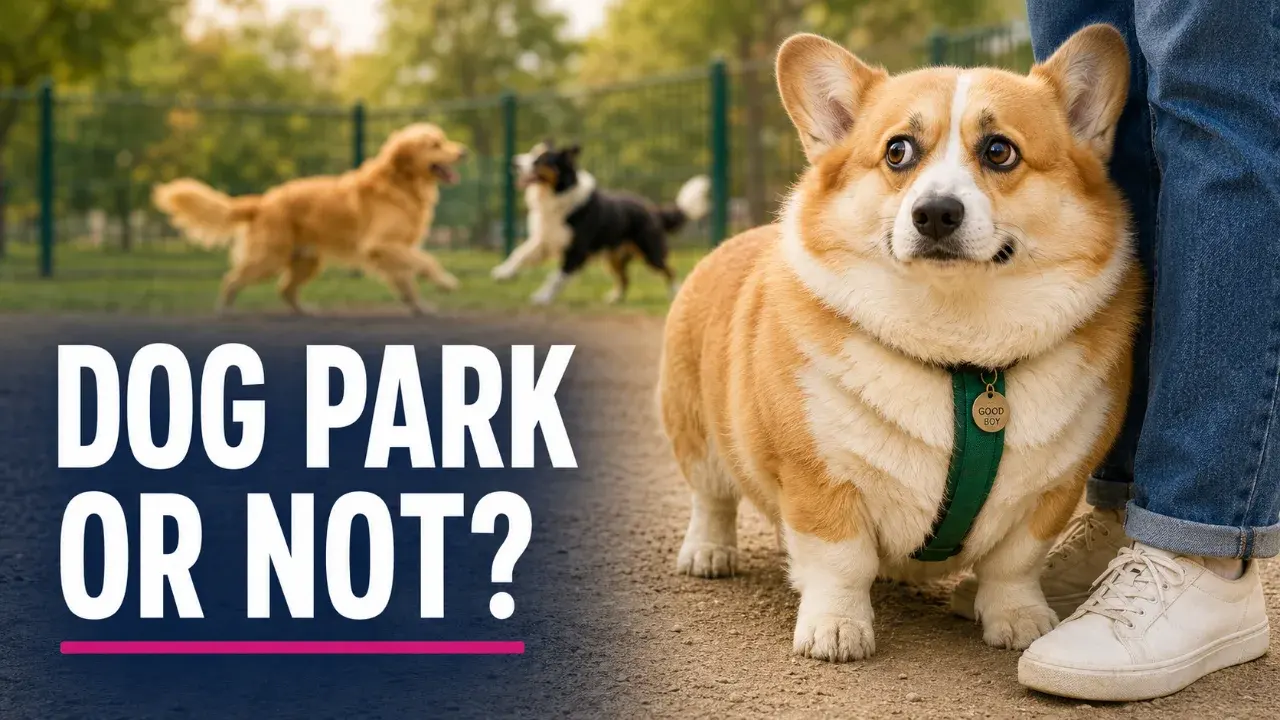
Crowded off-leash play can be exciting for confident, social dogs but stressful or unsafe for others. The deciding factor is not breed or size alone—it is how the individual dog responds.
A dog park can look like the perfect package: open space, exercise, playmates, and a tired dog at the end of the visit. For some dogs, it delivers exactly that. For others, the same environment creates pressure, fear, or conflict.
Skipping the dog park does not mean a dog is antisocial, poorly trained, or missing an essential part of life. Dogs vary widely in the kind of social contact they enjoy, and many are happier with familiar companions, structured activities, or quiet walks.
Social does not always mean comfortable in a crowd
A dog that enjoys one familiar playmate may not enjoy being surrounded by unfamiliar dogs with different sizes, energy levels, and play styles.
VCA Animal Hospitals notes that play between adult dogs who do not know one another is not necessarily normal or desirable for every dog. Some dogs actively seek group play, while others prefer interacting with their family or a small number of trusted companions.
Age and life history can also change a dog’s preferences. A playful adolescent may become more selective as an adult. A dog that has experienced frightening encounters may need greater distance and more predictable introductions.
Owners should judge the activity by the dog’s behavior, not by the assumption that every dog needs canine friends.
Stress can look surprisingly ordinary
Dogs do not always express discomfort by growling or snapping. Early stress signals can be easy to overlook.
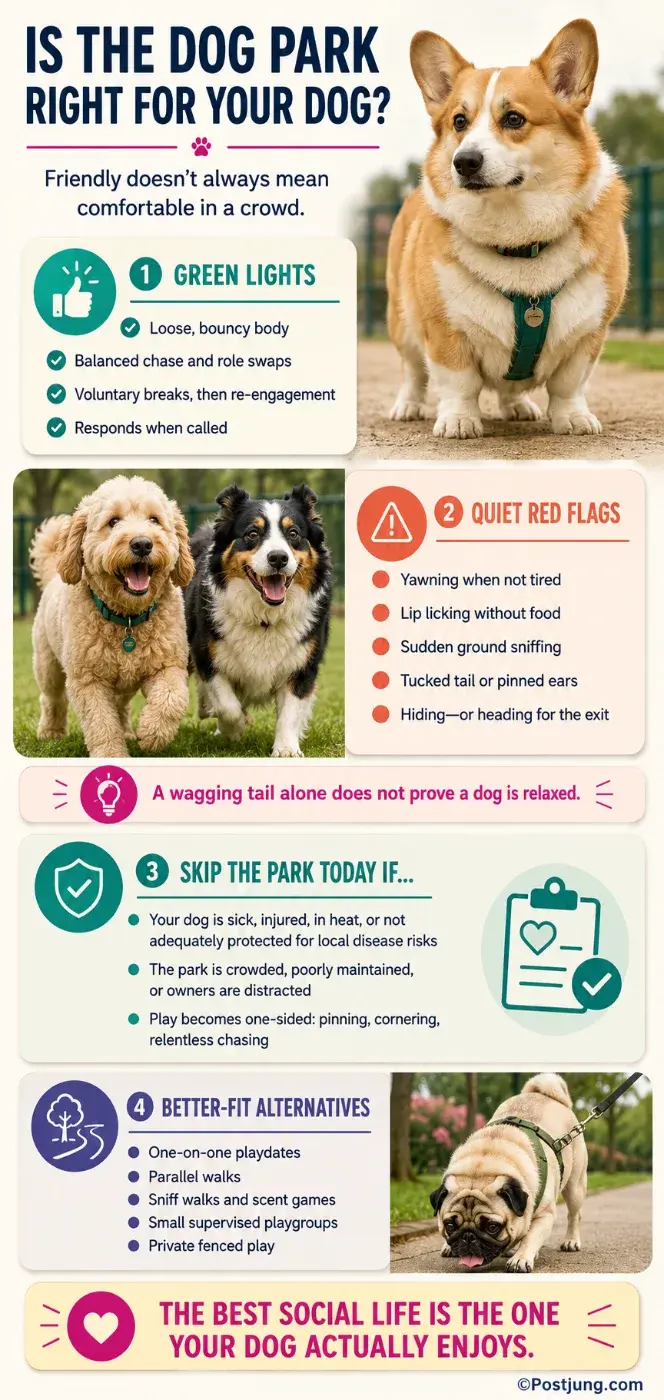
Warning signs may include:
- Repeated yawning when the dog is not tired
- Lip licking when food is not present
- Shaking off despite being dry
- A tucked tail or ears held back
- Hiding behind a person
- Avoiding other dogs or repeatedly moving toward the exit
- Sniffing the ground or eating grass when approached
- Becoming unusually still, tense, or difficult to redirect
The University of California, Davis School of Veterinary Medicine advises removing a puppy from an experience when signs such as a tucked tail, lip licking, yawning, shaking, or pinned-back ears suggest that the animal is becoming overwhelmed.
The RSPCA similarly advises owners to take regular signs of stress or fear seriously, especially when behavior changes unexpectedly.
A dog that stays close to its owner or avoids interaction is not necessarily “warming up.” It may be asking for distance. Forcing it to remain can make the experience more frightening rather than helping it become social.
Play should be voluntary and balanced
Healthy play generally has loose body movements, pauses, and role reversals. One dog may chase and then allow itself to be chased. Both dogs can disengage and return voluntarily.
The interaction becomes concerning when one dog persistently pursues, pins, corners, mounts, or body-slams another dog that is trying to escape. A dog repeatedly chasing unwilling participants may also be poorly suited to an uncontrolled group, even if its behavior appears playful to its owner.
Excitement alone is not proof that a dog is enjoying itself. High arousal can make it harder for dogs to respond to familiar cues and can allow rough play to escalate.
A reliable recall is therefore an important safety tool. UC Davis veterinary guidance describes recall as vital in off-leash situations, including dog parks, because it gives owners a way to interrupt play or remove a dog from danger.
Puppies require special care
Puppies need carefully managed positive experiences, but a busy dog park is not the only—or necessarily the best—place to provide them.
Young puppies can be physically vulnerable and may become overwhelmed when several unfamiliar dogs approach at once. Those that have not completed their veterinarian-recommended vaccination schedule may also be exposed to infectious organisms left by dogs of unknown health status.
UC Davis recommends allowing young puppies to interact with dogs known to be healthy, vaccinated, and behaviorally appropriate while avoiding potentially contaminated dog parks until the puppy has received its vaccinations, commonly around 16 weeks. The exact timing should be discussed with a veterinarian because disease risks and vaccination schedules vary by location.
Group settings also carry health risks
Any place that brings many dogs into close contact can facilitate the spread of respiratory, gastrointestinal, and parasitic infections.
The Ohio State University College of Veterinary Medicine explains that canine group settings—including parks, daycare facilities, classes, and sporting events—increase opportunities for infectious-disease exposure.
Dogs that are sick, injured, showing respiratory or digestive symptoms, or in heat should not enter an off-leash park. Owners should also discuss vaccination, parasite prevention, and region-specific health risks with their veterinarian.
Vaccination reduces important risks but does not make every group environment risk-free.
Better alternatives are widely available
Dogs that dislike crowded parks still need physical activity, opportunities to sniff and explore, mental stimulation, and positive social contact. Those needs can be met without free play among unfamiliar dogs.
Useful alternatives include:
- One-on-one playdates with a compatible, familiar dog
- Parallel walks in which two dogs walk with comfortable space between them
- Quiet walks that allow plenty of time for sniffing
- Reward-based training or nose-work classes
- Food puzzles, scent games, and supervised exploration
- Private fenced areas
- Small, professionally supervised playgroups matched by size and temperament
These options can be adjusted to the dog instead of asking the dog to cope with an unpredictable group.
For dogs that do enjoy public parks, owners can reduce pressure by first observing the park without the dog, visiting at quieter times, avoiding toys or food that may provoke conflict, and staying attentive throughout the visit.
The most useful question is not whether dog parks are universally good or bad. It is whether this particular dog remains relaxed, responsive, and willing to participate. A successful activity should enrich the dog’s life—not simply satisfy a human idea of how dogs are supposed to socialize.
SOURCES USED:
- VCA Animal Hospitals — Proper Etiquette at the Dog Park
- VCA Animal Hospitals — Using Enrichment, Predictability and Scheduling to Train Your Dog
- UC Davis School of Veterinary Medicine — Puppy Socialization
- UC Davis School of Veterinary Medicine — Recall Training in Dogs
- Ohio State University College of Veterinary Medicine — Disease Prevention at Canine Group Settings
- RSPCA — Understanding Your Dog’s Behaviour

เขียนโดย พชร ภูวดล
 7 บทเพลงไวรัลยุคโบราณ! เพลงงานวัดที่เปิดเมื่อไหร่ คนก็ลุกขึ้นรำวงเมื่อนั้น
 รู้หรือไม่? เปิดรายได้พนักงานส่งพัสดุของแต่ละแอป วันหนึ่งได้เท่าไร
 โรงเรียนที่มีนักเรียนมากที่สุดในไทย
 อำเภอที่มีชื่ออำเภอสั้นที่สุด 3 อำเภอเท่านั้นในประเทศไทย
 แปลปกสลาก งวด 1 ต.ค. 69 ส่องตัวเลขจากภาพปกสลากกินแบ่งรัฐบาล
 5 ไอเทมป้องกันความร้อนให้บ้านแบบโบราณ! ภูมิปัญญาเก่าที่ช่วยบ้านเย็นลงได้ 3-5 องศา
 ส่องเลข 3 สำนักพิมพ์ งวด 1 ต.ค. 69 ตัวไหนมีข้อมูลตรงกัน
 7 คันเบ็ดตกปลาโบราณ สายเรโทรยอมทุ่มเงินซื้อ! ยิ่งเก่า ยิ่งหายาก ยิ่งมีเรื่องราว
 ตาราง “เด่นเหนือเด่นใต้” งวด 1 ต.ค. 69 เปิดข้อมูลตามโพย เลขไหนอยู่ตรงไหน
 5 เมนูอาหารไทยโบราณที่หาทานยาก ชื่อคุ้นหู แต่คนรุ่นใหม่อาจไม่เคยชิม
 โรงเรียนชายล้วนแห่งแรกของไทยคือที่ไหน? ย้อนดูจุดเริ่มต้นโรงเรียนสวนกุหลาบวิทยาลัย
 รู้หรือไม่? ความทรงจำวัยเด็กอาจไม่ได้เหมือนที่เราเคยจำ! สมองสามารถ “เติมเรื่อง” ให้เราได้อำเภอที่มีชื่ออำเภอสั้นที่สุด 3 อำเภอเท่านั้นในประเทศไทย
 English Edition