When a Second Veterinary Opinion Can Help Your Pet
Another veterinarian may confirm the original plan, offer a different interpretation or recommend specialist care. Knowing when and how to seek that opinion can make the process safer and more productive.
Seeking a second veterinary opinion does not necessarily mean that the first veterinarian made a mistake. It gives another qualified professional an opportunity to review the diagnosis, test results and treatment options—especially when a condition remains unexplained, worsens or requires a difficult decision.
The result may be a different recommendation. It may also confirm that the original plan is reasonable. Either outcome can give an owner a clearer basis for deciding what happens next.
A second opinion is not always a referral
The terms are related but do not mean exactly the same thing.
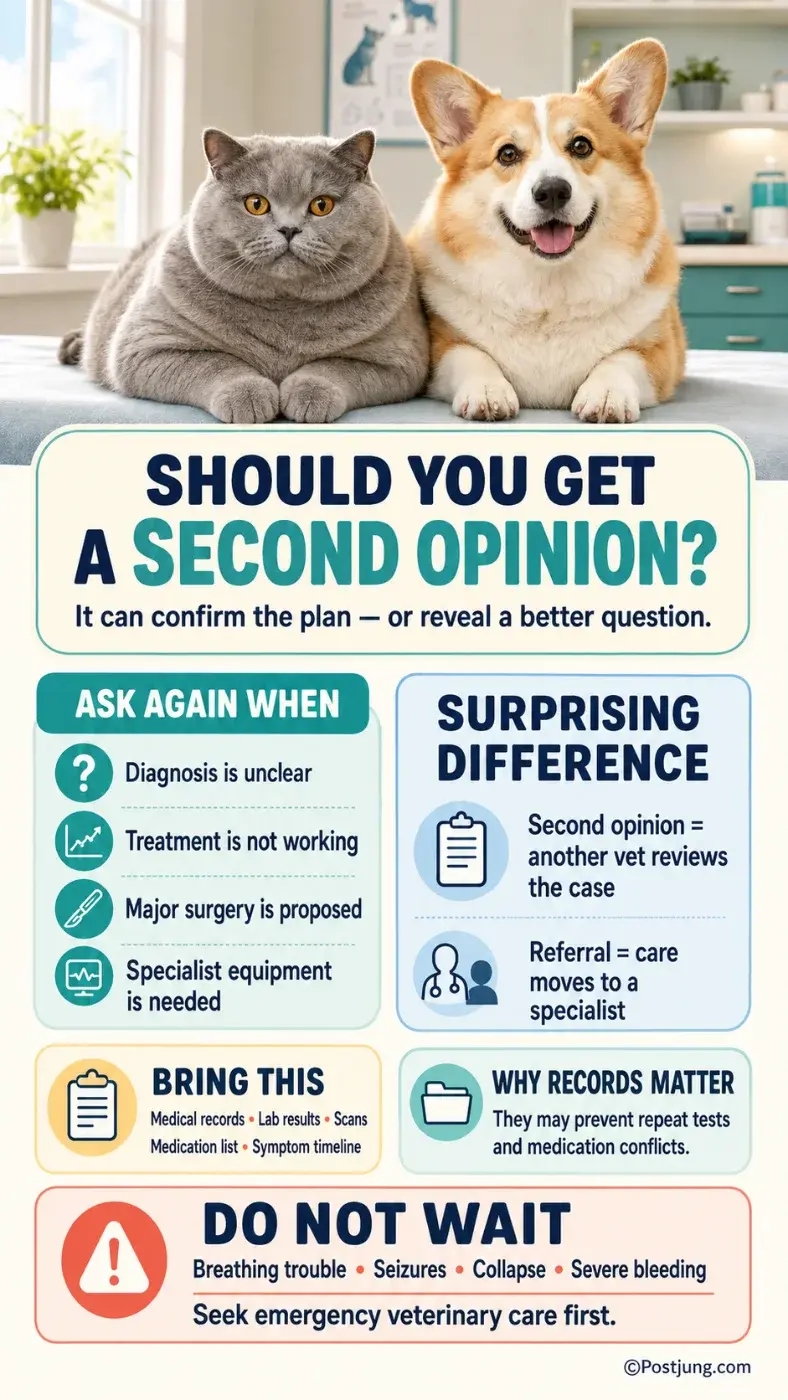
A second opinion generally involves asking another veterinarian to independently assess the case. That veterinarian may review the records, examine the animal and explain whether they agree with the existing diagnosis or treatment plan.
A referral transfers responsibility for part or all of the diagnosis or treatment to a veterinarian with relevant expertise, specialized equipment or advanced facilities. After a procedure or period of specialist care, the pet may return to its primary veterinarian for ongoing treatment.
The Royal College of Veterinary Surgeons, which regulates veterinary professionals in the United Kingdom, says veterinarians should facilitate requests for either option. Its guidance also emphasizes that differences between professional opinions should be explained constructively.
Rules and professional terminology vary by country, but collaboration between the original veterinarian and the second practice is generally better for the animal than treating the visits as two disconnected episodes.
When another opinion may be useful
The American Animal Hospital Association’s referral guidelines identify several situations in which additional expertise may be appropriate. These include an inconclusive diagnosis, a condition that is unresolved or getting worse, the need for advanced diagnostic equipment and the need for continuous medical supervision.
A second opinion may therefore be worth discussing when:
- Standard tests have not explained the symptoms
- Treatment is not producing the expected improvement
- Symptoms return repeatedly or continue to worsen
- Different conditions could produce similar signs
- A major procedure or long-term treatment is being considered
- The required test, surgery or monitoring is unavailable locally
- The owner does not understand the diagnosis or available options
A second veterinarian may interpret existing information differently, identify questions that have not yet been explored or recommend consultation with a specialist.
Not every case requires a specialist. Another experienced general practitioner may be able to provide the needed perspective. For uncommon, complicated or persistent conditions, however, a board-certified specialist may offer deeper training in an area such as cardiology, neurology, oncology, nutrition or internal medicine.
Professional titles differ internationally, so owners should verify a veterinarian’s qualifications through the appropriate regulatory or specialty organization in their country.
Bring the complete medical history
A second opinion is most useful when the new veterinarian can see what has already happened.
Owners should ask the original clinic to provide relevant clinical notes, laboratory reports, diagnostic images, medication details and information about previous procedures. Include the names, doses and schedules of prescription drugs, supplements and nonprescription products.
The RCVS advises owners to tell the second practice that the animal has already received care elsewhere. This allows the new clinic to request the records and may help avoid unnecessary repeat testing or treatments that could interfere with medication already given.
Repeat testing is sometimes medically necessary. Results may be outdated, incomplete or produced with a method that does not answer the new veterinarian’s question. When another test is recommended, owners can ask what new information it is expected to provide.
A concise symptom timeline can also help. Record when the problem began, how it changed, which treatments were tried and whether the pet’s appetite, weight, activity, breathing, urination or behavior changed.
Ask focused questions
A second-opinion visit should produce more than a simple statement of agreement or disagreement. Useful questions include:
- What diagnoses are still being considered?
- Which findings support the current diagnosis?
- Are any test results uncertain or open to another interpretation?
- What additional testing would materially change the treatment plan?
- What are the benefits, risks and likely costs of each reasonable option?
- How urgently must a decision be made?
- Who will manage follow-up care?
Owners should also ask for a written estimate before approving additional tests or procedures. Costs, insurance requirements and referral arrangements vary widely between countries and clinics.
If the two veterinarians disagree, ask each one to explain the evidence behind the recommendation. A different opinion does not automatically prove that either veterinarian is wrong. Clinical decisions may reasonably vary when evidence is limited or when several options have different costs, risks and expected outcomes.
Do not delay emergency treatment
A second opinion should not postpone urgent stabilization. Severe bleeding, difficulty breathing, choking, loss of consciousness, seizures, major trauma and suspected poisoning are among the situations that can require immediate veterinary consultation or emergency care.
In an emergency, take the animal to an appropriate veterinary facility first. Records and additional opinions can be coordinated after urgent risks have been addressed.
For a stable pet, contacting the original veterinarian remains a sensible starting point. That veterinarian already knows the history and may be able to recommend the right colleague or specialist while transferring the records efficiently.
Seeking another opinion can be part of responsible, collaborative care. Its purpose is not to find the answer an owner most wants to hear, but to make an important decision with the clearest information reasonably available.
SOURCES USED:
- American Animal Hospital Association — Referral and Consultation Guidelines
- Royal College of Veterinary Surgeons — Referrals and second opinions
- Royal College of Veterinary Surgeons — Treatment and care
- American College of Veterinary Internal Medicine — Information for animal owners
- American Veterinary Medical Association — Animal emergencies requiring immediate care

เขียนโดย พชร ภูวดล
 รู้หรือไม่? เปิดรายได้พนักงานส่งพัสดุของแต่ละแอป วันหนึ่งได้เท่าไร
 5 ไอเทมป้องกันความร้อนให้บ้านแบบโบราณ! ภูมิปัญญาเก่าที่ช่วยบ้านเย็นลงได้ 3-5 องศา
 7 บทเพลงไวรัลยุคโบราณ! เพลงงานวัดที่เปิดเมื่อไหร่ คนก็ลุกขึ้นรำวงเมื่อนั้น
 โรงเรียนที่มีนักเรียนมากที่สุดในไทย
 เช็กด่วน ! ข่าวบัตรสวัสดิการแจก 10,000 บาท ก.ย. 69 จริงหรือ ? ก่อนเชื่อควรรู้อะไร
 อำเภอที่มีชื่ออำเภอสั้นที่สุด 3 อำเภอเท่านั้นในประเทศไทย
 รู้หรือไม่? ความทรงจำวัยเด็กอาจไม่ได้เหมือนที่เราเคยจำ! สมองสามารถ “เติมเรื่อง” ให้เราได้
 เปิด 5 โรงเรียนหญิงล้วนเก่าแก่ของไทย ที่มีประวัติยาวนานกว่าศตวรรษ
 โรงเรียนชายล้วนแห่งแรกของไทยคือที่ไหน? ย้อนดูจุดเริ่มต้นโรงเรียนสวนกุหลาบวิทยาลัย
 ส่องเลข 3 สำนักพิมพ์ งวด 1 ต.ค. 69 ตัวไหนมีข้อมูลตรงกัน
 แปลปกสลาก งวด 1 ต.ค. 69 ส่องตัวเลขจากภาพปกสลากกินแบ่งรัฐบาล
 7 คันเบ็ดตกปลาโบราณ สายเรโทรยอมทุ่มเงินซื้อ! ยิ่งเก่า ยิ่งหายาก ยิ่งมีเรื่องราวอำเภอที่มีชื่ออำเภอสั้นที่สุด 3 อำเภอเท่านั้นในประเทศไทย
 English Edition