What to Ask Before Approving a Veterinary Procedure

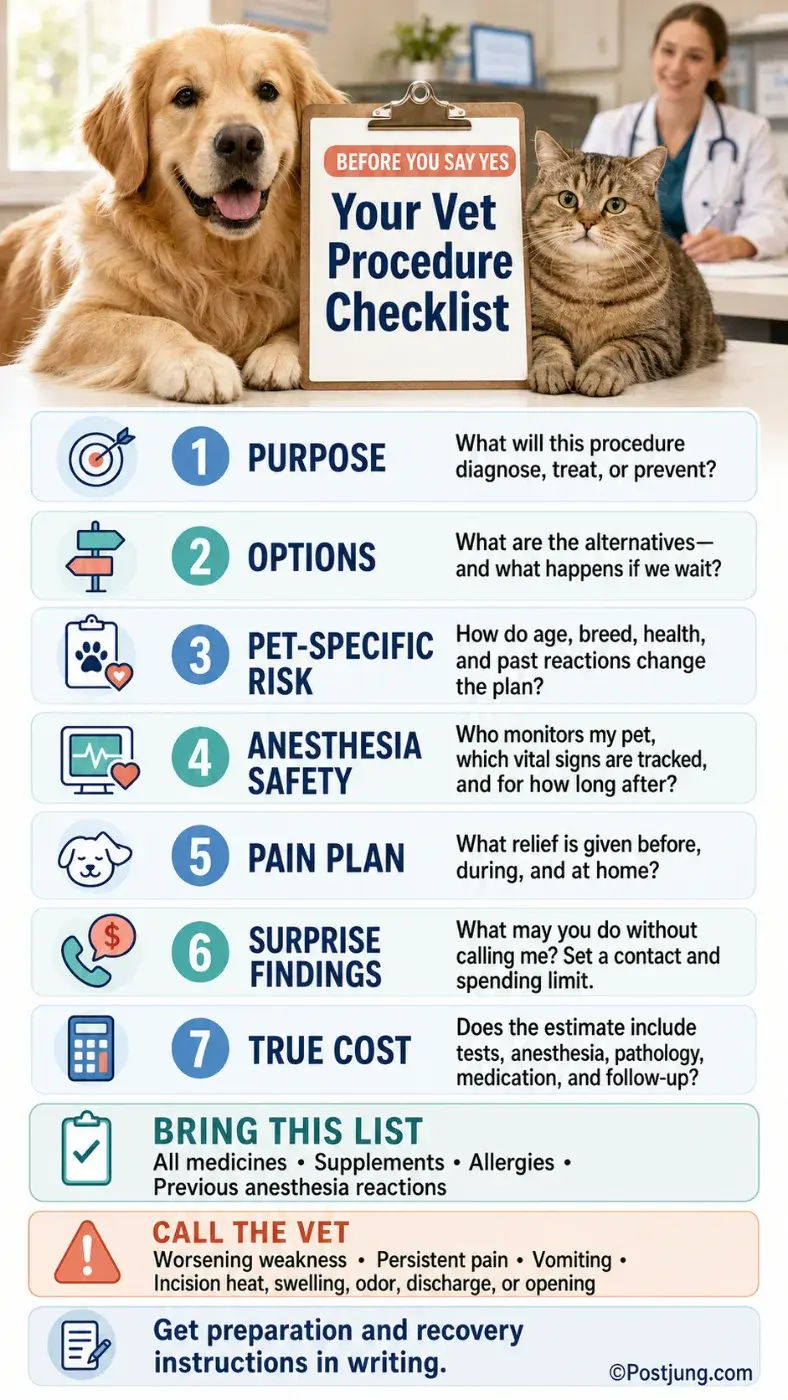
Before signing a consent form, make sure you understand what the procedure is expected to achieve, its alternatives and risks, how your pet will be monitored, and what the final cost could include.
Approving a veterinary procedure should involve more than signing a form at the reception desk. Whether your pet needs surgery, dentistry, diagnostic imaging, a biopsy, or another treatment requiring sedation or anesthesia, you should receive enough information to make a considered decision.
The right questions will vary with the animal and procedure. Still, every useful consent conversation should address the expected benefit, reasonable alternatives, pet-specific risks, pain control, cost, and recovery.
1. What problem are we trying to solve?
Ask the veterinarian to describe the diagnosis or suspected condition in plain language. Then ask what the proposed procedure is intended to accomplish.
Is it expected to diagnose a problem, relieve symptoms, prevent deterioration, or cure the condition? What outcome would count as success, and how soon should you expect to see it?
If the diagnosis remains uncertain, ask what the veterinarian knows, what remains unknown, and whether the procedure is meant to provide the missing answer.
2. What. are the alternatives?
A meaningful decision requires more than one option whenever alternatives exist. Ask whether the choices include medication, observation, a different test, a less invasive procedure, referral to a specialist, or postponement.
Also ask what is likely to happen if you decline or delay the procedure. “Do nothing for now” is not necessarily risk-free, but the nature and urgency of that risk should be explained rather than assumed.
If the procedure is not an emergency, it is reasonable to ask whether there is time to consider the options or obtain a second opinion.
3. What are the most relevant risks for my pet?
No procedure or anesthetic plan can be guaranteed risk-free. Request a discussion of both common complications and serious complications, even if the serious ones are uncommon.
The most useful answer will be specific to your animal. Age, breed, body condition, heart or breathing problems, kidney or liver disease, current illness, and previous drug reactions can all affect planning.
The American Animal Hospital Association’s anesthesia guidelines recommend discussing the procedure and patient-specific risks before written consent is obtained.
Ask how the team would recognize and respond to the complications that matter most in your pet’s case.
4. Does my pet need testing first?
A pre-anesthetic evaluation helps the team identify conditions that could change the procedure, drug selection, or monitoring plan.
Ask which tests are recommended and what each one could reveal. Depending on the pet and procedure, the plan might involve a physical examination, bloodwork, urine testing, imaging, blood-pressure measurement, or additional heart assessment.
Testing does not eliminate risk, and not every pet needs every test. The veterinarian should be able to explain why a test is appropriate for this particular patient.
5. What information and preparation do you need from me?
Give the team a complete list of prescription drugs, over-the-counter products, vitamins, supplements, herbal products, and cannabidiol products your pet receives. Report previous problems with anesthesia, known allergies, recent vomiting or coughing, appetite changes, breathing changes, and any new illness.
AAHA’s pre-anesthetic guidance specifically recommends reviewing medical conditions, prior drug reactions, medications, supplements, and earlier anesthetic recoveries.
Confirm instructions for food, water, and regular medication directly with the veterinary team. Do not withhold medication or impose a fasting schedule based only on generic online advice; instructions may differ for young, diabetic, medically fragile, or emergency patients.
6. How will anesthesia and recovery be monitored?
If sedation or general anesthesia is required, ask who will administer it, who will watch your pet, and what monitoring will continue during recovery.
Useful questions include:
- Will someone be assigned to monitor the patient?
- Which vital signs will be tracked?
- Will an intravenous catheter or fluids be used?
- How will the team maintain body temperature?
- How long will observation continue after the procedure?
- Is emergency equipment immediately available?
Anesthesia is a continuum that begins with preparation and continues through recovery—not simply the period when the procedure is performed. AAHA’s pet-owner guidance also emphasizes reporting symptoms and previous anesthetic experiences before the appointment.
7. What is the pain-control plan?
Ask what pain relief your pet will receive before, during, and after the procedure, how long it should last, and how you can recognize uncontrolled pain at home.
Request written dosing instructions and ask which adverse effects require a call. If an anti-inflammatory drug is prescribed, confirm whether it is approved or considered appropriate for your pet and whether any other medications must be avoided.
The U.S. Food and Drug Administration warns that human pain relievers may be unsafe for animals and that combining certain anti-inflammatory drugs or using them alongside steroids can increase the risk of serious adverse effects. Never give a pet a human pain medicine unless the veterinarian specifically directs you to do so.
8. Who will perform the procedure?
Ask about the clinician’s experience with this type of case and whether specialist referral would offer a meaningful advantage. Referral is not necessary for every procedure, but complex operations, unusual conditions, or high-risk patients may require specialized training or equipment.
The important question is not simply how many procedures the veterinarian has performed. Ask whether the clinic has the personnel, equipment, overnight care, and emergency support appropriate for your pet’s needs.
9. What happens if you find something unexpected?
A procedure may reveal a problem that was not visible beforehand. Discuss whether the team may perform additional treatment without contacting you and establish a clear authorization limit.
Confirm:
- Which additional actions you approve in advance.
- Which decisions require a phone call.
- Whom the clinic should contact if you cannot be reached.
- The maximum additional expense you authorize.
- What happens if an urgent decision cannot wait.
This prevents a vague consent form from becoming the only guidance available while your pet is anesthetized.
10. What will the full cost include?
Request a written, itemized estimate. Ask whether it includes preoperative testing, anesthesia, monitoring, medications, pathology, hospitalization, follow-up visits, protective collars, and take-home drugs.
Also ask what could make the total higher, whether the clinic will contact you before exceeding the estimate, and when payment is due. If you have pet insurance, confirm which documents the clinic can provide, but check coverage and authorization requirements with the insurer itself.
An estimate is not always a guaranteed final price because complications or unexpected findings can alter care. Clear financial boundaries are therefore part of informed decision-making, not a separate or embarrassing topic.
Get the recovery plan in writing
Before taking your pet home, obtain instructions covering food and water, medication, activity restriction, incision or bandage care, follow-up appointments, expected behavior, and warning signs.
Ask which clinic or emergency service to contact after hours. The American College of Veterinary Surgeons advises contacting the veterinary team for problems such as worsening weakness, persistent pain, vomiting, poor hydration, or increasing redness, swelling, discharge, odor, or opening at an incision.
A consent form records a decision, but it cannot replace a conversation. Before approving a procedure, you should be able to explain—in your own words—why it is recommended, what the realistic alternatives and risks are, what the team will do to protect your pet, and what will be expected of you during recovery.
Veterinary standards, consent rules, and available services differ across countries and jurisdictions. Questions about an individual animal should be resolved with the veterinarian responsible for examining and treating that patient.
SOURCES USED:
- American Animal Hospital Association — Client communication and education
- American Animal Hospital Association — Pre-anesthetic evaluation and planning
- American Animal Hospital Association — What can I expect when my pet needs anesthesia?
- American College of Veterinary Surgeons — Postoperative care after surgery
- U.S. Food and Drug Administration — Get the facts about pain relievers for pets

เขียนโดย Postjung Insights
 โรงเรียนที่มีนักเรียนมากที่สุดในไทย
 รู้หรือไม่? เปิดรายได้พนักงานส่งพัสดุของแต่ละแอป วันหนึ่งได้เท่าไร
 ตาราง “เด่นเหนือเด่นใต้” งวด 1 ต.ค. 69 เปิดข้อมูลตามโพย เลขไหนอยู่ตรงไหน
 7 บทเพลงไวรัลยุคโบราณ! เพลงงานวัดที่เปิดเมื่อไหร่ คนก็ลุกขึ้นรำวงเมื่อนั้น
 7 คันเบ็ดตกปลาโบราณ สายเรโทรยอมทุ่มเงินซื้อ! ยิ่งเก่า ยิ่งหายาก ยิ่งมีเรื่องราว
 5 ไอเทมป้องกันความร้อนให้บ้านแบบโบราณ! ภูมิปัญญาเก่าที่ช่วยบ้านเย็นลงได้ 3-5 องศา
 เปิด 5 โรงเรียนหญิงล้วนเก่าแก่ของไทย ที่มีประวัติยาวนานกว่าศตวรรษ
 แปลปกสลาก งวด 1 ต.ค. 69 ส่องตัวเลขจากภาพปกสลากกินแบ่งรัฐบาล
 อำเภอที่มีชื่ออำเภอสั้นที่สุด 3 อำเภอเท่านั้นในประเทศไทย
 เช็กด่วน ! ข่าวบัตรสวัสดิการแจก 10,000 บาท ก.ย. 69 จริงหรือ ? ก่อนเชื่อควรรู้อะไร
 โรงเรียนเพียงแห่งเดียวของประเทศไทย ที่อยู่มาตั้งแต่ยุครัชกาลที่ 4
 โรงเรียนชายล้วนแห่งแรกของไทยคือที่ไหน? ย้อนดูจุดเริ่มต้นโรงเรียนสวนกุหลาบวิทยาลัยอำเภอที่มีชื่ออำเภอสั้นที่สุด 3 อำเภอเท่านั้นในประเทศไทย
 English Edition