What Your Cat’s Litter Box Habits Can Reveal About Their Health
Changes in urine, stool, posture, frequency, or where a cat eliminates may point to pain, illness, mobility problems, stress, or dissatisfaction with the box. Some urinary warning signs require immediate veterinary care.
A litter box is more than a household necessity. It is also one of the few places where cat caregivers can regularly observe changes in urination, bowel movements, posture, and behavior—sometimes before other signs of illness become obvious.
No single litter box change identifies a disease. But a sudden departure from a cat’s normal routine can be an important reason to contact a veterinarian, especially when the cat strains, cries, passes little or no urine, or repeatedly enters and exits the box.
Repeated straining can be an emergency
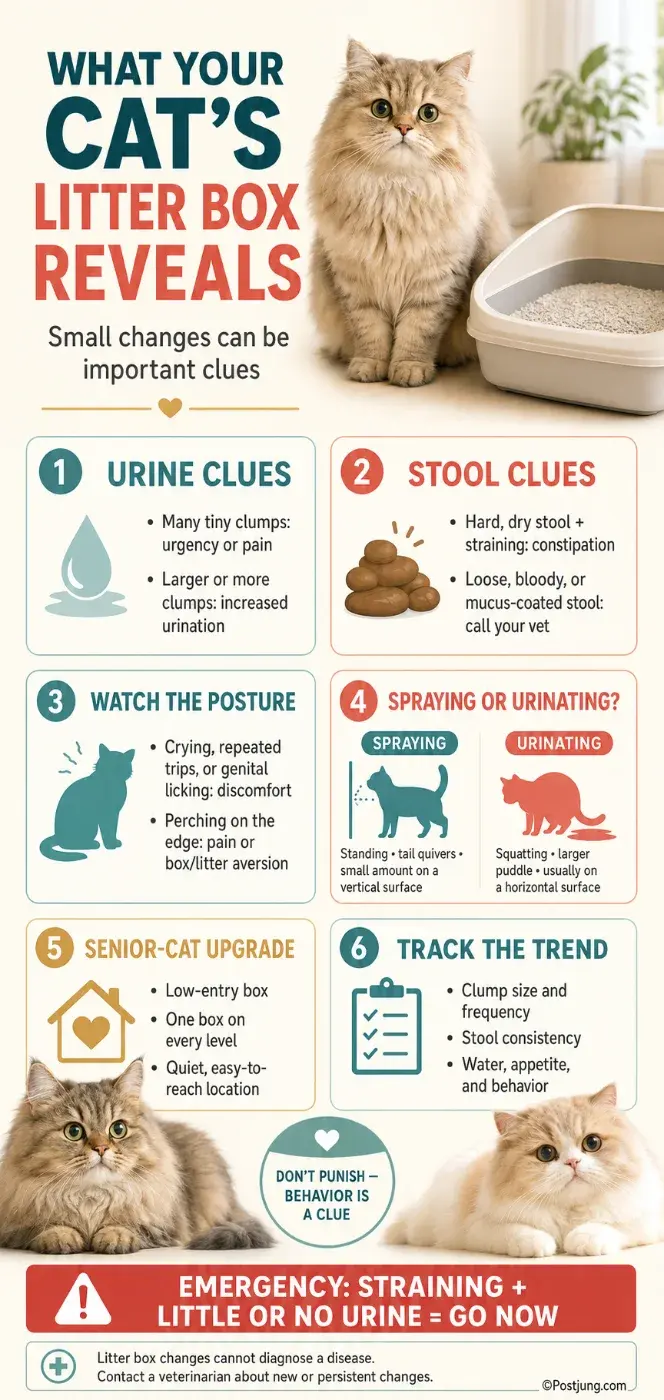
Frequent trips to the litter box, prolonged squatting, crying, genital licking, blood in the urine, or repeatedly producing only small amounts may indicate a lower urinary tract problem.
Possible causes include bladder inflammation, urinary stones, infection, and urethral obstruction. Because these conditions can produce similar signs, caregivers cannot reliably determine the cause from behavior alone.
A cat that repeatedly strains but produces little or no urine needs immediate veterinary attention. Cornell University’s Feline Health Center describes urethral obstruction as an absolute emergency because the blockage prevents urine from leaving the body and can quickly cause dangerous electrolyte disturbances.
Male cats face a greater risk because their urethra is narrower and more easily obstructed. Increasing distress, pain, vomiting, lethargy, loss of appetite, or reluctance to move make the situation even more urgent.
Straining is sometimes mistaken for constipation. When it is unclear whether a cat is trying to urinate or defecate, it is safest to seek veterinary advice promptly rather than waiting for the distinction to become obvious.
Urine clumps can show a change in output
The size and number of urine clumps can be useful when compared with the same cat’s established pattern.
Many small clumps accompanied by frequent visits may reflect urinary urgency or discomfort. An increase in the overall amount of urine may occur when a cat is drinking and urinating more than usual.
Cornell notes that kidney disease, hyperthyroidism, and diabetes mellitus can increase thirst and urination. These conditions cannot be diagnosed by looking at litter, but consistently larger or more numerous clumps deserve attention—particularly when accompanied by weight loss, appetite changes, vomiting, weakness, or changes in grooming.
The type and depth of litter, recent changes in diet, water consumption, and cleaning frequency can all affect the appearance of clumps. A trend over several days is generally more informative than one unusual clump, unless the cat is showing pain or difficulty urinating.
Stool offers a separate set of clues
Firm, dry feces, unsuccessful attempts to defecate, repeated box visits, or a noticeable decline in bowel movement frequency can suggest constipation. The Merck Veterinary Manual advises veterinary evaluation because some constipated cats also become lethargic, stop eating, vomit, or develop abdominal discomfort.
Loose stool may reflect a temporary digestive disturbance, but persistent diarrhea, blood, mucus, unusually dark stool, or diarrhea accompanied by weakness, vomiting, dehydration, or appetite loss warrants veterinary attention.
Caregivers should avoid treating suspected constipation with human laxatives or home enemas unless specifically instructed by a veterinarian. Some products and enema ingredients can be dangerous to cats.
Missing the box is not revenge
Urinating or defecating outside the litter box is often interpreted as misbehavior. Veterinary guidance presents a more complicated picture.
Urinary inflammation can create urgency or cause a cat to associate the box with pain. Digestive problems can make defecation painful or difficult to control. Kidney disease, diabetes, and thyroid disease may increase the need to urinate, while arthritis or age-related cognitive changes can make the box harder to reach or enter.
The environment may also be responsible. A cat may avoid a box that is dirty, too small, strongly scented, difficult to enter, located near a noisy appliance, or positioned where another animal can block the exit. A frightening experience near the box can create a lasting aversion.
Punishment does not identify or resolve any of these causes. It may instead increase fear and make elimination problems harder to detect.
Spraying is different from ordinary urination
Urine marking usually looks different from emptying the bladder.
A spraying cat commonly stands with an upright, sometimes quivering tail and deposits a small amount of urine on a vertical surface such as a wall or furniture. A cat urinating normally generally squats and leaves a larger amount on a horizontal surface.
Spraying can be associated with reproductive behavior, territorial communication, anxiety, unfamiliar smells, outdoor cats visible through windows, or conflict inside a multi-cat home. A new spraying pattern should still be discussed with a veterinarian because medical and behavioral problems can occur together.
Watch the cat as well as the litter
A useful litter box check includes more than counting clumps. Notice whether the cat:
- Enters and exits comfortably
- Squats normally or appears tense
- Strains, cries, or stays in position unusually long
- Returns repeatedly within a short period
- Produces urine or stool
- Runs away from the box or seems vulnerable near it
- Perches on the edge to avoid touching the litter
- Starts eliminating beside the box or in a new location
For multi-cat households, identifying which cat produced a change can be difficult. Temporarily supervising access, using a camera that does not disturb the cats, or consulting a veterinarian about safe identification methods may help.
Keeping a brief record of frequency, approximate urine-clump size, stool consistency, appetite, water intake, and associated behavior gives the veterinarian more useful information than a general statement that the cat is “acting differently.” Photos of unusual stool or urine may also help, provided they do not delay urgent care.
Litter box observations are clues, not diagnoses. Their real value comes from knowing what is normal for an individual cat—and responding when that pattern changes.
SOURCES USED:
- Cornell Feline Health Center — Feline Lower Urinary Tract Disease
- Cornell Feline Health Center — Feline Behavior Problems: House Soiling
- Feline Veterinary Medical Association — Feline House-soiling
- Merck Veterinary Manual — Disorders of the Stomach and Intestines in Cats
- Merck Veterinary Manual — Noninfectious Diseases of the Urinary System of Cats

เขียนโดย Postjung Insights
 รู้หรือไม่? เปิดรายได้พนักงานส่งพัสดุของแต่ละแอป วันหนึ่งได้เท่าไร
 7 คันเบ็ดตกปลาโบราณ สายเรโทรยอมทุ่มเงินซื้อ! ยิ่งเก่า ยิ่งหายาก ยิ่งมีเรื่องราว
 อำเภอที่มีชื่ออำเภอสั้นที่สุด 3 อำเภอเท่านั้นในประเทศไทย
 5 ไอเทมป้องกันความร้อนให้บ้านแบบโบราณ! ภูมิปัญญาเก่าที่ช่วยบ้านเย็นลงได้ 3-5 องศา
 เปิด 5 โรงเรียนหญิงล้วนเก่าแก่ของไทย ที่มีประวัติยาวนานกว่าศตวรรษ
 รู้หรือไม่? ความทรงจำวัยเด็กอาจไม่ได้เหมือนที่เราเคยจำ! สมองสามารถ “เติมเรื่อง” ให้เราได้
 ส่องเลข 3 สำนักพิมพ์ งวด 1 ต.ค. 69 ตัวไหนมีข้อมูลตรงกัน
 7 บทเพลงไวรัลยุคโบราณ! เพลงงานวัดที่เปิดเมื่อไหร่ คนก็ลุกขึ้นรำวงเมื่อนั้น
 โรงเรียนที่มีนักเรียนมากที่สุดในไทย
 ตาราง “เด่นเหนือเด่นใต้” งวด 1 ต.ค. 69 เปิดข้อมูลตามโพย เลขไหนอยู่ตรงไหน
 โรงเรียนเพียงแห่งเดียวของประเทศไทย ที่อยู่มาตั้งแต่ยุครัชกาลที่ 4
 เช็กด่วน ! ข่าวบัตรสวัสดิการแจก 10,000 บาท ก.ย. 69 จริงหรือ ? ก่อนเชื่อควรรู้อะไรอำเภอที่มีชื่ออำเภอสั้นที่สุด 3 อำเภอเท่านั้นในประเทศไทย
 English Edition