The real budget to plan before adopting a second cat

Some household items can be shared, but food, veterinary care and essential resources often cannot. Here is how to calculate the true extra cost before committing.:
A second cat may not double every line in your pet budget, but the added cost is usually greater than another bowl and a little more food. Veterinary care, insurance, litter, boarding and separate household resources can turn a seemingly small addition into a significant long-term commitment.
For a U.S. reference point, Rover’s 2026 cost research estimates that an adult cat can cost approximately $850 to $4,400 a year. Actual spending varies widely by location, health, diet and lifestyle, so the most reliable approach is to price each category locally rather than depend on a single national average.
Start with the first-month expenses
The adoption fee may be one of the smallest costs. Before bringing the new cat home, check exactly what the adoption organization has already provided.
Ask whether the cat has received:
- A recent veterinary examination
- Age-appropriate vaccinations
- Spay or neuter surgery
- Parasite treatment
- A microchip
- Relevant health testing
If any of these are missing, obtain estimates from a local veterinary clinic and add them to the startup budget.
Rover’s U.S. estimates place adoption fees around $50 to $155, although fees vary considerably. Its broader 2026 estimate for first-year cat expenses ranges from approximately $705 to $2,960, depending on medical needs, housing charges and the level of equipment purchased.
A “free” cat can therefore be more expensive initially than a shelter cat whose fee already includes medical care.
Budget for separate resources—not just more supplies
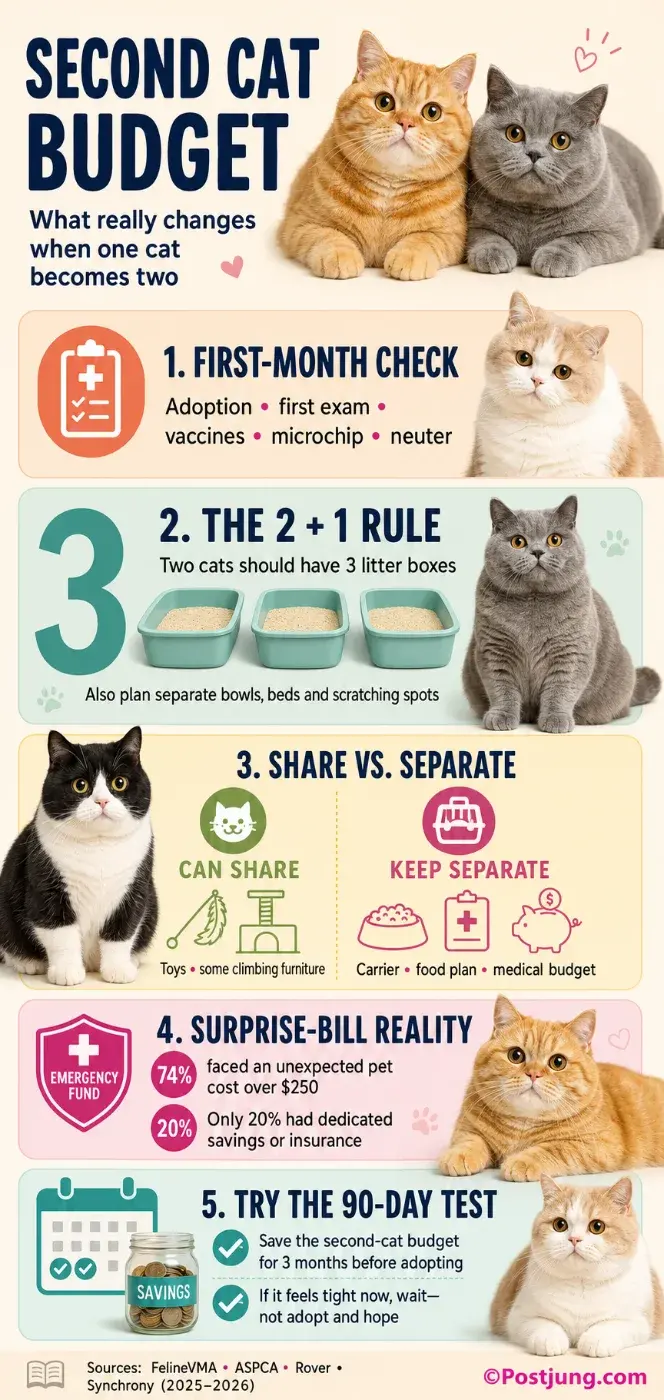
Cats living together should not be expected to share everything. Competition over litter boxes, food, water, hiding places and resting areas can contribute to stress even when there is no obvious fighting.
The Feline Veterinary Medical Association recommends providing one litter box, food bowl, water bowl, bed and scratching resource per cat, plus an additional one. These resources should be placed in separate, accessible areas rather than grouped together.
For a two-cat home, that can mean budgeting for:
- Three litter boxes in different locations
- Separate food and water stations
- Another carrier
- Additional scratching surfaces
- More beds, hiding places and elevated perches
- A temporary transition room for the newcomer
- Toys and individual play sessions
Some of these items can be inexpensive. A sturdy cardboard scratcher or cardboard-box hiding place may work as well as a costly designer product. The important factor is whether both cats can reach essential resources without being blocked or intimidated.
Calculate the monthly increase
Food is likely to be the clearest recurring increase. Use the new cat’s expected diet, body size and feeding amount to calculate a monthly figure rather than assuming the cats will eat the same food.
The second major recurring cost is litter. Two cats produce more waste, while the recommended additional boxes may require a larger initial supply. Rover’s 2026 U.S. research places annual litter spending for one cat at roughly $125 to $580, illustrating how much the product and cleaning routine can affect the total.
Other recurring expenses may include:
- Flea, tick, heartworm or parasite prevention
- Regular medication
- Replacement scratching pads and toys
- Grooming supplies
- License or registration fees
- Pet rent charged by a landlord
- Insurance premiums or contributions to a medical fund
Check whether buying larger food or litter packages lowers the unit price. Do not count a bulk discount until you have confirmed that both cats tolerate the same product.
Give each cat a medical budget
The ASPCA recommends at least one veterinary examination per cat each year, with more frequent care when a cat is sick or injured. Two cats therefore mean two sets of examinations, vaccines, dental assessments and age-related tests.
Insurance can turn some unpredictable medical expenses into a regular premium, but policies differ in deductibles, reimbursement rates, waiting periods, exclusions and coverage for pre-existing conditions. Compare the full terms—not only the monthly price.
If you prefer to self-fund veterinary care, keep the money in a dedicated account. The amount should reflect actual emergency prices at clinics in your area, not an arbitrary online recommendation.
Financial preparedness matters. A 2025 Synchrony survey of 4,861 U.S. pet owners found that 74% had encountered an unexpected pet expense exceeding $250. Only 20% of dog, cat and mixed-pet owners reported having dedicated emergency savings or insurance. A separate ASPCA survey published in March 2026 found that six in ten U.S. pet owners lacked confidence in their ability to afford a medical emergency.
Add the costs people often overlook
Travel can become more expensive with two cats. Price boarding, in-home pet sitting or additional transportation requirements before assuming a friend will always be available.
Housing may also change the calculation. Some landlords charge deposits or monthly fees for each pet, while others limit the number of animals permitted. Confirm the rules in writing before adopting.
Behavioral difficulties can produce unexpected costs as well. A gradual introduction may require gates, screens, pheromone diffusers or professional guidance. If tension continues, a veterinarian or veterinary behaviorist may be needed.
Try a budget rehearsal before adopting
Estimate the second cat’s monthly food, litter, preventive care, insurance or medical savings, and housing costs. Transfer that amount into a separate account every month for two or three months before adoption.
Also set aside the expected startup amount and confirm that doing so does not interfere with care for your current cat.
If the rehearsal feels difficult, postponing the adoption is a responsible decision. If the money remains manageable, you will enter the adoption with a useful emergency cushion and a clearer picture of what caring for two cats actually requires.
The best second-cat budget is not the cheapest possible plan. It is one that can support both cats independently—including when their diets, health needs or ability to live together do not develop exactly as expected.
SOURCES USED:
- Rover — The Cost of Cat Parenthood in 2026
- Feline Veterinary Medical Association — Are You Thinking of Getting Another Cat?
- Cats Protection — Preparing Your Home for a Cat
- ASPCA — General Cat Care
- ASPCA — Majority of America’s Pet Owners Unprepared for Costly Medical Emergencies
- Synchrony — 2025 Pet Lifetime of Care Study
Rover — The Cost of Cat Parenthood in 2026
Feline Veterinary Medical Association — Are You Thinking of Getting Another Cat?
Cats Protection — Preparing Your Home for a Cat
ASPCA — General Cat Care
ASPCA — Majority of America’s Pet Owners Unprepared for Costly Medical Emergencies
Synchrony — 2025 Pet Lifetime of Care Study

เขียนโดย Postjung Insights
 อำเภอที่มีชื่ออำเภอสั้นที่สุด 3 อำเภอเท่านั้นในประเทศไทย
 7 บทเพลงไวรัลยุคโบราณ! เพลงงานวัดที่เปิดเมื่อไหร่ คนก็ลุกขึ้นรำวงเมื่อนั้น
 7 คันเบ็ดตกปลาโบราณ สายเรโทรยอมทุ่มเงินซื้อ! ยิ่งเก่า ยิ่งหายาก ยิ่งมีเรื่องราว
 โรงเรียนที่มีนักเรียนมากที่สุดในไทย
 ส่องเลข 3 สำนักพิมพ์ งวด 1 ต.ค. 69 ตัวไหนมีข้อมูลตรงกัน
 รู้หรือไม่? ความทรงจำวัยเด็กอาจไม่ได้เหมือนที่เราเคยจำ! สมองสามารถ “เติมเรื่อง” ให้เราได้
 รู้หรือไม่? เปิดรายได้พนักงานส่งพัสดุของแต่ละแอป วันหนึ่งได้เท่าไร
 เปิด 5 โรงเรียนหญิงล้วนเก่าแก่ของไทย ที่มีประวัติยาวนานกว่าศตวรรษ
 5 ไอเทมป้องกันความร้อนให้บ้านแบบโบราณ! ภูมิปัญญาเก่าที่ช่วยบ้านเย็นลงได้ 3-5 องศา
 เช็กด่วน ! ข่าวบัตรสวัสดิการแจก 10,000 บาท ก.ย. 69 จริงหรือ ? ก่อนเชื่อควรรู้อะไร
 แปลปกสลาก งวด 1 ต.ค. 69 ส่องตัวเลขจากภาพปกสลากกินแบ่งรัฐบาล
 ทำไมหนังสือบางเล่มถึงมีหน้าว่างทั้งหน้า? มันอาจไม่ได้พิมพ์พลาดอำเภอที่มีชื่ออำเภอสั้นที่สุด 3 อำเภอเท่านั้นในประเทศไทย
 English Edition