Dog socialization means learning to handle the wider world

Meeting other dogs is only one small part of socialization. The broader goal is to help a dog feel safe and behave comfortably around the people, places, sounds, surfaces, and routines it will encounter throughout life.
A well-socialized dog is not necessarily the dog that runs up to every person or plays happily with every canine it meets. It is the dog that can encounter ordinary life without becoming overwhelmed—and that includes knowing when to engage, observe, or move away.
In behavioral terms, socialization introduces a developing dog to the experiences it may face as an adult. Other dogs are part of that picture, but so are unfamiliar people, traffic, household noises, veterinary handling, different walking surfaces, car rides, grooming, and periods of quiet independence.
The American Veterinary Medical Association describes socialization as preparation for being comfortable with animals, people, places, and activities. That makes it a much broader learning process than arranging frequent dog-to-dog greetings.
The goal is confidence, not constant interaction
Owners sometimes measure socialization by quantity: how many dogs the puppy met, how many strangers touched it, or how many busy places it visited.
That approach can miss what the puppy actually learned.
A successful experience teaches the dog that something new is safe or manageable. The puppy may approach, calmly observe from a distance, or briefly investigate before returning to its owner. Physical contact is not always necessary.
For example, a puppy can learn something useful by watching a calm dog across a park without greeting it. It can become familiar with children by observing gentle play from a comfortable distance. It can hear buses, motorcycles, doorbells, vacuum cleaners, and kitchen appliances without being placed directly beside them.
Neutrality is a valuable outcome. A dog that can notice another dog and continue walking calmly may be functioning better in public than one that expects to greet every dog it sees.
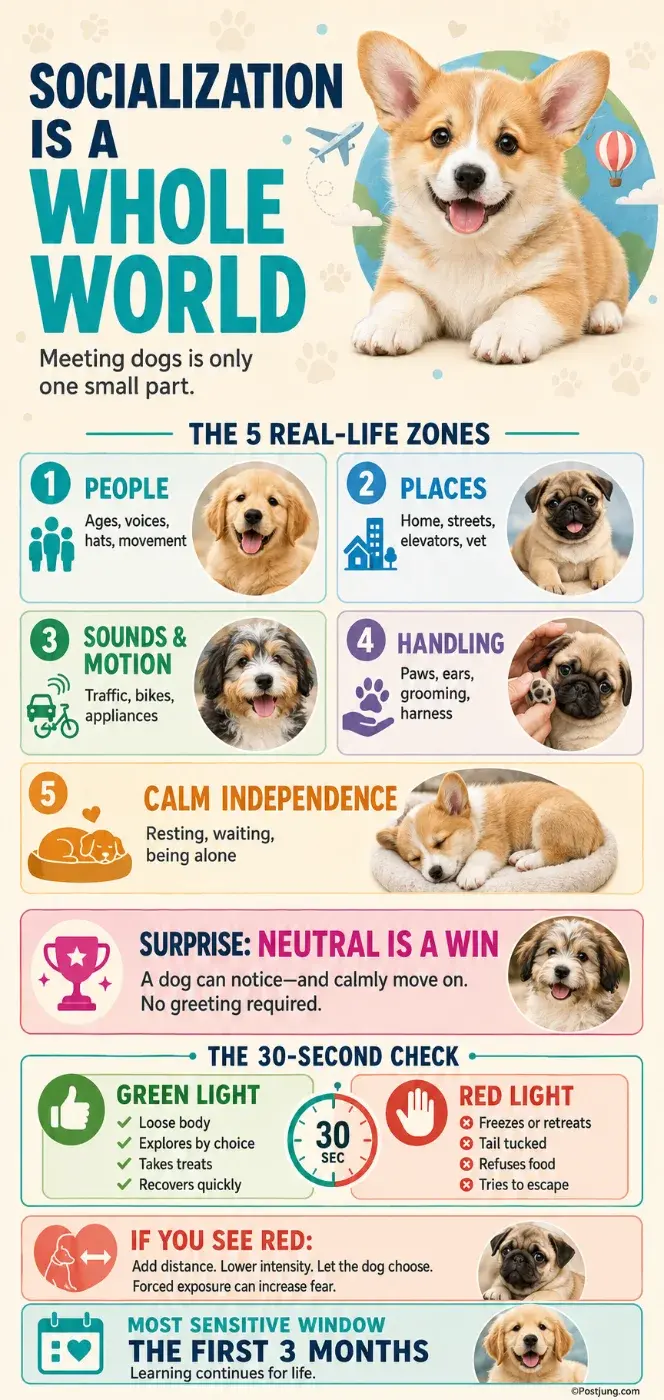
Socialization involves the whole environment
The American Veterinary Society of Animal Behavior identifies the first three months as the most important period for puppy socialization. During this stage, puppies should encounter a safe variety of people, animals, situations, places, objects, and surfaces without being pushed into fear or withdrawal.
A practical socialization plan can include:
- People of different ages, appearances, voices, and movement styles
- Calm, healthy, appropriately vaccinated dogs
- Cats or other animals under carefully controlled conditions
- Traffic, bicycles, umbrellas, hats, wheelchairs, and shopping carts
- Grass, tile, carpet, gravel, steps, ramps, and other surfaces
- Car travel and suitable public transportation
- Gentle examination of the paws, ears, mouth, and body
- Grooming equipment and visits to a veterinary clinic
- Time spent resting or playing independently
- Everyday household sounds at manageable volumes
These experiences should reflect the dog’s likely future. A puppy expected to live in a city may need gradual exposure to elevators, traffic, crowds, and delivery workers. A dog in a rural area may need to become comfortable around livestock, machinery, open spaces, and unfamiliar animals.
Exposure alone can backfire
Simply placing a puppy in a new environment does not guarantee useful socialization. If the experience is frightening or inescapable, the puppy may learn that the situation is dangerous.
The dog’s behavior should determine the pace. A relaxed puppy may explore, accept treats, keep a loose body, and move voluntarily toward or away from the new stimulus. A worried puppy may freeze, retreat, tuck its tail, avoid looking, refuse food, tremble, or repeatedly attempt to escape.
When those warning signs appear, increasing distance or ending the session is more constructive than insisting that the dog “get used to it.” The American Veterinary Society of Animal Behavior warns that overwhelming exposure can increase fear instead of reducing it.
Food, play, and gentle praise can help create positive associations, but rewards should not be used to lure a frightened dog closer than it wants to go. The dog should retain the ability to choose distance.
Dog parks are not a socialization requirement
An uncontrolled dog park may expose a puppy to unfamiliar dogs with unknown health, vaccination, or behavior histories. One frightening encounter can be particularly difficult for a young or cautious puppy.
Safer options include meetings with known, healthy dogs that communicate gently or well-managed puppy classes with vaccination, hygiene, and supervision requirements. The lesson does not have to be active play; puppies also benefit from practicing how to settle, disengage, and ignore another dog.
The Royal Society for the Prevention of Cruelty to Animals similarly recommends positive introductions to healthy, fully vaccinated animals while gradually familiarizing puppies with people, sights, sounds, cars, grooming, and handling.
Owners should ask their veterinarian about local infectious-disease risks and an appropriate vaccination schedule. Safe early learning does not require placing an incompletely vaccinated puppy on heavily used ground or among unknown dogs.
Learning continues beyond puppyhood
The early sensitive period is especially influential, but social learning does not end when that window closes. Adolescents and adult dogs can continue building comfort with new situations, although fearful dogs may need a slower, individualized plan.
Not every adult dog will learn to enjoy close interaction with strangers or unfamiliar dogs—and that does not automatically make it poorly socialized. A realistic goal may be calm observation, safe management, and the ability to move through the environment without panic or conflict.
If a dog regularly lunges, freezes, hides, attempts to escape, or cannot recover after an encounter, a veterinarian should first rule out pain or illness. A qualified reward-based behavior professional can then help design a gradual plan.
Good socialization does not create a dog that welcomes everything. It gives the dog enough safe experience, support, and choice to cope with the world it actually lives in.
SOURCES USED:
- American Veterinary Medical Association — Socialization of dogs and cats
- American Veterinary Society of Animal Behavior — Position Statement on Puppy Socialization
- American Veterinary Society of Animal Behavior — Socialization is more than mere exposure
- RSPCA — Caring for your puppy from 6 weeks to 12 months
- RSPCA and Dogs Trust — Dog Ownership Guide

เขียนโดย Postjung Insights
 7 บทเพลงไวรัลยุคโบราณ! เพลงงานวัดที่เปิดเมื่อไหร่ คนก็ลุกขึ้นรำวงเมื่อนั้น
 รู้หรือไม่? เปิดรายได้พนักงานส่งพัสดุของแต่ละแอป วันหนึ่งได้เท่าไร
 5 ไอเทมป้องกันความร้อนให้บ้านแบบโบราณ! ภูมิปัญญาเก่าที่ช่วยบ้านเย็นลงได้ 3-5 องศา
 อำเภอที่มีชื่ออำเภอสั้นที่สุด 3 อำเภอเท่านั้นในประเทศไทย
 7 คันเบ็ดตกปลาโบราณ สายเรโทรยอมทุ่มเงินซื้อ! ยิ่งเก่า ยิ่งหายาก ยิ่งมีเรื่องราว
 เปิด 5 โรงเรียนหญิงล้วนเก่าแก่ของไทย ที่มีประวัติยาวนานกว่าศตวรรษ
 รู้หรือไม่? ความทรงจำวัยเด็กอาจไม่ได้เหมือนที่เราเคยจำ! สมองสามารถ “เติมเรื่อง” ให้เราได้
 โรงเรียนที่มีนักเรียนมากที่สุดในไทย
 โรงเรียนชายล้วนแห่งแรกของไทยคือที่ไหน? ย้อนดูจุดเริ่มต้นโรงเรียนสวนกุหลาบวิทยาลัย
 ทำไมหนังสือบางเล่มถึงมีหน้าว่างทั้งหน้า? มันอาจไม่ได้พิมพ์พลาด
 แปลปกสลาก งวด 1 ต.ค. 69 ส่องตัวเลขจากภาพปกสลากกินแบ่งรัฐบาล
 ตาราง “เด่นเหนือเด่นใต้” งวด 1 ต.ค. 69 เปิดข้อมูลตามโพย เลขไหนอยู่ตรงไหนอำเภอที่มีชื่ออำเภอสั้นที่สุด 3 อำเภอเท่านั้นในประเทศไทย
 English Edition