Why kittens and puppies need food made for growth

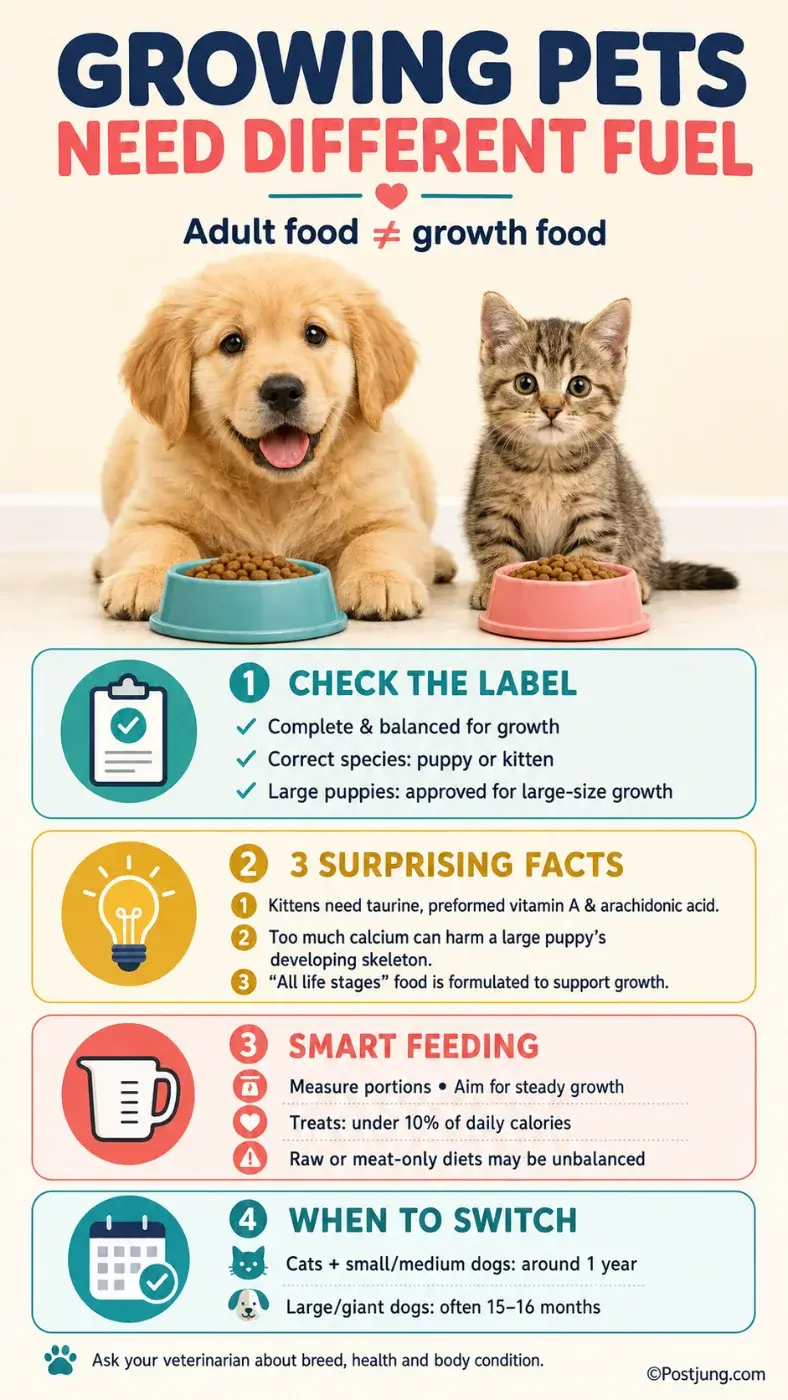
Young animals need different amounts and proportions of energy, protein, fats, vitamins, and minerals than adults. The right choice depends less on marketing claims and more on the food’s nutritional-adequacy statement.
Puppies and kittens are not simply smaller versions of adult pets. Their bodies are constructing bone, muscle, organs, immune defenses, and nervous tissue at remarkable speed, so they need food formulated specifically for growth.
That does not necessarily mean a costly, exotic, or breed-branded product. It means a diet that is complete and balanced for the animal’s species and life stage—and fed in an amount that supports steady growth without excessive weight gain.
Growth requires a different nutritional balance
Young animals generally need more energy and certain nutrients relative to their body size than adults. Just as important, minerals and other nutrients must be present in appropriate proportions.
Adult-maintenance food is designed for animals that have largely finished growing. Feeding it as a young animal’s primary diet can provide a nutritional balance that does not match the demands of development.
Simply giving a puppy or kitten a larger amount of adult food does not solve that mismatch. It increases every component of the food, including calories, without necessarily delivering the nutrient ratios needed for healthy growth.
In the United States, the Food and Drug Administration explains that foods carrying a “complete and balanced” claim must either meet an Association of American Feed Control Officials nutrient profile or pass an AAFCO feeding trial. Separate profiles exist for growth and reproduction and for adult maintenance.
Kittens cannot thrive on dog food
Cats have several species-specific nutritional requirements. According to the Merck Veterinary Manual, they require dietary sources of taurine, preformed vitamin A, and arachidonic acid, along with higher levels of certain amino acids and vitamins than dogs.
Taurine deficiency, for example, can damage a cat’s heart and retinas. Dog food is therefore not an appropriate main diet for a kitten, even if the kitten appears willing to eat it.
A kitten food should be complete and balanced for feline growth. Both wet and dry products can meet that standard, so format alone does not determine nutritional quality.
Large puppies need controlled growth—not maximum growth
Puppies also require growth-stage nutrition, but expected adult size matters. Large- and giant-breed puppies are particularly sensitive to excessive calorie and calcium intake while their skeletons are developing.
The goal is not to make a large puppy grow as quickly as possible. It is to support a steady rate of growth while maintaining a lean, healthy body condition.
The American Animal Hospital Association advises avoiding excessive calcium in large- and giant-breed puppies. Adding calcium powder or other mineral supplements to an already complete diet can disturb its carefully formulated balance and should not be done unless a veterinarian recommends it.
In markets using AAFCO-style labels, owners of dogs expected to weigh at least 70 pounds, or about 32 kilograms, as adults should look for language stating that the food is suitable “including growth of large size dogs.” Some growth foods specifically exclude this group.
Read the adequacy statement, not just the front of the package
Words such as “premium,” “natural,” or “high protein” do not by themselves show that a food can support growth. The most useful information is usually found in the smaller nutritional-adequacy statement.
Look for wording indicating that the product is complete and balanced for:
- Growth
- Puppies or kittens
- All life stages
“All life stages” diets are formulated to cover growth and reproduction as well as adulthood, according to the World Small Animal Veterinary Association. However, owners of large-breed puppies should still confirm that the formula includes growth of large-size dogs.
Labeling terminology varies between countries. Products may refer to AAFCO profiles, European Pet Food Industry Federation guidelines, or another recognized local standard. When the statement is unclear, ask the manufacturer or a veterinarian whether the food is complete for growth.
Products labeled for intermittent, complementary, or supplemental feeding are not intended to provide the entire diet. Treats and food toppers should not displace a nutritionally complete main food.
Homemade and raw diets require extra caution
Meat alone is not a balanced diet. Even meals that appear wholesome can be deficient in calcium, vitamins, fatty acids, or other essential nutrients—or contain excessive amounts of some nutrients.
The Merck Veterinary Manual notes that meat-heavy homemade diets can produce calcium deficiency, while diets containing excessive liver may cause vitamin A toxicity. These imbalances are especially concerning while bones and organs are developing.
Raw diets add another consideration. WSAVA’s guidance on raw meat-based diets says there is no evidence that they provide health benefits over commercial or properly balanced cooked diets. It also identifies risks including bacterial contamination, parasites, bones, and serious nutritional imbalances.
Owners who want to prepare food at home should use a recipe formulated for the individual animal by a qualified veterinary nutritionist rather than relying on an online recipe or improvising ingredients.
When should young pets change to adult food?
Cats and small- to medium-size dogs commonly remain on growth food until about one year of age. Some large- and giant-breed dogs may not reach skeletal maturity until approximately 15 or 16 months, so they may need an appropriate growth diet for longer.
Age is only a starting point. Breed, expected adult size, neuter status, activity, health, growth rate, and body condition can all affect feeding decisions.
Package directions are useful initial estimates, not permanent prescriptions. Portions should be adjusted as the animal grows, ideally with weight and body-condition checks during veterinary visits.
A puppy or kitten with persistent diarrhea, vomiting, poor appetite, unusual weight gain, poor growth, or a medical condition needs an individualized veterinary assessment. Orphaned animals that still require milk replacement also have different needs from weaned puppies and kittens.
The essential choice is straightforward: select a complete diet made for the correct species and growth stage, then feed enough to support steady development rather than the fastest possible growth.
SOURCES USED:
- U.S. Food and Drug Administration — “Complete and Balanced” Pet Food
- AAFCO — Selecting the Right Pet Food
- WSAVA — Guidelines on Selecting Pet Foods
- American Animal Hospital Association — Age-specific and Breed-specific Diets
- Merck Veterinary Manual — Nutritional Requirements of Small Animals
- WSAVA — Raw Meat Based Diets for Pets
เขียนโดย Postjung Insights
 รู้หรือไม่? เปิดรายได้พนักงานส่งพัสดุของแต่ละแอป วันหนึ่งได้เท่าไร
 ตาราง “เด่นเหนือเด่นใต้” งวด 1 ต.ค. 69 เปิดข้อมูลตามโพย เลขไหนอยู่ตรงไหน
 5 ไอเทมป้องกันความร้อนให้บ้านแบบโบราณ! ภูมิปัญญาเก่าที่ช่วยบ้านเย็นลงได้ 3-5 องศา
 เปิด 5 โรงเรียนหญิงล้วนเก่าแก่ของไทย ที่มีประวัติยาวนานกว่าศตวรรษ
 โรงเรียนที่มีนักเรียนมากที่สุดในไทย
 7 คันเบ็ดตกปลาโบราณ สายเรโทรยอมทุ่มเงินซื้อ! ยิ่งเก่า ยิ่งหายาก ยิ่งมีเรื่องราว
 อำเภอที่มีชื่ออำเภอสั้นที่สุด 3 อำเภอเท่านั้นในประเทศไทย
 7 บทเพลงไวรัลยุคโบราณ! เพลงงานวัดที่เปิดเมื่อไหร่ คนก็ลุกขึ้นรำวงเมื่อนั้น
 แปลปกสลาก งวด 1 ต.ค. 69 ส่องตัวเลขจากภาพปกสลากกินแบ่งรัฐบาล
 โรงเรียนเพียงแห่งเดียวของประเทศไทย ที่อยู่มาตั้งแต่ยุครัชกาลที่ 4
 รู้หรือไม่? ความทรงจำวัยเด็กอาจไม่ได้เหมือนที่เราเคยจำ! สมองสามารถ “เติมเรื่อง” ให้เราได้
 เช็กด่วน ! ข่าวบัตรสวัสดิการแจก 10,000 บาท ก.ย. 69 จริงหรือ ? ก่อนเชื่อควรรู้อะไรอำเภอที่มีชื่ออำเภอสั้นที่สุด 3 อำเภอเท่านั้นในประเทศไทย
 English Edition